
NIOS Class 12 Physics Chapter 23 Optical Instruments Solutions English Medium As Per New Syllabus to each chapter is provided in the list so that you can easily browse throughout different chapters NIOS Class 12 Physics Chapter 23 Optical Instruments Notes in English and select need one. NIOS Class 12 Physics Solutions English Medium Download PDF. NIOS Study Material of Class 12 Physics Notes Paper Code: 312.
NIOS Class 12 Physics Chapter 23 Optical Instruments
Also, you can read the NIOS book online in these sections Solutions by Expert Teachers as per National Institute of Open Schooling (NIOS) Book guidelines. These solutions are part of NIOS All Subject Solutions. Here we have given NIOS Class 12 Physics Notes, NIOS Senior Secondary Course Physics Solutions in English for All Chapter, You can practice these here.
Optical Instruments
Chapter: 23
| Module – VI: Optics And Optical Instruments |
INTEXT QUESTIONS 23.1
1. What is the nature of the images formed by (i) a simple microscope and (ii) a compound microscope?
Ans: A simple microscope uses a single short-focal-length convex lens placed close to the object. When the object lies between the lens and its first focal plane, the lens produces a virtual, erect and magnified image on the same side as the object. Because the image cannot be projected onto a screen, it is termed virtual; because the rays appear to diverge from a point upright with respect to the object, it is erect. In a compound microscope two lenses objective and eyepiece work in tandem. The objective, of very short focal length, forms a real, inverted and highly enlarged intermediate image just beyond its second focal point. The eyepiece then treats this intermediate image as its object and produces a still larger final image that is virtual, inverted with respect to the original object, and situated either at the least distance of distinct vision (25 cm) or at infinity for relaxed viewing. Thus, simple microscope images are virtual-erect, whereas compound microscope images are virtual-inverted.
2. Differentiate between magnifying power and magnification.
Ans: Magnification (often called linear magnification) is a simple size comparison: it equals the height of the image divided by the height of the object. If the image is twice as tall as the object, the linear magnification is 2. Magnifying power, by contrast, is an angular concept that accounts for the eye’s geometry. It is defined as the ratio of the angle subtended at the eye by the image when an instrument is used to the angle subtended by the object when it is placed directly at the least distance of distinct vision. Because the eye is sensitive to angular size, magnifying power indicates how “large” the object appears rather than how large its projected image actually is. Linear magnification therefore tells us how big the image is on a scale, while magnifying power tells us how much larger the object looks to an observer.
3. The magnifying power of a simple microscope is 11. What is its focal length?
Ans: Given: Magnifying power M = 1
least distance of distinct vision D = 25 cm
For a simple microscope with its final image at D,
= 25/f = 10
= f = 25/10 = 2.5 cm
Hence, the focal length of the lens must be 2.5 cm.
4. Suppose you have two lenses of focal lengths 100 cm and 4 cm respectively. Which lens would you choose as the eyepiece of your compound microscope and why?
Ans: In a compound microscope, the eyepiece acts essentially like a simple magnifier.
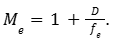
Its angular magnifying power equals:
A shorter focal length therefore yields a larger angular magnification and keeps the overall tube length manageable.
Using the 4 cm lens, Me becomes:
= 1 + 25/4
= 7.25
Whereas with the 100 cm lens Me would be a negligible 1.25. Consequently, the 4 cm lens is vastly superior as an eyepiece because it delivers higher magnification and fits inside a compact tube without introducing excessive aberrations.
5. Why should both the objective and the eyepiece of a compound microscope have short focal lengths?
Ans: A microscope’s total magnifying power is the product of the objective magnification:

and the eyepiece magnification
Me = 1 + D/fe
Shortening fo increases the linear magnification provided by the objective, while shortening fe raises the angular magnification contributed by the eyepiece. Together they yield a large overall M without necessitating an impractically long tube. Short focal lengths also allow the lenses to be made with smaller diameters, reducing cost and maintaining alignment accuracy.
Therefore, small fo and fe are essential for achieving the very high enlargements often several hundred times expected of a laboratory compound microscope.
INTEXT QUESTIONS 23.2
1. How would the magnification of a telescope be affected by increasing the focal length of (a) the objective _______________________.
(b) the eyepiece_________________________?
Ans: The angular magnifying power of an astronomical telescope in normal adjustment is:
M = fo/fe
(a) If fo is increased while fe remains fixed, the numerator grows, so M increases. The image appears larger and the field of view narrows.
(b) If fe is increased while fo stays constant, the denominator grows, so M decreases. The telescope therefore gives a smaller enlargement but a wider field and brighter view.
Thus, a long-focus objective and a short-focus eyepiece are desirable for high magnification.
2. If the focal length of the objective of a telescope is 50 cm and that of the eyepiece is 2 cm, what is the magnification?
Ans: Given: fo = 50 cm
Fe = 2 cm
In normal adjustment:
M = fo / fe
= 50/2
= 25.
The telescope therefore enlarges the angular size of distant objects twenty-five times.
3. State one difference between a refracting and a reflecting telescope.
Ans: A refracting telescope uses a large convex objective lens to collect and focus light, whereas a reflecting telescope employs a concave primary mirror. Because mirrors reflect all wavelengths equally, reflecting telescopes are free from chromatic aberration, a colour-fringe defect inherent to large lenses. This single optical distinction drives many practical differences in size, weight and cost between the two designs.
4. What is meant by normal adjustment?
Ans: Normal adjustment refers to the setting of a telescope or microscope in which the final image is formed at optical infinity. Under this condition the emerging rays from the eyepiece are parallel, the observer’s eye is relaxed, and no accommodation effort is required. Instruments are usually designed so that normal adjustment coincides with maximum clarity and minimum eyestrain during prolonged observations.
5. If the telescope is inverted, will it serve as a microscope?
Ans: Simply inverting a telescope does not create a functional microscope. Microscopes demand extremely short focal-length objectives able to form a real, magnified intermediate image from objects only a few millimetres away, whereas telescopes are built with long-focus objectives designed for parallel light from astronomical distances. Even turned around, a telescope’s large-focus lens cannot generate the required enlargement at close range, and the tube length cannot be shortened enough to focus. Thus an inverted telescope cannot substitute for a microscope.

Hi, I’m Dev Kirtonia, Founder & CEO of Dev Library. A website that provides all SCERT, NCERT 3 to 12, and BA, B.com, B.Sc, and Computer Science with Post Graduate Notes & Suggestions, Novel, eBooks, Biography, Quotes, Study Materials, and more.
Subject Ka Complete Video Solution Dekhein
Step-by-step easy concept explanation aur full questions Answer ke liye watch karein ya app download karein:

 Buy Now