
NIOS Class 12 Physics Chapter 25 Dual Nature of Radiation and Matter Solutions English Medium As Per New Syllabus to each chapter is provided in the list so that you can easily browse throughout different chapters NIOS Class 12 Physics Chapter 25 Dual Nature of Radiation and Matter Notes in English and select need one. NIOS Class 12 Physics Solutions English Medium Download PDF. NIOS Study Material of Class 12 Physics Notes Paper Code: 312.
NIOS Class 12 Physics Chapter 25 Dual Nature of Radiation and Matter
Also, you can read the NIOS book online in these sections Solutions by Expert Teachers as per National Institute of Open Schooling (NIOS) Book guidelines. These solutions are part of NIOS All Subject Solutions. Here we have given NIOS Class 12 Physics Notes, NIOS Senior Secondary Course Physics Solutions in English for All Chapter, You can practice these here.
Dual Nature of Radiation and Matter
Chapter: 24
| Module-VII: Atoms And Nuclei |
INTEXT QUESTIONS 25.1
1. State whether the following statements are true or false:
(a) In thermionic emission, electrons gain energy from photons.
Ans: False – In thermionic emission, electrons gain energy from thermal energy (heat), not from photons.
(b) The maximum velocity of photoelectron is independent of the frequency of incident radiation.
Ans: False – The maximum velocity of photoelectrons is directly dependent on the frequency of incident radiation.
(c) There exists a frequency v₀ below which no photoelectric effect takes place.
Ans: True – For every material, there exists a threshold frequency ν₀ below which no photoelectric emission occurs, regardless of the intensity of incident light.
2. Refer to Fig. 25.3 and interpret the intercepts on x and y-axes and calculate the slope.
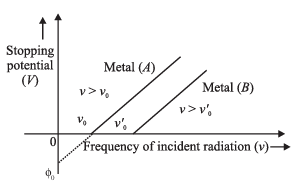
Ans: From Fig. 25.3, which shows the variation of stopping potential (V₀) with frequency (ν) of incident light:
X-intercept interpretation: The x-intercept represents the threshold frequency (ν₀) of the material. At this point, the stopping potential V₀ = 0, meaning that photoelectrons are emitted with zero maximum kinetic energy. This occurs when the photon energy exactly equals the work function: h·ν₀ = φ₀.
Y-intercept interpretation: The y-intercept represents the negative work function divided by electronic charge (-φ₀/e). When extrapolated to ν = 0, the stopping potential equals -φ₀/e, where φ₀ is the work function and e is the electronic charge.
Slope calculation: From Einstein’s photoelectric equation:
h·ν = φ₀ + e·V₀
Rearranging: V₀ = (h/e)·ν – φ₀/e
Comparing with the standard equation y = mx + c,
the slope = h/e
= Planck’s constant/electronic charge
= 6.626 × 10⁻³⁴ / 1.602 × 10⁻¹⁹
= 4.14 × 10⁻¹⁵ V·s.
This slope is universal for all materials and represents the ratio of Planck’s constant to electronic charge.
3. Draw a graph showing the variation of stopping potential (–V₀) with the intensity of incident light.
Ans: The graph showing the variation of stopping potential (-V₀) with intensity of incident light is a horizontal straight line.
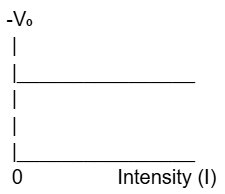
The stopping potential depends only on the frequency of incident light and the work function of the material, not on the intensity. According to Einstein’s photoelectric equation, the maximum kinetic energy of photoelectrons (and hence the stopping potential) is determined by: eV₀ = hν – φ₀. Since neither h, ν, nor φ₀ depends on intensity, the stopping potential remains constant regardless of light intensity. Increasing intensity only increases the number of photons and hence the number of emitted photoelectrons (photocurrent), but does not affect their individual energies. This independence of stopping potential from intensity was one of the key experimental observations that classical wave theory could not explain but was successfully explained by Einstein’s photon theory.
INTEXT QUESTIONS 25.2
1. Calculate the momentum of a photon of frequency ν.
Ans: Given: Photon frequency = ν
For a photon, the energy is given by: E = h·ν
From Einstein’s mass-energy relation: E = m·c² (where m is the relativistic mass)
Therefore: h·ν = m·c²
Solving for mass: m = h·ν/c²
The momentum of a photon is given by: p = m·c
Substituting the value of m: p = (h·ν/c²) × c = h·ν/c
Alternatively, using the relation E = p·c for photons (since photons are massless and travel at speed c):
h·ν = p·c
Therefore: p = h·ν/c
= h/λ (since c = ν·λ)
The momentum of a photon of frequency ν is h·ν/c or h/λ, where λ is the wavelength of the photon.
2. If the wavelength of an electromagnetic radiation is doubled, how will the energy of the photons change?
Ans: Given: Initial wavelength = λ,
Final wavelength = 2λ
The energy of a photon is given by: E = h·c/λ
Initial energy: E₁ = h·c/λ
Final energy (when wavelength is doubled): E₂ = h·c/(2λ) = (h·c/λ)/2 = E₁/2
Result: When the wavelength of electromagnetic radiation is doubled, the energy of the photons becomes half of the original energy.
Energy of photons is inversely proportional to wavelength (E ∝ 1/λ). This relationship comes from combining Planck’s equation E = h·ν and the wave equation c = ν·λ. Since frequency and wavelength are inversely related, doubling the wavelength means halving the frequency, which results in halving the photon energy. This principle is fundamental in understanding why higher frequency radiations (shorter wavelengths) like X-rays and gamma rays are more energetic than lower frequency radiations like radio waves.

Hi, I’m Dev Kirtonia, Founder & CEO of Dev Library. A website that provides all SCERT, NCERT 3 to 12, and BA, B.com, B.Sc, and Computer Science with Post Graduate Notes & Suggestions, Novel, eBooks, Biography, Quotes, Study Materials, and more.
Subject Ka Complete Video Solution Dekhein
Step-by-step easy concept explanation aur full questions Answer ke liye watch karein ya app download karein:

 Buy Now