
NCERT Class 9 English Chapter 4 Vitamin – M Solutions As Per New Syllabus. to each chapter is provided in the list so that you can easily browse through different chapters NCERT Class 9 English Chapter 4 Vitamin – M Notes and select need one. NCERT Class 9 English Chapter 4 Vitamin – M Question Answers Download PDF. NCERT Class 9 English Kaveri Question Answer.
NCERT Class 9 English Chapter 4 Vitamin – M
Also, you can read the NCERT book online in these sections Solutions by Expert Teachers as per Central Board of Secondary Education (CBSE) Book guidelines. CBSE Class 9 English Kaveri Solutions are part of All Subject Solutions. Here we have given NCERT Solutions For Class 9 English Kaveri, CBSE Class 9 English Kaveri Notes for All Chapters, You can practice these here.
Vitamin – M
Chapter: 4
| Reflect and Respond |
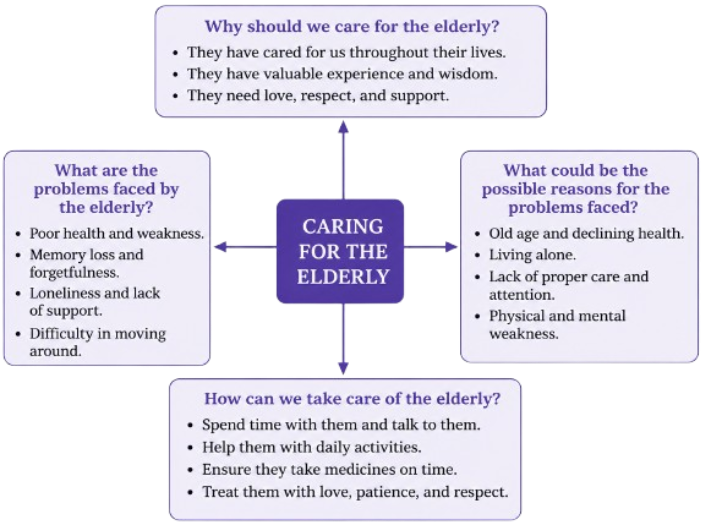
I. From your experience with an elderly person at home or in your neighbourhood, complete the following graphic organiser.
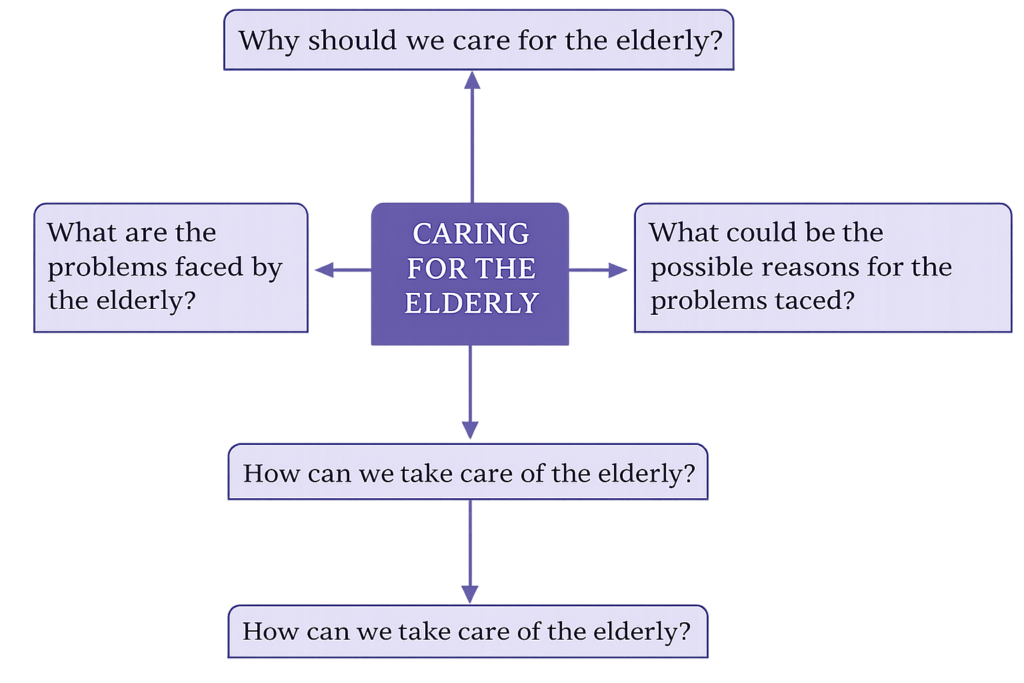
Now, discuss the points written in the organiser with your classmates and teacher.
Ans:
II. Fill in the table given below. You may check your answers with the help of a dictionary.
| Word | Not heard this word before | Have heard this word but don’t know what it means | I know this word. It has something to do with… | Write the meaning of this word |
| frail | ||||
| shuddered | ||||
| poky | ||||
| forbid | ||||
| pottering | ||||
| winced |
Ans:
| Word | Not heard this word before | Have heard this word but don’t know what it means | I know this word. It has something to do with… | Write the meaning of this word |
| frail | ✔ | weakness | weak and delicate | |
| shuddered | ✔ | fear/shock | trembled suddenly because of fear or cold | |
| poky | ✔ | small place | small and cramped | |
| forbid | ✔ | stopping someone | to not allow | |
| pottering | ✔ | moving slowly | doing small tasks in a relaxed way | |
| winced | ✔ | pain/embarrassment | showed pain or discomfort on the face |
III. Think of a tradition, story, or recipe passed down by grandparents or an elderly relative in your family. What does it mean to you? How does it connect you to your growing-up years? Share with your classmates and teacher.
Ans: My grandmother taught me a traditional recipe of homemade mango pickle. Every summer, we used to sit together and cut raw mangoes while she shared stories from her childhood. She carefully mixed spices and explained the importance of patience and cleanliness in cooking.
This recipe means a lot to me because it reminds me of my childhood days spent with my grandmother. It connects me to my growing-up years through happy family memories, love, and togetherness. Even today, whenever I taste mango pickle, I remember her care, wisdom, and the special time we spent together.
| Check Your Understanding |
I. Why did Grandpa dislike living in the city with his daughter?
Ans: Grandpa disliked living in the city because it was noisy, crowded, and he missed the peace and quiet of his small house in town.
II. Why did Vidya not want her father to go out alone?
Ans: Vidya did not want her father to go out alone because he had become forgetful and had once lost his way back home.
III. Was Ravi in favour of his mother treating Grandpa like a child? How can you say so?
Ans: No, Ravi was not in favour of his mother treating Grandpa like a child. We can say this because Ravi felt uncomfortable when his mother spoke loudly to Grandpa as if he could not understand anything.
IV. Would Ravi be able to keep up his promise to his mother?
Ans: No, Ravi would probably not be able to keep up his promise because Grandpa insisted on going out alone, and Ravi secretly followed him.
| Check Your Understanding |
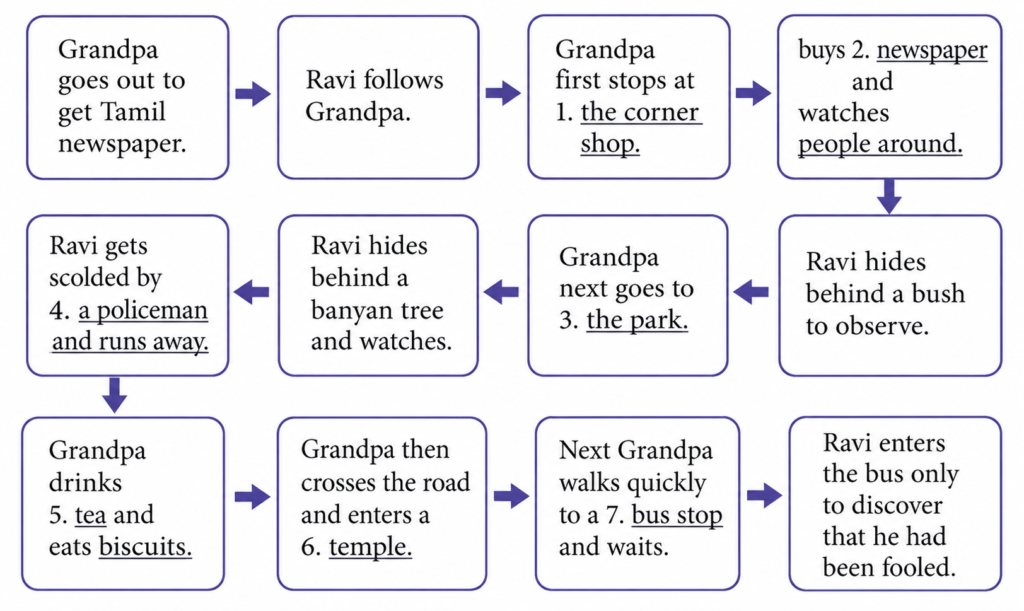
I. Complete the flow chart by describing Grandpa’s day out.
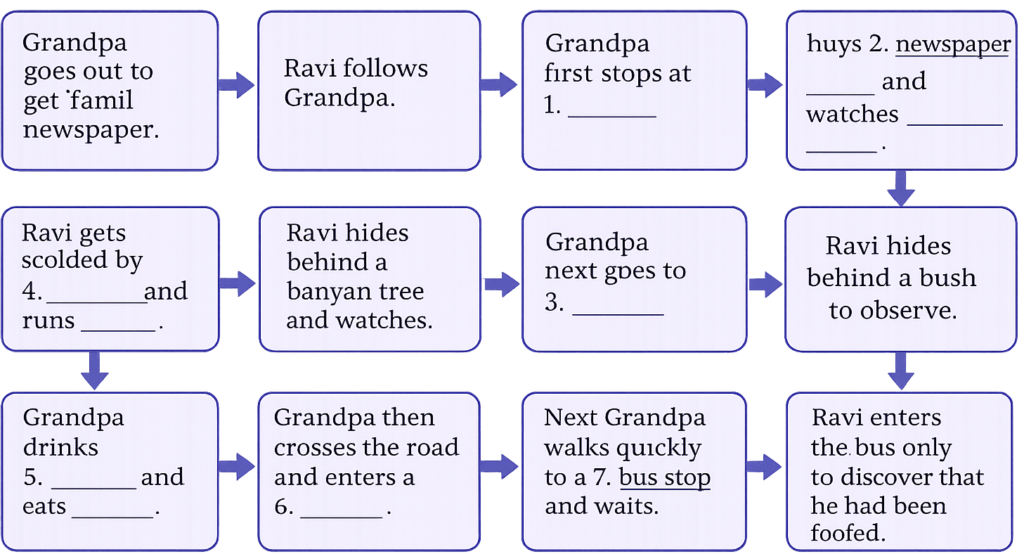
Ans:
II. Was Grandpa lost as feared by Ravi’s mother?
Ans: No, Grandpa was not lost. He safely returned home before Ravi and was resting in his bedroom. This showed that he could still manage himself well.
III. How would Ravi feel after seeing Grandpa?
Ans: Ravi felt great relief, happiness, and affection after seeing Grandpa safe at home. He was no longer worried and even hugged his grandfather.
IV. Do you think Ravi’s mother will get to know about what had happened?
Ans: No, Ravi’s mother did not come to know what had happened. Ravi decided not to question Grandpa because he would have had to admit that he had been following him. Grandpa also did not reveal the truth to her.
| Check Your Understanding |
I. Describe how Ravi’s emotional reaction upon finding Grandpa safe at home reveals his feelings towards his grandfather.
Ans: Ravi felt great relief, love, and affection when he found Grandpa safe at home. He hugged Grandpa warmly, which shows that he deeply cared for and loved his grandfather.
II. What might be the significance of Grandpa’s habit of giving gifts to everyone on his birthday rather than receiving them?
Ans: Grandpa’s habit of giving gifts on his birthday shows his generosity and loving nature. It also suggests that he believed happiness comes from giving to others rather than receiving gifts himself.
III. Why do you think Grandpa gave Ravi a detective story book as a gift? What might this suggest about Grandpa’s awareness of Ravi’s actions earlier in the day?
Ans: Grandpa gave Ravi a detective story book because he knew Ravi had secretly followed him like a detective. This suggests that Grandpa was fully aware of Ravi’s actions earlier in the day and cleverly hinted at it through the gift.
| Critical Reflection |
Read the extracts given below and answer the questions that follow.
1. Grandpa hated the noise and bustle of city life and when they were on their own, he often spoke longingly of his small brick house in town. “Such a wonderful place…! With that big mango tree in the garden! It is so quiet that at dusk you can even hear a leaf fall!” But then Grandpa had slipped and fallen in the garden late one evening while he was pottering around and lain outside all night because there was no one at home to help him up.
(i) Choose the emotion displayed by the Grandfather.
A. regretful.
B. apologetic.
C. nostalgic.
D. wistful.
Ans: C. nostalgic.
(ii) Complete the following sentence with a reason. Grandpa hated the busy and noisy city life because ___________.
Ans: Grandpa hated the busy and noisy city life because he loved the peace and quiet of his small house in town.
(iii) Why did Grandpa come to the city despite his dislike for city life?
Ans: Grandpa came to the city because he had fallen in his garden and there was no one at home to help him, so his daughter brought him to live with her.
(iv) Choose an expression similar in meaning to, ‘you can even hear a leaf fall’.
A. End of one’s life.
B. Arrival of autumn.
C. Sign of good luck.
D. Pin drop silence.
Ans: D. Pin drop silence.
(v) State one advantage and one disadvantage of the Grandfather living in the house in town.
Ans: Advantage: Grandpa could live peacefully and independently in his town house.
Disadvantage: There was no one to help him in emergencies when he fell down.
| I Cannot Remember My Mother |
| Reflect and Respond |
I. Work in pairs. Discuss the memories from your childhood that you remember. List them and share with your classmates and teacher.
Ans: Some of the beautiful memories from my childhood are:
(i) Playing games like hide and seek and cricket with friends in the evening.
(ii) Going to my grandparents’ house during summer vacations.
(iii) Celebrating birthdays with family and friends.
(iv) Watching cartoons and listening to bedtime stories from my mother.
(v) Going on picnics and family trips during holidays.
(vi) I loved eating food from my grandmother’s hands because it made me feel special and cared for.
These memories are very special because they make me feel happy and remind me of the love and care I received during childhood.
II. Discuss how children’s relationship with their mother can influence their emotions and memories in short
Ans: A child’s relationship with their mother greatly influences their emotions and memories. A loving and caring mother makes children feel safe, happy, and confident. The special moments spent with their mother become beautiful memories that children remember throughout their lives.
III. Match the words given in Column 1 with their meanings in Column 2.
| Column 1 | Column 2 |
| 1. hover | (i) sing a tune with your lips closed |
| 2. hum | (ii) a type of flower (coral jasmine) |
| 3. cradle | (iii) look steadily for a long time |
| 4. shiuli | (iv) rituals conducted in a temple |
| 5. morning service | (v) linger or remain near a place |
| 6.gaze | (vi) a small bed for a baby |
Ans:
| Column 1 | Column 2 |
| 1. hover | (v) linger or remain near a place |
| 2. hum | (i) sing a tune with your lips closed |
| 3. cradle | (vi) a small bed for a baby |
| 4. shiuli | (ii) a type of flower (coral jasmine) |
| 5. morning service | (iv) rituals conducted in a temple |
| 6. gaze | (iii) look steadily for a long time |
| Check Your Understanding |
I. Fill in the blanks with appropriate words.
Stanza 1
1. The poet remembers his mother while he ____________.
Ans: The poet remembers his mother while he is at play.
2. The poet remembers the ____________ but not the ____________. Setting: ____________ (outdoor/indoor)
Ans: The poet remembers the tune of a song but not the mother.
Setting: indoor.
Stanza 2
1. The poet remembers his mother in the ____________ season.
Ans: The poet remembers his mother in the early autumn season.
2. The poet remembers his mother by the smell of ____________. Setting: ____________ (outdoor/indoor)
Ans: The poet remembers his mother by the smell of shiuli flowers.
Setting: outdoor.
Stanza 3
1. The poet feels that his mother ____________ at him from the ____________. Setting: ____________ (outdoor/indoor)
Ans: The poet feels that his mother gazes at him from the sky.
Setting: indoor.
II. The senses of olfactory (smell), auditory (hearing), and visual (sight), are three of the five basic senses in humans. Give examples of references to senses from the poem. Complete the table given below.
| Stanza | Lines from the Poem | Senses |
| 1 | ||
| 2 | “…the smell of the shiuli flowers floats in the air…” | olfactory |
| 3 | ” |
Ans:
| Stanza | Lines from the Poem | Senses |
| 1 | “…the tune of some song that she used to hum while rocking my cradle.” | auditory |
| 2 | “…the smell of the shiuli flowers floats in the air…” | olfactory |
| 3 | “…I send my eyes into the blue of the distant sky…” | visual |
III. Read the poem silently once again and complete the following.
1. Two examples of alliteration from the poem are (i) __________ and (ii) ___________.
Ans: (i) Some song and (ii) While rocking.
2. An example of onomatopoeia is ________________.
Ans: An example of onomatopoeia is hum.
3. The poem uses imagery extensively. Explain.
Ans: The poem uses imagery extensively because the poet describes sounds, smells, and sights to express the memories of his mother. These images help the reader clearly imagine the poet’s feelings and experiences.
4. Although the poem does not have a rhyme scheme, it is enjoyable because ______________.
Ans: Although the poem does not have a rhyme scheme, it is enjoyable because it has deep emotions and musical flow.
5. What is the tone of the poet? Why do you say so?
Ans: The tone of the poet is nostalgic and emotional because he lovingly remembers his mother and misses her presence.
6. What impact does the title of the poem have on the overall mood of the poem?
Ans: The title of the poem creates a sad and emotional mood because it shows that the poet cannot clearly remember his mother.
7. The poet uses ‘I cannot remember my mother’ as a refrain because __________________.
Ans: The poet uses “I cannot remember my mother” as a refrain because it highlights his pain and longing for his mother.
8. The poet uses symbolism to indicate the memory of his mother’s presence. Identify the symbols used in the poem
Ans: The symbols used in the poem are the tune of the song, shiuli flowers, and the blue sky, which represent the memory and presence of his mother.
Subject Ka Complete Video Solution Dekhein
Step-by-step easy concept explanation aur full questions Answer ke liye watch karein ya app download karein:




 Buy Now