
NCERT Class 9 English Chapter 3 Winds of Change Solutions As Per New Syllabus. to each chapter is provided in the list so that you can easily browse through different chapters NCERT Class 9 English Chapter 3 Winds of Change Notes and select need one. NCERT Class 9 English Chapter 3 Winds of Change Question Answers Download PDF. NCERT Class 9 English Kaveri Question Answer.
NCERT Class 9 English Chapter 3 Winds of Change
Also, you can read the NCERT book online in these sections Solutions by Expert Teachers as per Central Board of Secondary Education (CBSE) Book guidelines. CBSE Class 9 English Kaveri Solutions are part of All Subject Solutions. Here we have given NCERT Solutions For Class 9 English Kaveri, CBSE Class 9 English Kaveri Notes for All Chapters, You can practice these here.
Winds of Change
Chapter: 3
| Reflect and Respond |
I. Does anyone in your family use a hand fan? What do you call it in your language? What is it made of?
Ans: Yes, my grandmother uses a hand fan. In Assamese, it is called “Bisooni” (বিচনী). It is made of bamboo and palm leaves.
II. Work in pairs. Study the pictures given below carefully and complete the information. Discuss your answers with your classmates and teacher.
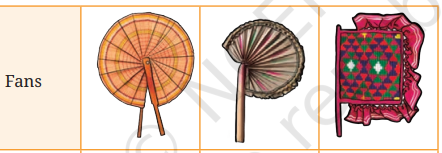
| The State it is from | Assam | Kerala | Uttar Pradesh |
| Shape | |||
| Made of | Palm leaf | Moonj grass |
Ans:
| The State it is from | Assam | Kerala | Uttar Pradesh |
| Shape | Round | Semi-circular | Rectangular |
| Made of | Bamboo | Palm leaf | Moonj grass |
III. Work in pairs. Match the underlined words in Column 1 with their meanings in Column 2 given on the next page. Share your answers with your classmates and teacher. I visited the crafts fair yesterday. It was a wonderful experience.
Each indigenous artefact was an innovative creation of industrious craftspersons with its intricate design. It invoked a sense of respect for the initiatives taken by the government to showcase them.
| Column 1 | Column 2 |
| 1. indigenous | (i) hardworking |
| 2. innovative | (ii) actions to improve a situation |
| 3. industrious | (iii) brought out |
| 4. intricate | (iv) local – from where it originated |
| 5. invoked | (v) new and original in approach |
| 6. initiatives | (vi) elaborate/detailed |
Ans:
| Column 1 | Column 2 |
| 1. indigenous | (iv) local – from where it originated |
| 2. innovative | (v) new and original in approach |
| 3. industrious | (i) hardworking |
| 4. intricate | (vi) elaborate/detailed |
| 5. invoked | (iii) brought out |
| 6. initiatives | (ii) actions to improve a situation |
| Check Your Understanding |
I. Work in pairs to complete the table on pankha. Share your answers with your classmates and teacher.
| State | Type of Fan | Material Used |
| Rajasthan | appliqué hand fan | __________ |
| __________ | __________ | gold thread |
| __________ | temple hand fans | __________ |
| Gujarat | mirror work hand fans | __________ |
| __________ | __________ | beads |
| __________ | __________ | leather, decorated with thread and wool |
| West Bengal | sola hand fans | __________ |
| Uttar Pradesh | __________ | pure gold, silver zari, silk and satin frills |
| Bihar | __________ | bamboo |
Ans:
| State | Type of Fan | Material Used |
| Rajasthan | appliqué hand fan | cloth and thread work |
| Odisha | palm leaf hand fan | gold thread |
| Tamil Nadu | temple hand fans | palm leaf |
| Gujarat | mirror work hand fans | mirrors and cloth |
| Manipur | beadwork hand fans | beads |
| Kashmir | leather hand fans | leather, decorated with thread and wool |
| West Bengal | sola hand fans | sola pith |
| Uttar Pradesh | zari hand fans | pure gold, silver zari, silk and satin frills |
| Bihar | bamboo hand fans | bamboo |
| Critical Reflection |
I. Read the extracts given below and answer the questions that follow.
1. Over time, pankhas became significant cultural goods distributed through trade routes. They were considered exotic and stylish. Although there was substantial commonality in their use across India, different villages and towns developed their own varieties of traditional pankhas. Each place developed pankhas with distinct materials or a variety of intricate designs, that set them apart from one another.
(i) State whether the following sentence is true or false. Pankhas were one of the most popular items of commerce.
Ans: True.
(ii) Why has the word ‘traditional’ been used to describe pankhas?
Ans: because it expresses people’s personal feelings and views, which may differ from person to person.
(iii) Complete the following statement. The sentence ‘They were considered exotic and stylish’ is an opinion and not a fact because ______________________.
Ans: because it expresses people’s personal feelings and views, which may differ from person to person.
(iv) Infer one reason for commonality in the use of pankhas across India.
Ans: Pankhas were commonly used across India because they provided relief from heat and were useful in daily life.
(v) Select which one of the two statements is the correct assertion for the given reason.
Reason: Pankhas were made of indigenous materials, unique to the region, with elaborate designs.
A. Each kind of pankha could be distinguished from the other.
B. Pankhas were used by many people.
Ans: A. Each kind of pankha could be distinguished from the other.
Explanation: Since pankhas were made from local materials and had unique regional designs, each type looked different and could easily be identified from others.
2. With time and the advent of technology and innovative creations, the beautiful culture of pankhas runs the risk of slowly losing its presence among Indians. Once made for personal use, over time this handicraft has transformed into a commercial business and now provides some form of livelihood to India’s artisans. The slight increase in popularity and demand is significantly factored by the different versions of the pankha being crafted.
(i) Infer one negative impact of technological advancement on pankha.
Ans: Technological advancement has reduced the use and popularity of traditional pankhas.
(ii) Complete the statement with an appropriate reason. The writer refers to ‘pankhas’ not just as an object but as a ‘culture’ because ___________.
Ans: because pankhas reflect the traditions, art, and craftsmanship of different regions of India.
(iii) Select a line from the extract which depicts how the role of the pankha has changed over the years.
Ans: “Once made for personal use, over time this handicraft has transformed into a commercial business and now provides some form of livelihood to India’s artisans.”
(iv) List one way in which the increase in demand of pankhas might benefit artisans.
Ans: The increase in demand helps artisans earn more income and supports their livelihood.
(v) Select the factor that has contributed to the commercialisation of pankhas.
(A) Cultural preservation.
(B) Economic demand.
(C) Technological advancements.
(D) Artisan initiative.
Ans: (B) Economic demand.
II. Answer the following questions.
1. How does the title ‘Winds of Change’ capture the essence of the chapter?
Ans: The title ‘Winds of Change’ captures the essence of the chapter because it highlights the changing role and popularity of traditional pankhas over time. With technological advancements like electric fans and air conditioners, the use of handmade pankhas has decreased. At the same time, pankhas have transformed from simple household objects into cultural and commercial handicrafts that provide livelihood to artisans.
2. Support the following statement with any two relevant examples from the chapter. ‘The structure and design of pankhas are testimony to the cultural identity of the region.’
Ans: (i) In Gujarat, mirror work hand fans reflect the traditional mirror embroidery art of the region.
(ii) In Uttar Pradesh, pankhas decorated with pure gold, silver zari, silk, and satin frills show the rich and royal artistic culture of the state.
3. The chapter mentions pankhas running the risk of slowly losing their presence among Indians. Evaluate how the balance between preserving traditional craftsmanship and incorporating innovative designs in the creation of pankhas will help in this regard.
Ans: Balancing traditional craftsmanship with innovative designs can help preserve the cultural value of pankhas while making them attractive to modern buyers. Traditional methods and regional art forms keep the heritage alive, whereas new designs, colours, and decorative styles increase their popularity and demand. This balance can encourage younger generations to appreciate and use pankhas, helping artisans continue their craft and livelihood.
4. How might initiatives such as pankha-making workshops contribute to the preservation of this traditional craft?
Ans: Pankha-making workshops spread awareness about the beauty and importance of this traditional craft. They teach people the skills and techniques involved in making pankhas and encourage interest among the younger generation. Such workshops also provide artisans with opportunities to showcase their talent and earn income.
5. The writer mentions celebrating pankhas in the concluding part of the chapter. Assess how this could be beneficial to artisans and the craft.
Ans: Celebrating pankhas can increase public appreciation for the craft and help artisans gain recognition for their work. It can create more demand for handmade pankhas, improve artisans’ livelihoods, and encourage the continuation of traditional craftsmanship. It also helps preserve India’s cultural heritage.
6. How does the restriction of the use of pankha for decorative purposes reflect the changing cultural role of these traditional fans in modern India?
Ans: Earlier, pankhas were mainly used for daily cooling purposes, but today electric fans and air conditioners have replaced them. As a result, pankhas are now mostly valued as decorative and cultural items. This change reflects how traditional objects in modern India are gradually shifting from practical use to symbols of art, heritage, and cultural identity.
| Canvas of Soil |
| Reflect and Respond |
I. Work in pairs. Discuss what all you see in a garden. Think of the colours you see and where you see them. Share your responses with your teacher.
Ans: Ans: In a garden, we can see colourful flowers, green plants, trees, grass, butterflies, birds, and pathways.
We can see red roses, yellow marigolds, pink lotuses, white jasmine flowers, and different shades of green leaves and grass.
II. Look at the picture of a garden and a painting given below. Speak about any similarities between the garden and the painting.
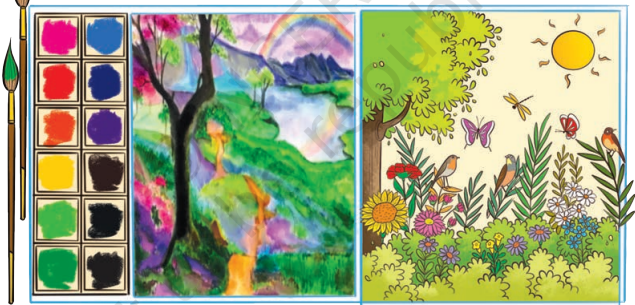
Speak using the following:
(i) Just as a garden ______________, similarly, a painting ______________
(ii) A garden and a painting, both ________.
(iii) ______________ is common to both a garden and a painting.
(iv) Like a garden, a painting too __________
Ans: Similarities between a Garden and a Painting
(i) Just as a garden is full of colourful flowers, similarly, a painting is full of beautiful colours.
(ii) A garden and a painting, both look attractive and pleasing.
(iii) Beauty and creativity are common to both a garden and a painting.
(iv) Like a garden, a painting too gives peace and happiness to people.
| Check Your Understanding |
Read the poem again and complete the summary of each stanza by filling in the blanks.
1. The ______________ is portrayed as a rich palette where gardeners’ __ __ __ a __ s flourish in the form of ______________ , awaiting spring.
Ans: The earth is portrayed as a rich palette where gardeners’ dreams flourish in the form of seeds, awaiting spring.
2. The garden flowers ______________ into a beautiful display of different b __ __ __ __ __ m s, resembling a ______________ by Mother Nature, in the light of morning.
Ans: The garden flowers bloom into a beautiful display of different blossoms, resembling a painting by Mother Nature, in the light of morning.
3. Each garden is likened to a wide __ __ n __ __ s, integrating art and __________. Through the efforts of gardeners, gardens transform into still-life ______________.
Ans: Each garden is likened to a wide canvas, integrating art and life. Through the efforts of gardeners, gardens transform into still-life paintings.
II. Select the appropriate title for each stanza from those given below. There are two extra titles.
1. Nature’s Work of Art
2. Sweet-smelling Blossoms
3. Gardens as Living Canvases
4. Earth and Possibilities
5. The Painter’s Canvas
Ans:
| Stanza | Appropriate Title |
| Stanza 1 | 4. Earth and Possibilities |
| Stanza 2 | 1. Nature’s Work of Art |
| Stanza 3 | 3. Gardens as Living Canvases |
III. Match the poetic devices in Column 1 to the examples in Column 2. Discuss your responses in pairs. Then share the responses with your classmates and teacher.
| Column 1 | Column 2 |
| 1. Imagery [mind pictures] | (i) appreciative |
| 2. Metaphor [comparison without use of ‘like’ or ‘as’] | (ii) AABB |
| 3. Rhyme Scheme | (iii) ‘Blossoms bloom’ |
| 4. Tone [what the poet feels] | (iv) colours, brushstrokes, blossoms, shades of green |
| 5. Mood [what the reader feels] | (v) a gardener |
| 6. Speaker | (vi) garden as a painting, plot as canvas, seeds as brushstrokes |
| 7. Alliteration [same consonant sound] | (vii) joyful |
Ans:
| Column 1 | Column 2 |
| 1. Imagery [mind pictures] | (iv) colours, brushstrokes, blossoms, shades of green |
| 2. Metaphor [comparison without use of ‘like’ or ‘as’] | (vi) garden as a painting, plot as canvas, seeds as brushstrokes |
| 3. Rhyme Scheme | (ii) AABB |
| 4. Tone [what the poet feels] | (i) appreciative |
| 5. Mood [what the reader feels] | (vii) joyful |
| 6. Speaker | (v) a gardener |
| 7. Alliteration [same consonant sound] | (iii) ‘Blossoms bloom’ |
Subject Ka Complete Video Solution Dekhein
Step-by-step easy concept explanation aur full questions Answer ke liye watch karein ya app download karein:




 Buy Now