
NCERT Class 9 English Chapter 2 The Pot Maker Solutions As Per New Syllabus. to each chapter is provided in the list so that you can easily browse through different chapters NCERT Class 9 English Chapter 2 The Pot Maker Notes and select need one. NCERT Class 9 English Chapter 2 The Pot Maker Question Answers Download PDF. NCERT Class 9 English Kaveri Question Answer.
NCERT Class 9 English Chapter 2 The Pot Maker
Also, you can read the NCERT book online in these sections Solutions by Expert Teachers as per Central Board of Secondary Education (CBSE) Book guidelines. CBSE Class 9 English Kaveri Solutions are part of All Subject Solutions. Here we have given NCERT Solutions For Class 9 English Kaveri, CBSE Class 9 English Kaveri Notes for All Chapters, You can practice these here.
The Pot Maker
Chapter: 2
| Reflect and Respond |
Look at the pictures given below and identify the vocations. Now, list at least five more vocations.
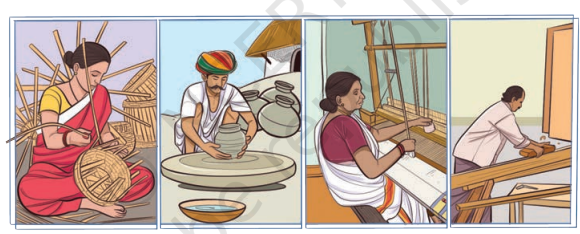
Ans: Vocations shown in the pictures:
Basket weaver.
Potter.
Weaver.
Five more vocations:
Farmer.
Tailor.
Blacksmith.
Plumber.
Electrician.
II Work in pairs. Discuss the following questions and share your answers with your classmates and teacher.
1. What is common among these pictures?
Ans: In the pictures show people engaged in different vocations (occupations). They are skilled workers who use their hands and tools to make useful items or provide services. Their work helps meet the daily needs of society.
2. We refer to such skill-based work as v__ __ a __ __ o __ s.
Ans: Vocations.
3. Mention a few differences between handmade and machine-made products.
Ans:
| Handmade Products | Machine-made Products |
| Made by hand | Made by machines |
| Unique in design | Similar in design |
| Take more time to make | Produced quickly |
| Usually costlier | Usually cheaper |
| Check Your Understanding |
I. Do you think pot making is easy? If yes, why? If no, why not?
Ans: No, pot making is not easy because it requires skill, patience, hard work, and creativity. A pot maker must carefully shape the clay and use the wheel properly to make good pots.
II. Would Sentila be able to fulfil her dream of becoming a pot maker? Explain.
Ans: Yes, Sentila would be able to fulfil her dream of becoming a pot maker because she was interested in learning the craft and was determined to practise and improve her skills.
III. Do you think Mesoba and Arenla would support Sentila? Give a reason.
Ans: Yes, Mesoba and Arenla would support Sentila because they cared for her and wanted her to follow her dream and learn the traditional art of pot making.
| Check Your Understanding |
I. Do you think Onula’s support helped Sentila? If yes, why? If no, why not?
Ans: Yes, Onula’s support helped Sentila because she encouraged and guided her. Her support gave Sentila confidence to continue learning pot making.
II. Sentila observes her mother making pots. What does this tell us about her?
Ans: Sentila observing her mother making pots tells us that she was curious, attentive, and eager to learn the art of pot making. She admired her mother’s skill and wanted to become a pot maker herself.
III. Arrange the following events of the story in the correct sequence. Share your answer with your classmates and teacher
| No. | Events |
| 1. | The village council called Mesoba to know about Arenla’s unwillingness to teach pottery to Sentila. |
| 2. | Arenla made a new batch of pots and asked Sentila to continue the work as she was unwell. |
| 3. | Sentila observed how other expert potters crafted beautiful pots. |
| 4. | Sentila was passionate about pottery but did not share it with her mother. |
| 5. | Onula guided Sentila in the art of pot making. |
| 6. | Sentila overheard her mother saying that pot making was a tiring job and that she earned very little from it. |
| 7. | Onula observed two rows of pots inside the work shed, which she felt was the work of two people. |
| 8. | Sentila learnt the art of pot making for a year from her mother, but was unsuccessful. |
| 9. | Sentila was able to make pots quickly and skillfully, just one less than her mother’s. |
Ans:
| Correct Sequence | Events |
| 1 | Sentila was passionate about pottery but did not share it with her mother. |
| 2 | Sentila overheard her mother saying that pot making was a tiring job and that she earned very little from it. |
| 3 | Sentila observed how other expert potters crafted beautiful pots. |
| 4 | The village council called Mesoba to know about Arenla’s unwillingness to teach pottery to Sentila. |
| 5 | Sentila learnt the art of pot making for a year from her mother, but was unsuccessful. |
| 6 | Onula guided Sentila in the art of pot making. |
| 7 | Arenla made a new batch of pots and asked Sentila to continue the work as she was unwell. |
| 8 | Sentila was able to make pots quickly and skillfully, just one less than her mother’s. |
| 9 | Onula observed two rows of pots inside the work shed, which she felt was the work of two people. |
| Critical Reflection |
Read the extracts given below and answer the questions that follow.
1. Pounding the stubborn clay inside bamboo cylinders to soften it, is also tedious. So many times I’ve dropped 43 The Pot Maker the mould out of sheer exhaustion and have had to start all over again. It takes months to bring out a batch of pots after so much labour. And the reward? A few rupees. But if Sentila learns weaving, she can make much more money besides providing enough cloth for the family. Weaving is not messy like pot making and can be done indoors in all seasons. Also, the time spent on weaving one shawl is much less and the return is handsome.
(i) Choose the correct reason for the given assertion.
(A): The effort in making pots is far greater than the returns.
A. The process of pot making is quite tiresome and long, and one hardly earns much.
B. The process of pot making is exhausting, takes a long time, yet gives a sense of satisfaction.
Ans: A. The process of pot making is quite tiresome and long, and one hardly earns much.
(ii) Why does Arenla want Sentila to learn weaving?
Ans: Arenla wants Sentila to learn weaving because weaving earns more money, takes less time, and can be done indoors in all seasons.
(iii) State one advantage that weaving has over pot making, as per the extract.
Ans: One advantage of weaving is that it can be done indoors in all seasons.
(iv) Choose the sentence that uses the word ‘handsome’ in the same way as in the extract.
A. My father is a handsome man.
B. They will make a handsome profit selling this property.
Ans: B. They will make a handsome profit selling this property.
(v) ‘And the reward?’ What is the author’s purpose of using a question mark here?
Ans: The author uses the question mark to emphasise Arenal’s disappointment and frustration about getting very little reward after so much hard work.
2. Onula saw her taking out some clay and the implements from her basket quietly. She watched Sentila’s clumsy efforts to make a pot and noticed that Sentila was too tense. As a result, the clay seemed unable or unwilling to yield the right shape. When Sentila wearily let the misshapen lump fall flat on the ground, Onula went to her and said, “Don’t worry, little one, I shall teach you how to make a perfect pot.” Sentila watched in amazement as Onula fashioned a beautiful pot and asked her to try again.
(i) Complete the sentence with an appropriate reason.
Onula feels Sentila’s effort at making a pot is clumsy because ______________.
Ans; Onula feels Sentila’s effort at making a pot is clumsy because she was too tense and lacked confidence while shaping the clay.
(ii) Choose the correct option to complete the following sentence.
‘Don’t worry, little one, I shall teach you how to make a perfect pot.’
This shows that Onula was _____________.
(A) Sincere and generous.
(B) Forgiving and thoughtful.
(C) Thoughtful and generous.
(D) Forgiving and sincere.
Ans: (c) thoughtful and generous.
(iii) Which among the following is the effect of a cause?
(A) As a result, the clay seemed unable or unwilling to yield the right shape.
(B) Onula saw her taking out some clay and the implements from her basket quietly.
Ans: (A) As a result, the clay seemed unable or unwilling to yield the right shape.
(iv) ‘Onula fashioned a beautiful pot.’ Here, the word ‘fashioned’ means ______________. (created/styled)
Ans: Created.
| Gifts of Grace: Honouring Our Vocations |
| Reflect and Respond |
Given below are four riddles. Read and identify who these people are.
1. In furrows deep, secrets I sow, As time passes, I watch them grow. Who am I? ________________
Ans: A Farmer.
2. From wheel to kiln, my skill is born, Step by step, an art takes form. Who am I? ________________________
Ans: A Potter.
3. I lay foundations, brick by brick, To build a house, it’s me you pick. Who am I? ________________________
Ans: A Mason.
4. I work with pots, pans, and spice, Creating dishes that taste so nice. Who am I? ________________________
Ans: A Cook/ Chef.
II. What is the role and relevance of the people you identified in the riddles. How do they contribute to the society? Discuss with your classmates and teacher.
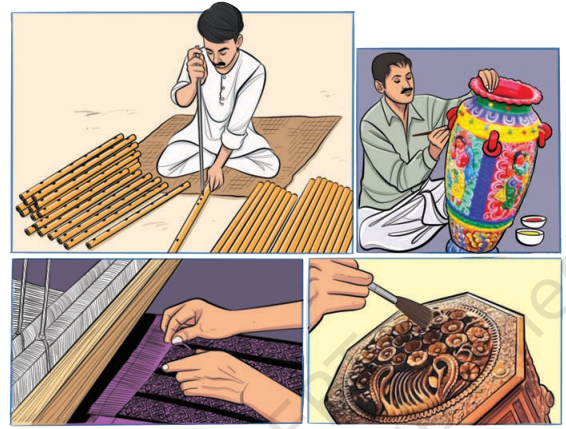
Ans: These people play an important role in society. They use their skills to make useful and beautiful items for everyday life. The bamboo craftsman makes baskets, mats, and other bamboo products. The potter makes clay pots and utensils used in homes. The weaver produces cloth and garments, while the wood carver creates decorative and functional wooden objects.
Their work helps preserve traditional arts and crafts, provides employment, and supports the local economy. They contribute to society by supplying essential goods, promoting cultural heritage, and passing their skills on to future generations.
| Check Your Understanding |
I. Based on your understanding of the poem, state whether the following statements are true or false. Also, rectify the false statements.
1. The poem highlights the skilled work of craftspeople.
Ans: True.
2. The poet shares that musicians express emotions through their instruments.
Ans: True.
3. The carpenters in the poem are admired for their logical work.
Ans: False.
4. The electricians in the poem are recognised for their crucial role in lighting up lives.
Ans: True.
5. The poem pays homage to shoemakers who manufacture quality footwear.
Ans: True.
6. The poem celebrates the patriotism of the people of Bharat.
Ans: True.
7. The poet feels that each vocation deserves to be respected.
Ans: True.
II. Let us appreciate the poem.
1. Rhyme Scheme and Lineation
(i) Does the poem strictly adhere to a rhyme scheme, or is it in free verse?
Ans: The poem does not strictly follow a rhyme scheme. It is written mostly in free verse.
(ii) What is the impact of the varying length of lines in the poem?
Ans: The varying length of lines makes the poem more natural, expressive, and rhythmic. It also helps to emphasize different ideas and emotions.
(iii) What is the pattern in the structure of most lines of the poem?
Ans: Most lines of the poem follow a simple and descriptive structure, highlighting different professions and their importance.
2. Speaker
(i) Who appears to be the speaker and what is her/his role here?
Ans: The speaker appears to be the poet. The poet’s role is to appreciate and honour people from different vocations and their contribution to society.
3. Tone and Mood
(i) Fill in the blanks with suitable options from the box given below.
serious, celebratory, hostile, reverential, joyful, sympathetic.
A. The tone is ______________and _____________ , depicting a sense of admiration and respect for the artisans and craftspersons.
Ans: The tone is reverential and sympathetic, depicting a sense of admiration and respect for the artisans and craftspersons.
B. There is a _____________mood throughout the poem, capturing the vibrancy and richness of cultural traditions and skills.
Ans: There is a celebratory mood throughout the poem, capturing the vibrancy and richness of cultural traditions and skills.
4. Imagery
(i) Select any two descriptions from the poem that evoke visual images.
Ans: Any two descriptions that evoke visual images:
- The carpenters building houses carefully.
- The shoemakers making strong and beautiful footwear.
(ii) Fill in the blanks with suitable phrases. The poem includes auditory imagery through mentions of artisans with lutes, _______________, and _______________, emphasising the sounds associated with each vocation.
Ans: The poem includes auditory imagery through mentions of artisans with lutes, drums, and flutes, emphasising the sounds associated with each vocation.
5. Metaphor
(i) State whether the following sentence is true or false.
The mention of ‘delicious singing’ of the cook is a metaphor because it implies that the quality of the singing is so enjoyable or pleasing that it can be equated to the experience of tasting something delicious.
Ans: The statement is True.
The phrase “delicious singing” is a metaphor because it compares the sweetness of singing to the pleasant taste of delicious food.
6. Personification
(i) Select the line that tells us that the poet personifies vocations by attributing humanlike qualities to them.
Ans: The line that personifies vocations is:
“I hear Bharat celebrating, the varied vocations I hear!”
Here, Bharat is given the human quality of celebrating.
7. Repetition
(i) Why might the poet have begun and ended with the same line—‘I hear Bharat celebrating, the varied vocations I hear!’?
Ans: The poet begins and ends with the same line to emphasize the importance and dignity of different vocations in Bharat. The repetition creates a strong patriotic feeling and gives unity to the poem.
Subject Ka Complete Video Solution Dekhein
Step-by-step easy concept explanation aur full questions Answer ke liye watch karein ya app download karein:




 Buy Now