
NCERT Class 9 English Chapter 1 How I Taught My Grandmother to Read Solutions As Per New Syllabus. to each chapter is provided in the list so that you can easily browse through different chapters NCERT Class 9 English Chapter 1 How I Taught My Grandmother to Read Notes and select need one. NCERT Class 9 English Chapter 1 How I Taught My Grandmother to Read Question Answers Download PDF. NCERT Class 9 English Kaveri Question Answer.
NCERT Class 9 English Chapter 1 How I Taught My Grandmother to Read
Also, you can read the NCERT book online in these sections Solutions by Expert Teachers as per Central Board of Secondary Education (CBSE) Book guidelines. CBSE Class 9 English Kaveri Solutions are part of All Subject Solutions. Here we have given NCERT Solutions For Class 9 English Kaveri, CBSE Class 9 English Kaveri Notes for All Chapters, You can practice these here.
How I Taught My Grandmother to Read
Chapter: 1
| Reflect and Respond |
I. completed the given word web.
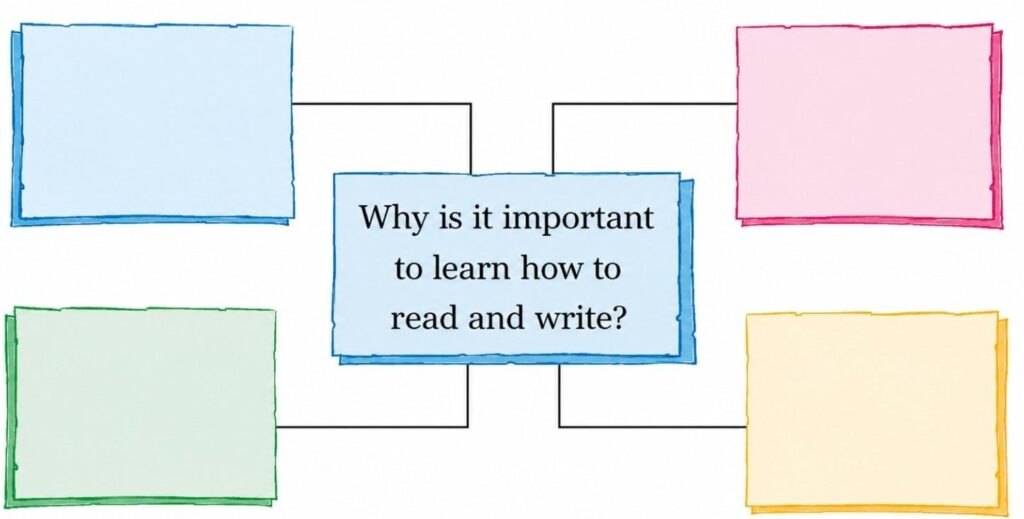
Ans:
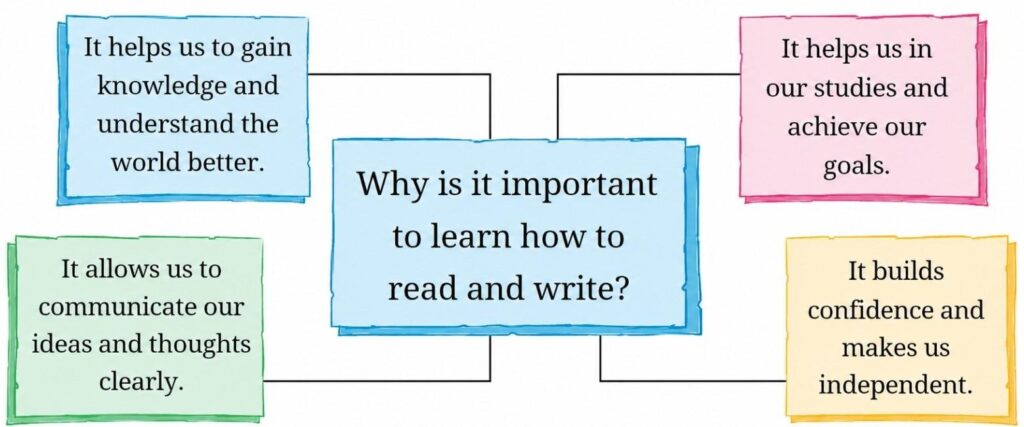
II Read the questions given below and share your answers with your classmates and teacher.
1. Which language(s) do your grandparents or elderly relatives speak? Bhojpuri and hindi
Ans: My grandparents and elderly relatives speak Bhojpuri and Hindi.
2. How do they spend their time? How do you spend time with them?
Ans: They spend their time praying, watching TV, talking with family members, cooking, and sometimes going for walks. I spend time with them by talking, helping them in small tasks, listening to their stories, and learning cooking from them.
3. What is your favourite experience with them?
Ans: My favourite experience with them is listening to their childhood stories, spending time together during festivals, and hearing them talk about my childhood memories.
4. What is something that the elderly in your family cannot do easily but enjoy watching you do?
Ans: The elderly in my family cannot use mobile phones and laptops easily, but they enjoy watching me use technology and help them with it.
III. Read the following passage. Match the highlighted words with their meanings given in the box below.
1. excitedly
2. believable
3. people living in one particular area
4. discussion
5. a part of a story
6. focus
7. main character
8. directed
The casting for the (i) protagonist of our school’s annual play was done after a lot of (ii) debate as many good actors had auditioned for the role. We had decided to present an (iii) episode from an inspirational story. It was a life story of a group of children who worked with the (iv) community to spread literacy. Every day, we reached school early to practise with (v) concentration. We waited (vi) eagerly for the final presentation. All of us played our roles in a very (vii) convincing manner as our theatre teacher had (viii) guided us well.
Ans:
| Sl. No. | Meaning | Word from the Passage |
| (i) | Excitedly | Eagerly |
| (ii) | Believable | Convincing |
| (iii) | People living in one particular area | Community |
| (iv) | Discussion | Debate |
| (v) | A part of a story | Episode |
| (vi) | Focus | Concentration |
| (vii) | Main character | Protagonist |
| (viii) | Directed | Guided |
| Check Your Understanding |
I. Complete the cause and effect table given below based on Part I of the story. Share your answers with your classmates and teacher.
| Cause | Effect |
| (i) The morning papers arrived late in the day and weekly magazines would come one day late. | |
| 2. The grandmother, Krishtakka, never went to school. | |
| (iii) She was deeply interested in the story and discussed it with her friends. | |
| 4. The narrator went to a wedding for a week. | |
| (vi) The grandmother regretted not going to school. | |
| 6. The grandmother regretted not going to school. |
Ans:
| Cause | Effect |
| 1. The narrator’s village was very far from the city. | (i) The morning papers arrived late in the day and weekly magazines would come one day late. |
| 2. The grandmother, Krishtakka, never went to school. | (ii) She could not read or write. |
| 3. The narrator read the story of Kashi Yatre to her grandmother every week. | (iii) She was deeply interested in the story and discussed it with her friends. |
| 4. The narrator went to a wedding for a week. | (iv) The grandmother realised how helpless she was because she could not read the story by herself. |
| 5. The grandmother never went to school. | (vi) The grandmother regretted not going to school. |
| 6. The grandmother regretted not going to school. | She decided to learn to read and write. |
II. Do you think the narrator expected to see her grandmother in tears when she returned to the village? If yes, why? If no, why not?
Ans: No, the narrator did not expect to see her grandmother in tears when she returned to the village because she had never seen her grandmother cry even in the most difficult situations. She was surprised and worried to see her grandmother crying.
III. How might the narrator help her grandmother to fulfil her desire to learn to read and write?
Ans: The narrator might help her grandmother by teaching her the alphabet, simple words, and reading lessons every day with patience and encouragement.
| Check Your Understanding |
I. State whether the following sentences are true or false. Share your answers with your classmates and teacher.
| Sentence | True / False |
| 1. The grandmother wanted to learn the Kannada alphabet to gain independence. | |
| 2. The grandmother asked someone in the village to read Kashi Yatre to her while the narrator was away. | |
| 3. The narrator was the grandmother’s first teacher and taught her how to read Kannada. | |
| 4. The grandmother believed that there was no age limit for learning. | |
| 5. The grandmother touched the narrator’s feet as a mark of respect for her as a teacher. | |
| 6. The narrator was disappointed with the progress her grandmother made in learning to read. |
Ans:
| Sentence | True / False |
| 1. The grandmother wanted to learn the Kannada alphabet to gain independence. | True |
| 2. The grandmother asked someone in the village to read Kashi Yatre to her while the narrator was away. | False |
| 3. The narrator was the grandmother’s first teacher and taught her how to read Kannada. | True |
| 4. The grandmother believed that there was no age limit for learning. | True |
| 5. The grandmother touched the narrator’s feet as a mark of respect for her as a teacher. | True |
| 6. The narrator was disappointed with the progress her grandmother made in learning to read. | False |
| Critical Reflection |
I. Read the extracts given below and answer the questions that follow.
1. When I came back to my village, I saw my grandmother in tears. I was surprised, for I had never seen her cry even in the most difficult situations.What had happened? I was worried.
‘Avva, is everything all right? Are you okay?”
I used to call her Avva, which means mother in the Kannada spoken in north Karnataka.
She nodded but did not reply. I did not understand and forgot about it. In the night, after dinner, we were sleeping in the open terrace of our house. It was a summer night and there was a full moon. Avva came and sat next to me. Her affectionate hands touched my forehead.
(i) Complete the following sentence with the appropriate option.
The phrase ‘never seen her cry in the most difficult situations’ tells us that the grandmother was ______________.
A. Strong-willed.
B. Understanding.
C. Considerate.
D. Bold.
Ans: A. Strong-willed.
(ii) Complete the following with the correct option from those given in the brackets. Grandmother did not reply when the narrator asked if she was alright because she might have been too ________________________ (emotional/tired) to respond.
Ans: Emotional.
(iii) Identify the clue from the extract that indicates a rural setting with traditional customs.
Ans: “We were sleeping in the open terrace of our house. It was a summer night and there was a full moon.”
(iv) Which lines of the extract establish a tender atmosphere?
Ans: “Avva came and sat next to me. Her affectionate hands touched my forehead.”
(v) Which of the following aspect is NOT emphasised in the given extract?
A. The emotional turmoil of the grandmother.
B. The affectionate bond between the narrator and her grandmother.
C. The grandmother’s regret over her lack of education.
D. The narrator’s concern for her grandmother.
Ans: C. The grandmother’s regret over her lack of education.
2. ‘I have decided I want to learn the Kannada alphabet from tomorrow onwards. I will work very hard. I will keep Saraswati Puja day during Dassara as the deadline. That day I should be able to read a novel on my own. I want to be independent.’
AI saw the determination on her face. Yet I laughed at her. ‘Avva, at this age of sixty-two you want to learn the alphabet? All your hair is grey, your hands are wrinkled, you wear spectacles and you work so much in the kitchen…’
Childishly I made fun of the old lady. But she just smiled.
‘For a good cause if you are determined, you can overcome any obstacle. I will work harder than anybody but I will do it. For learning there is no age bar.’
(i) What does the grandmother’s statement, “I want to be independent,” reveal about her character?
(A) She wanted to be literate.
(B) She desires self-sufficiency.
(C) She wants to prove her intelligence to others.
(D) She feels pressured by society to learn.
Ans: (B) She desires self-sufficiency.
(ii) Fill in the blank with the appropriate option from those given in brackets. The grandmother’s determination shows that learning has no ___________________. (age limit/gender bias/cultural barriers)
Ans: Age limit.
| Bharat Our Land |
| Reflect and Respond |
I. Recall the lines of the National Anthem and complete the table given below with the names of the states, mountain ranges, and rivers mentioned in it.
| States/Provinces | Mountain Ranges | Rivers |
| ____________ | ____________ | ____________ |
| ____________ | ____________ | ____________ |
| ____________ | ____________ | ____________ |
| ____________ | ____________ | ____________ |
Ans:
| States/Provinces | Mountain Ranges | Rivers |
| Punjab | Vindhya | Yamuna |
| Sindh | Himalaya | Ganga |
| Gujarat | — | — |
| Maratha | — | — |
| Warriors | Peerless | Upanishads |
| Ganga | Buddha | Himavant |
| sages | praise | historical greatness |
| Brahma-knowledge |
II. Work in pairs. Discuss what the words ‘जय हे’ (Jaya he) in the last two lines of the National Anthem convey. Share your answer with your classmates and teacher.
Ans: The words ‘जय हे’ mean “Victory to thee” or “Hail to thee.” They express respect, honour, praise, and glory for the nation and inspire feelings of patriotism and unity among the people of India.
III. Read the underlined words in the given lines of the poem. Choose the odd one out that does not correspond with the meaning of the underlined word.
1. She’s peerless, let’s praise her!
valuable, incomparable, unmatched
Ans: Valuable.
2. Many a sage has sanctified this land.
blessed , purified, applauded
Ans: Applauded.
3. And here all auspicious things are found.
fortunate, fantastic, favourable
Ans: Fantastic.
4. Of hoary antiquity is Bharat,
ancient times, recent past, time immemorial
Ans: Recent past.
| Check Your Understanding |
I. Fill in the blanks by choosing appropriate words from the box given below to complete the summary of the poem.
The poem is a tribute to India, celebrating its natural beauty, spiritual heritage, and 1. _______. The poet praises the 2. _______, describing it as mighty and unparalleled. The 3. _______ is depicted as generous and graceful, while the 4. _______ are honoured as sacred and unmatched. The poem highlights the contributions of 5. _______ and 6. _______ who have enriched the land with their bravery and wisdom. It also acknowledges the presence of 7. _______ and the teachings of 8. _______, highlighting India’s deep-rooted spiritual and philosophical traditions. The poet repeatedly asserts that India is 9. _______, urging everyone to 10. ________ her
Ans: The poem is a tribute to India, celebrating its natural beauty, spiritual heritage, and 1. historical greatness. The poet praises the 2. Himavant, describing it as mighty and unparalleled. The 3. Ganga is depicted as generous and graceful, while the 4. sages are honoured as sacred and unmatched. The poem highlights the contributions of 5. warriors and 6. Buddha who have enriched the land with their bravery and wisdom. It also acknowledges the presence of 7. Upanishads and the teachings of 8. Brahma-knowledge, highlighting India’s deep-rooted spiritual and philosophical traditions. The poet repeatedly asserts that India is 9. peerless, urging everyone to 10. praise her.
II. Complete the following features about the poem.
1. The impact on the readers (mood): _________
Ans: The impact on the readers (mood): Patriotic and inspirational.
2. The poet’s attitude (tone): ___________
Ans: The poet’s attitude (tone): Proud and appreciative.
3. The rhyme scheme: __________
Ans: The rhyme scheme: Free verse / no fixed rhyme scheme
4. Examples of personification: _________
Ans: Examples of personification: “The generous Ganga is ours” and “This sunny golden land is ours.”
III. What is the impact of the refrain, ‘she’s peerless, let’s praise her!’?
Ans: The refrain creates a strong feeling of patriotism and admiration for India. It repeatedly reminds readers that India is unique and worthy of praise.
IV. Complete the following sentence appropriately.
Ans: India is metaphorically described as ‘this sunny golden land,’ suggesting that it is prosperous, beautiful, and full of richness and positivity.
V. The poet uses symbolism. Match the symbols in Column 1 to what they suggest in Column 2.
| Column 1 | Column 2 |
| 1. Himavant | (i) knowledge and enlightenment |
| 2. Ganga | (ii) spiritual and philosophical legacy |
| 3. Upanishads | (iii) purity and generosity |
| 4. Gallant warriors and sages | (iv) richness and glory |
| 5. Brahma-knowledge and Buddha’s Dhamma | (v) strength and permanence |
| 6. Sunny golden land | (vi) courage and wisdom |
Ans:
| Column 1 | Column 2 |
| 1. Himavant | (v) strength and permanence |
| 2. Ganga | (iii) purity and generosity |
| 3. Upanishads | (ii) spiritual and philosophical legacy |
| 4. Gallant warriors and sages | (vi) courage and wisdom |
| 5. Brahma-knowledge and Buddha’s Dhamma | (i) knowledge and enlightenment |
| 6. Sunny golden land | (iv) richness and glory |
VI. The poet uses imagery (descriptive language to create vivid mental pictures that appeal to the senses). Give any two examples from the poem.
Ans: “This sunny golden land is ours”
→ We imagine a bright, beautiful, rich, and glowing land.
The words sunny and golden help us picture India vividly.
“The generous Ganga is ours”
→ We imagine the flowing River Ganga giving water and life to people.
The word generous makes the river seem caring and life-giving.
Subject Ka Complete Video Solution Dekhein
Step-by-step easy concept explanation aur full questions Answer ke liye watch karein ya app download karein:



 Buy Now