
NCERT Class 8 Social Science Chapter 12 Citizenship: Rights and Duties Solutions English Medium As Per New Syllabus. to each chapter is provided in the list so that you can easily browse through different chapters NCERT Class 8 Social Science Chapter 12 Citizenship: Rights and Duties Notes and select need one. NCERT Class 8 Social Science Chapter 12 Citizenship: Rights and Duties Question Answers Download PDF. NCERT Class 8 Social Science Texbook Solutions English Medium.
NCERT Class 8 Social Science Chapter 12 Citizenship: Rights and Duties
Also, you can read the NCERT book online in these sections Solutions by Expert Teachers as per Central Board of Secondary Education (CBSE) Book guidelines. CBSE Class 8 Social Science Textual Solutions in English Medium are part of All Subject Solutions. Here we have given NCERT Class 8 Social Science Notes, CBSE Class 8 Social Science English Medium Solutions for All Chapters, You can practice these here.
Citizenship: Rights and Duties
Chapter: 12
| Theme D — Governance and Democracy |
The Big Questions
1. What does it mean to be a citizen, not just legally, but in everyday life?
Ans: Being a citizen means more than legally belonging to a country. In everyday life, it means being a responsible, caring and active member of society. A good citizen respects others, follows laws, helps people in need, protects the environment, stands against injustice and ensures that everyone feels welcomed and included.
2. Why are both rights and duties essential?
Ans: Rights and duties are essential because they go together and help maintain a fair, peaceful and democratic society. Rights give us freedom, equality, education and dignity, while duties remind us to respect others, obey laws, protect public property and care for the environment. Fulfilling our duties helps protect everyone’s rights and maintains harmony in society.
3. How can we help build a society where everyone is treated fairly, respected, and included?
Ans: We can build such a society by treating everyone equally, respecting different languages, religions, cultures and backgrounds, and standing against discrimination. We should help people in need, include everyone in social activities, respect the opinions of others and provide equal opportunities to all. By showing kindness, empathy and responsibility in our everyday actions, we can create a fair, peaceful and inclusive society.
LET’S EXPLORE
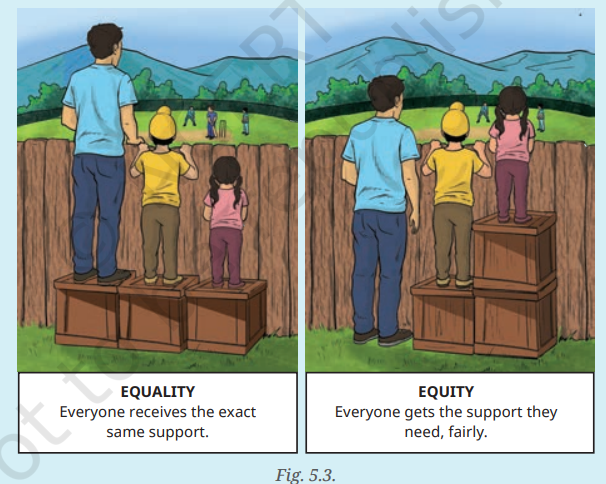
What do you observe in the illustrations above? As you can see, sometimes providing the same thing to every individual does not provide the same benefits on account of differences among them. These differences can be due to inequality and discrimination which may have been carried historically too. To be able to ensure that everyone gets the support they need, we look at the principle of equity (as you can see in the figure on the right). There are many initiatives taken by the government as well as civil society organisations to ensure that equity is established in such cases. The Beti Bachao Beti Padhao campaign was to build awareness in society as well as to provide support to girls’ education. Can you think of other such examples? (Page 148)
Ans: The illustrations show the difference between equality and equity.
(i) Equality: Everyone receives the same support, regardless of their needs.
(ii) Equity: Everyone receives support according to their needs so that all can get equal opportunities.
Other examples of government initiatives that promote equity:
(i) Scholarships and free education for poor students.
(ii) Reservation facilities for disadvantaged communities.
(iii) Free or subsidised healthcare for economically weaker sections.
(iv) Mid-Day Meal Scheme to provide nutritious food to school children.
(v) Schemes supporting education and empowerment of persons with disabilities.
2. “If I was asked to name any particular article in this Constitution as the most important — an article without which this Constitution would be a nullity— I could not refer to any other article except this one [right to constitutional remedies]. It is the very soul of the Constitution and the very heart of it…”, said Dr. B.R. Ambedkar during the Constituent Assembly Debates. Why is it important to have a way to protect rights? (Page 153)
Ans: It is important to have a way to protect our rights because:
(i) It protects people from injustice and discrimination.
(ii) It ensures that everyone is treated equally.
(iii) It allows people to seek justice when their rights are violated.
(iv) It prevents the misuse of power by authorities.
(v) It helps people live with freedom, dignity and security.
Thus, the Right to Constitutional Remedies protects all other Fundamental Rights.
2. Here are some everyday situations for reflection. Which right or duty is involved?
(i) Ravi decides not to join a protest march at school because he disagrees with it. Some classmates say they will exclude him from their group unless he joins.
(ii) On School Culture Day, Rukmini wants to wear her family’s traditional dress from her village. Some students laugh at her and say she should wear ‘modern’ clothes instead.
(iii) During the recess, some children were throwing chocolate wrappers on the playground, instead of the dustbin. The teacher then reminds them to keep their surroundings clean.
(iv) In a mock youth parliament activity, students use a voting app to share their ideas for improving school facilities. Even those who live in remote areas are able to join in the discussion online.
Ans: (i) Ravi’s situation: Right to freedom of expression and choice. Everyone has the freedom to express their opinions and make their own decisions without pressure.
(ii) Rukmini’s situation: Right to equality and cultural freedom. Everyone should respect other people’s culture, traditions and choices.
(iii) Children’s situation: Fundamental Duty to protect public property and keep the surroundings clean.
(iv) Mock youth parliament: Right to freedom of speech and expression and equal participation.
Everyone should get an opportunity to share their ideas, including those living in remote areas.
Can we demand rights without doing our duties?
Ans: No, we should perform our duties while enjoying our rights. Rights and duties go together. We must respect others’ rights and fulfil our responsibilities as good citizens.
THINK ABOUT IT
1. It’s Sports Day at school. The weather is very hot. Some students are told to wear full school uniforms with shoes, even though they will be running, playing games, and spending time outdoors. A few students feel uncomfortable and wonder why they can’t wear lighter clothes like T-shirts and sports shoes for such activities. One student starts a discussion at break time. “Shouldn’t we be allowed to wear comfortable sports clothes on Sports Day?” Some classmates agree, saying that comfort and safety are important while playing sports. Others feel that wearing the school uniform shows discipline and equality among all students. A couple of teachers overhear the conversation and remind everyone that school rules about uniforms must be followed. Was the student exercising freedom of speech? Could they have raised their concern differently? How should schools handle student opinions? (Page 149)
Ans: Yes, the student was exercising freedom of speech by politely expressing their opinion and raising a concern about the school uniform.
(i) The student had the right to share their views about wearing comfortable clothes on Sports Day.
(ii) They could have raised the concern respectfully with teachers or the school principal.
(iii) They could have explained that lighter clothes and sports shoes would provide better comfort and safety during outdoor activities.
(iv) The school authorities could listen to the students and consider their suggestions while following school rules.
2. What would you do if you saw a child working instead of being in school? Discuss in class, then write one step you could take:
(i) Could you talk to your teacher or principal?
(ii) Could you write to a child helpline? (Page 152)
Ans: (i) I would inform my teacher or principal so that they could take suitable action to help the child.
(ii) I could contact the Childline helpline (1098) to report the situation and seek protection and support for the child.
These steps would help protect the child’s rights and ensure their safety and education.
3. Can you name a duty that matches your right to education? (Page 158)
Ans: The duty that matches my right to education is to attend school regularly, study sincerely, complete my homework and respect my teachers.
4. Imagine there is a student in your class who takes a little longer to read or write because they have a different way of learning. Sometimes during group work, others do not wait for them or forget to include them. What would you do in this situation? Could you support them by being patient, explaining something clearly, or making sure they get a chance to speak? What steps can you take to make your classroom more inclusive? (Page 163)
Ans: I would treat the student with kindness, patience, and respect. I would help them understand difficult topics by explaining things clearly and giving them enough time to read or write. During group activities, I would make sure they are included and get a chance to share their ideas.
To make our classroom more inclusive, we should:
(i) Respect everyone’s learning abilities and differences.
(ii) Help classmates who need extra time or support.
(iii) Give everyone an equal chance to participate.
(iv) Avoid teasing, bullying, or making fun of anyone.
(v) Work together and encourage one another.
In this way, we can create a friendly classroom where everyone feels accepted, respected, and valued.
Questions and activities
1. Why is it important to respect others’ religions?
Ans: It is important to respect others’ religions because it promotes peace, equality, harmony and mutual understanding in society.
2. How would you feel if you were left out of something?
Ans: I would feel sad, lonely and hurt if I were left out. Everyone should be treated equally and included.
3. If rights are guaranteed, why do we still see discrimination in society?
Ans: Discrimination still exists because of social inequality, poverty, lack of awareness, old beliefs and prejudices.
4. Can there ever be a conflict between rights and duties? Give an example.
Ans: Yes, sometimes rights and duties may conflict. For example, a person has the right to freedom of expression but must also respect others and avoid spreading harmful information.
5. How does respecting diversity strengthen democracy?
Ans: Respecting diversity promotes equality, unity and mutual respect. It ensures that everyone gets an opportunity to participate in democracy.
6. Do you think technology (social media, online platforms) makes it easier or harder to practise citizenship? Why?
Ans: Technology makes practising citizenship easier because people can share their opinions, spread awareness, participate in discussions and access information. However, false information and online bullying can create problems.
7. Imagine everyone in society enjoyed rights but ignored their duties. What would life look like?
Ans: If everyone enjoyed their rights but ignored their duties, society would become disorderly. There would be pollution, conflicts, discrimination and disrespect for others. Life would become difficult and unsafe.
8. How can students your age practise inclusion in everyday school life?
Ans: Students can practise inclusion in the following ways:
(i) Treat everyone equally and respectfully.
(ii) Include all classmates in games and activities.
(iii) Respect different religions, cultures and traditions.
(iv) Help students who need support.
(v) Never bully or discriminate against anyone.
9. What can be done in the following situations?
(a) A school does not allow girls to join a mathematics or science club.
Ans: I would discuss the issue with teachers and the principal and request equal opportunities for girls and boys to participate in the club.
(b) A fellow student has dropped out of school because they are forced to work in a welding shop.
Ans: I would inform my teacher or principal and a trusted adult. I would also seek help from Childline (1098) so that the child can get protection and return to education.
10. Make a classroom charter that outlines rights and duties, and ensures inclusion and prevents discrimination.
Ans: Classroom Charter
Our Rights:
(i) Everyone has the right to education and equal opportunities.
(ii) Everyone has the right to express their opinions.
(iii) Everyone has the right to be treated with respect.
(iv) Everyone has the right to participate in classroom activities.
Our Duties:
(i) Respect teachers and classmates.
(ii) Keep the classroom clean.
(iii) Listen to others and respect their opinions.
(iv) Help classmates and share learning materials.
(v) Never discriminate, bully or hurt anyone.
Our Promise: We will treat everyone equally, respect diversity and make our classroom a safe, friendly and inclusive place for all.
Subject Ka Complete Video Solution Dekhein
Step-by-step easy concept explanation aur full questions Answer ke liye watch karein ya app download karein:


 Buy Now