
NCERT Class 8 Social Science Chapter 9 India’s Long Road to Independence Solutions English Medium As Per New Syllabus. to each chapter is provided in the list so that you can easily browse through different chapters NCERT Class 8 Social Science Chapter 9 India’s Long Road to Independence Notes and select need one. NCERT Class 8 Social Science Chapter 9 India’s Long Road to Independence Question Answers Download PDF. NCERT Class 8 Social Science Texbook Solutions English Medium.
NCERT Class 8 Social Science Chapter 9 India’s Long Road to Independence
Also, you can read the NCERT book online in these sections Solutions by Expert Teachers as per Central Board of Secondary Education (CBSE) Book guidelines. CBSE Class 8 Social Science Textual Solutions in English Medium are part of All Subject Solutions. Here we have given NCERT Class 8 Social Science Notes, CBSE Class 8 Social Science English Medium Solutions for All Chapters, You can practice these here.
India’s Long Road to Independence
Chapter: 9
| Theme B — Tapestry of the Past |
The Big Questions
1. How did a land of diverse geographies, languages and religions come together to challenge and finally end nearly two centuries of British rule?
Ans: Indians united against British rule because of common problems like exploitation, discrimination and unfair laws. Leaders like Mahatma Gandhi encouraged people from different religions and communities to join movements such as Non-Cooperation, Civil Disobedience and Quit India. Their unity and sacrifices helped India achieve independence on 15 August 1947.
2. What were the main developments and who were some important figures in India’s struggle for freedom?
Ans: The main developments in India’s freedom struggle were the Swadeshi Movement, Non-Cooperation Movement, Civil Disobedience Movement and Quit India Movement. Important freedom fighters included Mahatma Gandhi, Jawaharlal Nehru, Subhas Chandra Bose, Bhagat Singh, Bal Gangadhar Tilak, Sardar Vallabhbhai Patel and Lala Lajpat Rai. Their contributions helped India achieve independence in 1947.
3. What issues did the leading freedom fighters agree or disagree upon?
Ans: All freedom fighters agreed that India should become free from British rule. However, they disagreed about the methods of achieving freedom. Moderates wanted peaceful discussions and gradual reforms, Gandhi supported non-violence, while revolutionaries like Bhagat Singh supported armed struggle. Subhas Chandra Bose also believed in fighting the British through an armed force.
LET’S EXPLORE
1. Talk to your grandparents or elderly family members and find out what they remember or heard about India’s freedom struggle. Note which leaders or methods people supported. Discuss in class how, despite sharing the same goal of freedom, people followed different paths. (Page 38)
Ans: After talking to my grandparents, I learned that people admired leaders like Mahatma Gandhi, Subhas Chandra Bose, Bhagat Singh, Jawaharlal Nehru and Sardar Vallabhbhai Patel.
Many people supported Gandhi’s non-violent methods, while others admired Bhagat Singh’s revolutionary activities and Subhas Chandra Bose’s Indian National Army.
Although they followed different methods, everyone shared the same goal of ending British rule and making India independent. Their efforts helped India gain freedom in 1947.
2. Below are the first two stanzas of the song. Can you make out some of their meaning? (Page 42)
Vande Mātaram!
sujalām suphalām malayajaśhītalām
śhasyaśhyamalam, mataram!
Vande mantram!
Śhubhrajyotsnām pulakitayāminɨm
phullakusurnita drurnadalashobhinɨm
suhāsinɨm sumadhura bhāshinɨm
sukhadām varadām mātaram!
Vande mātaram!
Ans: The song Vande Mataram praises our motherland, India. It describes India as a beautiful and fertile land, rich in water, fruits and green fields. It also speaks about cool breezes, moonlit nights, blooming flowers and sweet languages. The song describes our motherland as a giver of happiness and blessings. “Vande Mataram” means “I bow to you, Mother.”
3. How are the values expressed by Swami Vivekananda above relevant in the 21st century? Can some of them help you achieve your goals? Share your thoughts with your classmates. (Page 43)
Ans: Swami Vivekananda taught us self-confidence, inner strength, service to humanity, respect for our culture and good character. These values are important even today because they help us face challenges with courage and work for society.
Yes, these values can help me achieve my goals. Self-confidence, determination and discipline will help me overcome difficulties and become a responsible and successful citizen.
4. Why do you think the Bande Mataram daily avoided using the word ‘independence’? (Page 50)
Ans: The Bande Mataram daily avoided using the word ‘independence’ because the British government strictly controlled newspapers and could punish those who openly demanded freedom. Therefore, it used indirect words to express its ideas and avoid censorship.
5. Comment on the phrase ‘absolute national autonomy’ in the above quotation from a Bande Mataram article.
Ans: The phrase means complete self-rule. It expresses the idea that India should be free from British control and should govern itself independently.
6. Looking at the two boxes on either side of the daily’s title in Fig. 2.12, what do you observe?
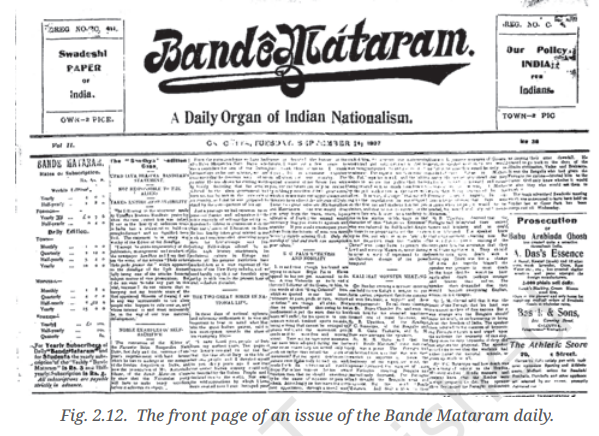
Ans: The two boxes contain important information about the newspaper, including its publication details and price. They show that Bande Mataram was a regularly published newspaper.
7. In what ways are these two representations of Mother India similar or different? (Page 52)
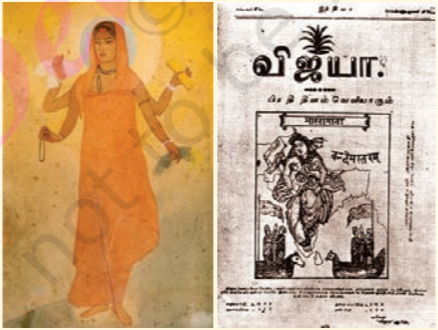
Ans: Both pictures represent India as Mother India and create a feeling of patriotism. Abanindranath Tagore’s painting shows Mother India as a peaceful woman holding symbolic objects, while the Vijaya cover presents her in a more powerful and energetic form.
8. What details can you discern in the front cover of Subramania Bharati’s Vijaya?
Ans: The cover shows Mother India in a powerful form, with the words ‘Vande Mataram’ beside her. It also shows people and buildings below her, representing the spirit of nationalism and the struggle for freedom.
9. You may explore further and find out more about the freedom struggle in the North-East and known and lesser-known freedom fighters from this area. (Page 55)
Ans: (i) Tirot Sing (Meghalaya): He led the Khasi Revolt (1829–1833) against British rule.
(ii) Singpho Rebellion (Assam): The Singpho community resisted British rule.
(iii) Maniram Dewan and Piyali Baruah (Assam): They took part in the Revolt of 1857 and were hanged by the British in 1858.
(iv) Rani Gaidinliu (Manipur): She began resisting British rule at the age of thirteen and encouraged people not to pay taxes or work for the British.
(v) Kanaklata Barua (Assam): She sacrificed her life during the Quit India Movement in 1942 while leading a procession to hoist the national flag.
(vi) Kushal Konwar (Assam): He was executed by the British in 1943 during the Quit India Movement.
These freedom fighters showed great courage and made valuable contributions to India’s struggle for independence.
10. Rabindranath Tagore sent a strong letter of protest to the then Viceroy. “The accounts of the insults and sufferings by our brothers in Punjab,” wrote Tagore, “have trickled through the gagged silence, reaching every corner of India, and the universal agony of indignation roused in the hearts of our people has been ignored by our rulers—possibly congratulating themselves for what they imagine as salutary lessons.” In the same letter, Tagore returned the knighthood he had received from the British. (Page 63)
What does Tagore mean when he assumes that the colonial rulers ‘congratulated themselves’ after the Jallianwala Bagh massacre?
Ans: Tagore meant that the British rulers considered the brutal massacre a successful way to frighten and control Indians. They believed they had taught Indians a lesson, instead of feeling ashamed of their cruel actions. This showed their arrogance and lack of sympathy for the suffering of Indian people.
Questions and activities
The following are suggested activities to choose from.
True or False. Find out whether the following statements are true or false:
1. Right from its inception, the Indian National Congress called for India’s independence.
Ans: False.
2. Bal Gangadhar Tilak turned a Shivaji festival into a popular event.
Ans: True.
3. The Ghadar Movement of 1914–15 aimed to start a mutiny within the British Indian Army while British troops were busy with World War I.
Ans: True.
4. Vallabhbhai Patel earned the title ‘Sardar’ for his leadership during the Satyagraha agitation in Gujarat.
Ans: True.
5. The Kakori train robbery of 1925 was carried out to fund the activities of the Hindustan Republican Association.
Ans: True.
6. The ‘Do or Die’ call was given by Mahatma Gandhi during the Non-Cooperation Movement in 1920.
Ans: False.
7. B.R. Ambedkar and Gandhi were in total agreement regarding the issue of ‘separate electorates’ for Dalits.
Ans: False.
8. Sir Stafford Cripps was sent to India in 1942 because Winston Churchill supported immediate independence for India.
Ans: False.
9. Subhas Chandra Bose raised an army during his stay in Germany.
Ans: False.
10. The Radcliffe Line, which divided India and Pakistan, was announced a few weeks before Independence Day.
Ans: False.
Who Am I? Can you identify these figures?
1. Known as the ‘Lion of Punjab’, I was severely injured during a brutal lathi charge while protesting against the Simon Commission.
Ans: Lala Lajpat Rai.
2. I famously declared, ‘Swaraj is my birthright, and I shall have it!’ I used the Kesari newspaper and festivals like Ganesh Chaturthi to unite people against British rule.
Ans: Bal Gangadhar Tilak.
3. I was a leader of the Nationalist faction of the Congress. In the daily Bande Mataram, I wrote on the need for India to attain absolute autonomy.
Ans: Aurobindo Ghosh (Sri Aurobindo).
4. I earned my nickname ‘Bagha’ after wrestling a tiger with my bare hands. I was a revolutionary leader who died in a gunfight at while waiting for a shipment of German arms to start an uprising.
Ans: Bagha Jatin (Jatindranath Mukherjee).
5. I organised the daring attempt to throw a bomb at the Viceroy in 1912. I later escaped to Japan, where I spent years working to organise a movement from there.
Ans: Rash Behari Bose.
6. I was martyred at a young age after an attempt on the life of a British judge.
Ans: Khudiram Bose.
7. I was martyred at a young age after throwing non-lethal bombs in Delhi’s Central Legislative
Assembly.
Ans: Bhagat Singh.
8. I turned the freedom struggle into a mass movement through the principles of ahimsa and satyagraha, leading campaigns such as the Dandi March.
Ans: Mahatma Gandhi.
9. I sought help from the Axis powers during World War II to organise the Indian National Army.
Ans: Subhas Chandra Bose.
10. A British lawyer, I was given just five weeks to draw the boundary line that would partition the Indian subcontinent into two separate nations.
Ans: Sir Cyril Radcliffe.
1. What kinds of sacrifices are needed to achieve freedom? Think about the lives of Indian soldiers during wars, families suffering during famines, leaders and ordinary people who were arrested, and countless others who lost their homes and safety while participating in protests. If you were living during India’s freedom struggle, would you have chosen to participate in it? What comforts, opportunities, or personal goals might you have been willing to give up for a cause you strongly believed in?
Ans: To achieve freedom, people often have to sacrifice their comfort, money, family life and even their lives. During India’s freedom struggle, many people went to jail and faced great hardships. If I had lived during that time, I would have joined the movement and given up my personal comforts for the freedom of my country.
2. What values does Tilak’s statement, “Swaraj is my birthright and I shall have it,” reflect? Can these values be meaningful for young people today?
Ans: Tilak’s words show his courage, confidence and love for the country. He strongly believed that every Indian had the right to rule their own country. These values are still important for young people because they teach us to stand up for our rights and work honestly for our country.
3. How did peasants, workers, tribals, and students contribute to the national movement in ways different from political leaders?
Ans: (i) Peasants protested against high taxes and unfair treatment.
(ii) Workers went on strikes to protest against poor working conditions.
(iii) Tribals fought against British laws that took away their land and forest rights.
(iv) Students joined protests, boycotted British institutions and spread awareness about freedom.
4. Discuss in class this extract from Nehru’s speech on 15 August 1947:
“Long years ago we made a tryst with destiny, and now the time comes when we shall redeem our pledge, not wholly or in full measure, but very substantially. At the stroke of the midnight hour, when the world sleeps, India will awake to life and freedom. A moment comes, which comes but rarely in history, when we step out from the old to the new, when an age ends, and when the soul of a nation, long suppressed, finds utterance…”
What is meant by “redeem our pledge”? How would you define the ‘soul of a nation’?
Ans: (i) Redeem our pledge means fulfilling the promise of making India free and building a better country.
(ii) Soul of a nation means the shared hopes, values, culture and feelings of its people.
5. Imagine you are a freedom fighter.
(a) Explain the method you support to achieve freedom.
Ans: I would support peaceful protests, boycotting British goods and following the path of non-violence. I believe people can bring change through unity and peaceful struggle.
(b) Discuss with your classmates any other method they would support. Be respectful in your debate.
Ans: Some of my classmates may support revolutionary methods, while others may prefer peaceful protests. We should listen to each other’s views respectfully.
(c) What does this debate teach us about unity and disagreement?
Ans: It teaches us that we may have different opinions, but we can still work together for the same goal. We should respect others and remain united.
6. Write a news report based on an important event in the Freedom Movement (Swadeshi, boycott, satyagraha, Non-Cooperation, Quit India, or Partition).
(a) Write a headline.
(b) Include one interview or public reaction.
(c) Explain why this event was important.
Ans: (a) Headline: Gandhi Leads the Historic Salt March Against British Rule
News Report:
Dandi, 6 April 1930: Mahatma Gandhi completed his historic Salt March from Sabarmati Ashram to Dandi. There, he broke the British salt law by making salt from seawater. Thousands of Indians were inspired by his action and joined the Civil Disobedience Movement.
(b) Public Reaction:
A participant said, “We are ready to fight peacefully against the British and do everything possible to make our country free.”
(c) Importance of the Event:
The Salt March became an important turning point in India’s freedom struggle. It encouraged ordinary people to stand against British rule and brought many people together. It also showed the power of peaceful protest and non-violence.
7. Imagine you are part of a team creating a small museum exhibition on India’s freedom struggle.
(a) Choose a title for your exhibit.
Ans: India’s Journey to Freedom.
(b) Select three objects (for example: a letter, a photograph, a newspaper, a prison diary — you can add to these examples) and explain what each object represents
Ans: (i) Mahatma Gandhi’s photograph: It reminds us of his peaceful struggle for freedom.
(ii) Kesari newspaper: It represents how newspapers spread awareness among Indians.
(iii) A freedom fighter’s prison diary: It tells us about the hardships and sacrifices faced by freedom fighters.
(c) Write a short note on what visitors should learn or feel after seeing this exhibit.
Ans: Visitors should understand how much our freedom fighters struggled to make India independent. They should feel proud of their sacrifices and learn to respect the freedom we enjoy today.
8. As a class activity, write and stage a small play or skit based on the Freedom Movement.
Ans: We can prepare a short play on the Dandi March. One student can act as Mahatma Gandhi, while others can play his followers and British officers. The play will show how Gandhi protested peacefully against the British salt law and inspired thousands of Indians to join the freedom struggle.
9. India achieved freedom after great sacrifice. What responsibilities do citizens have today to protect and strengthen this freedom? Write 5 to 10 lines.
Ans: (i) We should respect our Constitution and follow the laws.
(ii) We should respect people of different religions and cultures.
(iii) We should keep our country clean and protect public property.
(iv) We should live peacefully and help one another.
(v) We should use our voting rights responsibly.
(vi) We should protect the unity and integrity of our country.
(vii) We should work honestly for the progress of India.
Subject Ka Complete Video Solution Dekhein
Step-by-step easy concept explanation aur full questions Answer ke liye watch karein ya app download karein:


 Buy Now