
Nifty vs Sensex is an important comparison for investors tracking the Indian stock market. Both indices represent leading Indian companies, but they differ in the number of stocks, composition and sector exposure. In 2026, earnings growth, domestic demand, crude oil prices, interest rates and global market conditions will remain key factors.
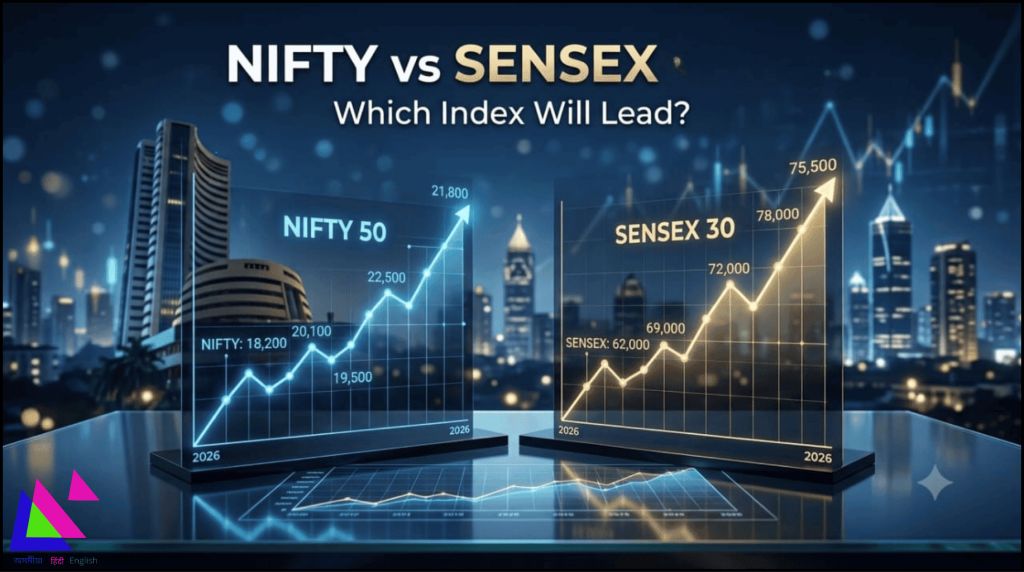
Nifty vs Sensex: Key Difference
| Feature | Nifty 50 | Sensex |
| Exchange | NSE | BSE |
| Companies | 50 | 30 |
| Coverage | Broader | More concentrated |
| Index Type | Large-cap | Large-cap |
Nifty tracks 50 companies, while Sensex tracks 30 major companies. Therefore, Nifty provides slightly broader exposure to India’s large-cap market.
Sector Exposure
Nifty has strong exposure to financial services, IT, oil and gas, automobiles and consumer companies. Sensex also has major exposure to banking, IT, energy, consumer and industrial stocks.
Because their sector weightings differ, Nifty vs Sensex can show different performance when a particular sector leads or weakens in the market.
2026 Performance
The Indian market has faced volatility in August 2026. On August 19, Nifty closed at 24,070.65, while Sensex ended at 76,991.33. Both indices declined as higher crude oil prices and global bond yields affected investor sentiment.
At the same time, corporate earnings have provided some support. Nifty 50 companies recorded average profit growth of 18% in the June 2026 quarter, according to Reuters.
What Can Drive Nifty in 2026?
- Strong corporate earnings
- Banking and credit growth
- Domestic consumption
- Infrastructure and capital spending
- Recovery in IT and technology demand
- What Can Drive Sensex in 2026?
- Growth in large banking companies
- Strong corporate earnings
- Consumer demand
- Infrastructure spending
- Performance of major energy and technology stocks
Valuation
Valuation will remain important for both indices. Investors should compare their P/E ratios with historical levels and expected earnings growth rather than looking at price movements alone.
A higher valuation can remain justified when earnings grow strongly, but disappointing results can put pressure on expensive stocks.
Key Risks
Both Nifty and Sensex face similar risks in 2026:
- High crude oil prices: Rising oil costs can increase inflationary pressure.
- Global interest rates: Higher rates can reduce foreign investment flows.
- Geopolitical tensions: Global conflicts can increase market volatility.
- Weak earnings: Slower profit growth can affect valuations.
- Foreign selling: Large FII outflows can pressure Indian equities.
- Nifty vs Sensex: Which Could Perform Better?
Which Is Better for Investors?
Investors seeking broader large-cap exposure may prefer Nifty-based index funds or ETFs. Those who prefer a concentrated portfolio of major companies can consider Sensex-based investments.
For long-term investors, consistency, diversification and investment horizon matter more than trying to predict the exact winner every year.
Conclusion
Nifty vs Sensex remains a useful comparison for investors in 2026. Nifty offers broader large-cap exposure, while Sensex provides a more concentrated basket of major companies. Strong earnings and domestic growth can support both, but global risks and crude prices may create volatility. Investors should focus on fundamentals and long-term goals rather than short-term predictions.
FAQs
1. Which is better, Nifty or Sensex?
Ans: Both are major Indian indices. Nifty offers 50 stocks, while Sensex tracks 30 companies.
2. Which has more companies?
Ans: Nifty has 50 companies, compared with 30 in Sensex.
3. Can Nifty outperform Sensex in 2026?
Ans: Yes, but future performance cannot be predicted with certainty.
4. What will affect both indices?
Ans: Earnings, crude prices, interest rates, foreign flows and economic growth will remain important.
5. Is Nifty or Sensex better for long-term investment?
Ans: Both can be suitable for long-term investors, depending on their investment goals, risk tolerance and preferred market exposure.
Disclaimer: This article is for informational purposes only and not investment advice. Market performance, valuations and forecasts can change. Investors should assess risks before investing.

Hi, I’m Dev Kirtonia, Founder & CEO of Dev Library. A website that provides all SCERT, NCERT 3 to 12, and BA, B.com, B.Sc, and Computer Science with Post Graduate Notes & Suggestions, Novel, eBooks, Biography, Quotes, Study Materials, and more.



 Buy Now