
NCERT Class 9 Social Science Chapter 7 Elections Solutions English Medium As Per New Syllabus. NCERT Class 9 Social Science Chapter 7 Elections Notes to each chapter is provided in the list so that you can easily browse throughout different chapter NCERT Class 9 Social Science Chapter 7 Elections Question Answer Download PDF and select needs one.
NCERT Class 9 Social Science Chapter 7 Elections
Also, you can read the CBSE book online in these sections Solutions by Expert Teachers as per (CBSE) Book guidelines. NCERT Class 9 Social Science Textual Solutions. These solutions are part of NCERT All Subject Solutions. Here we have given NCERT Class 9 Social Science Notes in English Medium Solutions for All Subject, You can practice these here.
Elections
Chapter – 7
| Part – I: Political Science |
| Textual Question Answer |
The Big Questions
1. Why are elections essential to a democratic system?
Ans: Elections are essential to a democratic system because they allow citizens to choose their representatives, exercise their right to vote, and participate in governance. They ensure that governments remain accountable to the people through regular and periodic elections. Elections also provide legitimacy to the government and promote representation, equality, and accountability in a democracy.
2. How do electoral systems and rules shape political representation and fairness?
Ans: Electoral systems determine how votes are converted into seats and who forms the government, while election laws regulate voter registration, candidate nominations, campaigning, voting, and dispute resolution. The Election Commission of India ensures that elections are free, fair, transparent, and inclusive, thereby promoting equal representation, fairness, and public confidence in the democratic process.
3. What role do institutions and laws play in ensuring free and fair elections?
Ans: Institutions such as the Election Commission of India (ECI) and laws like the Representation of the People Acts ensure that elections are conducted in a free, fair, transparent, and impartial manner. They regulate voter registration, candidate nominations, election campaigns, voting procedures, counting of votes, and the resolution of election disputes. They also prevent corrupt practices and protect the rights of voters, ensuring the integrity of the electoral process.
4. What challenges do elections face in practice, and how can these challenges affect democracy?
Ans: Elections may face challenges such as corrupt practices, vote-buying, misuse of religion or caste during campaigns, inaccurate voter lists, accessibility issues for voters, and unfair election practices. These challenges can reduce public trust, weaken the fairness and transparency of elections, and undermine democratic values by affecting equal participation and free choice.
LET’S EXPLORE
(A) Do you know what ETPBS is?
ETPBS stands for Electronically Transmitted Postal Ballot System. It enables service voters to cast their vote on an electronically received postal ballot from their preferred location, which is outside their originally assigned voting constituency.
Find out who are classified as service voters and who can vote using ETPBS?
Ans:
| Question | Answer |
| (i) What is ETPBS? | ETPBS stands for Electronically Transmitted Postal Ballot System. It allows eligible service voters to receive their postal ballot electronically and vote from their place of duty, even if they are away from their home constituency. |
| (ii) Who are classified as service voters and who can vote using ETPBS? | Service voters include: • Members of the Indian Armed Forces (Army, Navy, and Air Force). • Members of the Armed Police Forces of a State serving outside that State. • Government employees posted outside India. These eligible service voters can cast their vote using the ETPBS facility. |
LET’S MAP
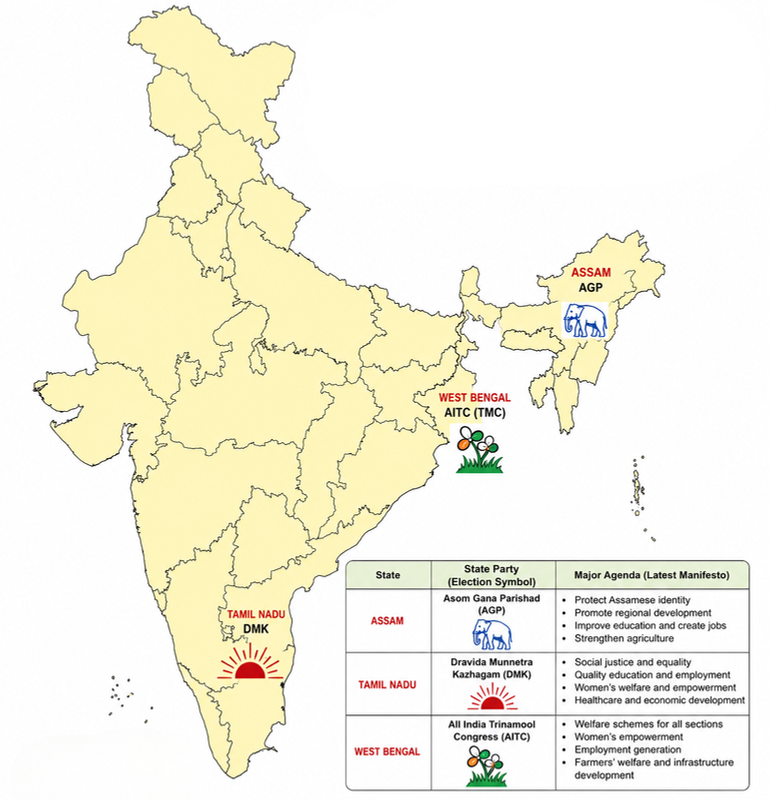
1. Choose any three states (including yours). Find the symbols of state parties belonging to those states and plot them on the given map of India. List down their major agenda, as mentioned in their manifesto in the latest Lok Sabha/Vidhan Sabha/Local Body Elections.
Questions and activities
1. What reforms have been introduced by the ECI to make voting more inclusive for the following groups?
(a) People with Disabilities.
Ans: (i) Saksham App helps PwDs in voter registration and locating polling stations.
(ii) EVMs with Braille enable visually impaired voters to cast their votes independently.
(iii) Home voting is available for PwDs with 40% benchmark disability.
(b) Service Voters.
Ans: (i) ETPBS (Electronically Transmitted Postal Ballot System) allows service voters to receive and cast postal ballots electronically from their place of posting outside their constituency.
(c) Senior Citizens—60 years and above; and 80 years and above.
Ans: (i) Senior citizens aged 85 years and above can vote from home.
(ii) The ECI has taken steps to make polling stations more accessible for senior citizens.
(d) Prisoners.
Ans: (i) Prisoners are not allowed to vote while they are in prison.
(ii) The exception is persons under preventive detention.
(e) Persons in preventive detention.
Ans: (i) Persons under preventive detention are allowed to vote.
(ii) They can cast their vote through the postal ballot facility.
2. What are the various functions of the Election Commission of India? Which of these functions is most important for the conduct of free and fair elections? Explain.
Ans: (i) It prepares and updates the electoral rolls.
(ii) It decides the schedule and dates of elections.
(iii) It registers political parties and allots election symbols.
(iv) It conducts elections in a free, fair, transparent, and inclusive manner.
(v) It supervises the counting of votes and declares election results.
Most Important Function:
(vi) Ensuring free and fair elections is the most important function because it protects the integrity of the electoral process, ensures equal opportunity for all candidates and voters, and strengthens public confidence in democracy.
3. Elections are the soul of a democracy. Do you agree? Why or why not?
Ans: (i) Yes, I agree that elections are the soul of democracy.
(ii) They allow citizens to choose their representatives.
(iii) They make the government accountable to the people.
(iv) They ensure peaceful transfer of power through the people’s mandate.
(v) They promote representation, equality, legitimacy, and accountability in a democratic system.
5. Why should you vote? Arrange the following in the descending order of your choice. Discuss the reasons for your choice.
Ans: (i) Strengthens democracy (d) – Voting helps maintain a strong and healthy democratic system.
(ii) Opportunity to choose my representative (a) – It allows citizens to elect leaders who will represent their interests.
(iii) Opportunity to change the non-performing representative (c) – Elections give people the power to replace ineffective representatives.
(iv) Makes me a responsible person (b) – Voting is a fundamental duty that encourages active participation in the democratic process.
6. What is the Special Intensive Revision (SIR) initiative of the ECI? Explain the objectives and the necessity of conducting SIR.
Ans:
(i) What is SIR?
⇛ Special Intensive Revision (SIR) is an initiative of the Election Commission of India (ECI) to update, verify, and correct the electoral rolls.
(ii) Objectives of SIR
⇛ To ensure that no eligible citizen is left out and no ineligible person is included in the electoral roll.
(iii) Necessity of SIR
⇛ It adds the names of new voters who have turned 18, removes the names of deceased, shifted, duplicate, or permanently untraceable voters, and ensures accurate and updated electoral rolls.
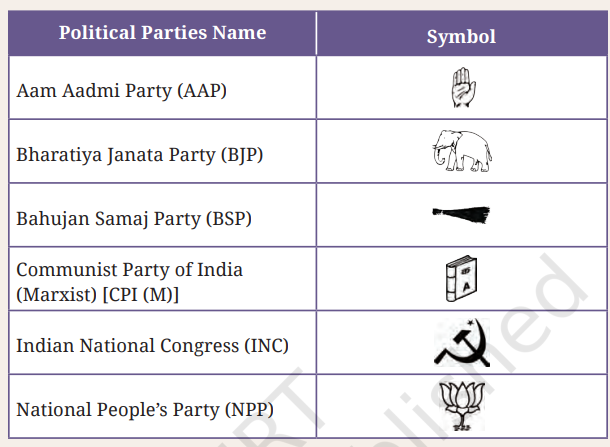
7. Match the political party name with its symbol.
Ans:
| Political Party Name | Correct Symbol |
| Aam Aadmi Party (AAP) | Broom (🧹) |
| Bharatiya Janata Party (BJP) | Lotus (🪷) |
| Bahujan Samaj Party (BSP) | Elephant (🐘) |
| Communist Party of India (Marxist) [CPI(M)] | Hammer, Sickle and Star (☭⭐) |
| Indian National Congress (INC) | Hand (✋) |
| National People’s Party (NPP) | Book (📖) |
8. Read the case study below and answer the following questions.
(a) What initiatives were taken by the ECI to enable the voters to cast their vote?
Ans: (i) Online voter registration through the ECI portal.
(ii) Wheelchair facility and volunteers for persons with disabilities.
(iii) VVPAT facility for verification of votes.
(iv) Home voting facility for senior citizens above 85 years.
(b) If Ishani was allowed to vote even without carrying her Voter ID card or Aadhaar card, which other document might she be carrying that is valid for voting?
Ans: (i) Passport.
(ii) Driving Licence.
(iii) PAN Card.
(iv) MNREGA Job Card.
(v) Passbook with photograph issued by a Bank or Post Office.
(c) Cite the examples of violations of the Model Code of Conduct.
Ans: (i) Wall writing.
(ii) Pasting campaign posters on public property without permission.
(d) Give a suitable title to the passage.
Ans: “A First-Time Voter’s Election Experience”.
(e) Find out how the police and army personnel cast their votes.
Ans: (i) Army personnel and other service voters cast their votes through the Electronically Transmitted Postal Ballot System (ETPBS).
(ii) Police personnel deployed on election duty may vote through the postal ballot or Election Duty Certificate (EDC), as permitted by the Election Commission.
9. A comparative chart of three countries is given below. Based on the information given in the chart, answer the questions.
| Dimension | Country A | Country B | Country C |
| Political Dimension | Written constitution, periodic elections, voting rights, party system varies from two-party to multi-party. | Written constitution, periodic elections, voting rights, one political party. | Written constitution, monarchy, no voting rights, no political party. |
| Economic Dimension | Average standard of living. | Above-average standard of living. | High standard of living. |
(a) What is the difference between having a voting right in a country with a multi-party system and another with a single-party system?
Ans: (i) In a multi-party system, voters can choose from different political parties and candidates.
(ii) In a single-party system, voters have limited choice because only one political party contests elections.
(b) In which of the above countries would you like to stay and why?
Ans: (i) I would like to stay in Country A.
(ii) It has a written constitution, periodic elections, voting rights, and a multi-party system, which provides citizens with greater political freedom and the opportunity to choose their representatives.
10. What are the challenges to conducting free and fair elections?
Ans: (i) Corrupt practices such as bribery and vote-buying.
(ii) Appealing to voters on the basis of religion, caste, race, community, or language.
(iii) Inaccurate or outdated electoral rolls.
(iv) Accessibility issues faced by persons with disabilities and senior citizens.
(v) Misuse of government machinery or influence during elections.
(vi) Lack of transparency and fairness in the electoral process can reduce public confidence in democracy.
11. On the Stage. Elections are to be held in your school for the posts of Head Girl, Head Boy, and Sports Captain. Assume the roles of an Election Commissioner, Returning Officer, Polling Agent, Candidate, Campaigner, Polling Officer, Police Personnel, and a Journalist, and perform their roles while ensuring free, fair, and transparent elections. 182 Understanding Society: India and Beyond Grade 9 – Part 1
Ans: Activity to be performed in the classroom.
12. Try and make videos or audios on topics like: My Vote My Nation; No Voter to be Left Behind; How to Eliminate the Ill of Money Power, etc.
Ans: Activity to be done by students.
13. Select one national or state political party. Using authentic and reliable sources such as the Election Commission of India (ECI) website, the official website of the selected political party, and newspapers. Prepare a comparative chart of the last two State Legislative Assembly elections. The chart should include the following details for the chosen party:
(a) Some promises made in the Election manifesto
(b) Percentage of votes polled
(c) Number of seats won
(d) Number of women who contested
(e) Number of women candidates elected Present the data for both elections in a clear and comparative format, citing all sources used.
Ans:
| Particulars | Assam Assembly Election 2021 | Assam Assembly Election 2016 |
| (a) Some promises in the Election Manifesto | Employment generation, women empowerment, infrastructure development, welfare schemes | Development, employment, anti-corruption, better roads and healthcare |
| (b) Percentage of votes polled | 33.21% | 29.51% |
| (c) Number of seats won | 60 | 60 |
| (d) Number of women who contested | 6 | 6 |
| (e) Number of women candidates elected | 4 | 3 |
14. Do you think ‘One Nation, One Election’ can improve the efficiency of the electoral process? Divide the class and discuss into two groups—one to examine its potential advantages and the other to analyse its limitations.
Ans: Group A – Potential Advantages
(i) Reduces the cost of conducting elections.
(ii) Saves time and administrative resources.
(iii) Reduces frequent disruption of governance due to elections.
(iv) Ensures better deployment of security forces and election staff.
(v) Allows governments to focus more on development activities.
Group B – Potential Limitations
(i) Simultaneous elections may reduce focus on state-specific issues.
(ii) Mid-term dissolution of a government may create constitutional challenges.
(iii) Managing elections across the entire country at one time is a huge logistical task.
(iv) Regional parties may receive less attention compared to national parties.
(v) Implementing the system would require major constitutional and legal changes.

 Buy Now