
NCERT Class 9 Skill Education Chapter 9 Personal and Lifestyle Services Solutions English Medium As Per New Syllabus. to each chapter is provided in the list so that you can easily browse through different chapters NCERT Class 9 Skill Education Chapter 9 Personal and Lifestyle Services Notes and select need one. NCERT Class 9 Skill Education Chapter 9 Personal and Lifestyle Services Question Answers Download PDF. NCERT Class 9 Skill Education Texbook Solutions.
NCERT Class 9 Skill Education Chapter 9 Personal and Lifestyle Services
Also, you can read the NCERT book online in these sections Solutions by Expert Teachers as per Central Board of Secondary Education (CBSE) Book guidelines. CBSE Class 9 Skill Education Textual Solutions in English Medium are part of All Subject Solutions. Here we have given NCERT Class 9 Skill Education Notes, CBSE Class 9 Skill Education in English Medium Textbook Solutions for All Chapters, You can practice these here.
Personal and Lifestyle Services
Chapter: 9
| TEXTUAL SOLUTIONS |
Observe a service in your neighbourhood
You must have observed services that people around you use daily, like a ration shop, anganwadi centre, milk booth, bus stop, village water point/handpump, local | Personal and Lifestyle Services 149 grocer or panchayat help point. Choose any one place that you pass by regularly on your way to school and record the following observations:
1. Name of the service observed.
Ans: Local Grocer Shop (Kirana Store)
2. How will you identify the service provider (for example, uniform, name plate, and where they are seated, etc.)?
Ans: The shopkeeper sits near the billing counter. He can be identified by the shop name board, weighing counter, and the apron he wears while working.
3. How is information communicated to the user (for example, labels, timings, tokens, and announcements, etc.)?
Ans: Information is communicated through price labels, product arrangement on shelves, verbal communication, and announcements about offers or new stock.
4. Which tools or materials are used (for example, weighing scale, register, phone, tokens, and vessels, etc.)?
Ans: The shop uses a weighing scale, calculator, mobile phone, register, carry bags, shelves, baskets, and barcode scanner.
5. What are the things that appear to make the users of the service happy? Justify your answer based on your observations.
Ans: Customers feel happy when the shopkeeper speaks politely, provides quick service, keeps the shop clean, and offers fresh products at reasonable prices. People also like that required items are easy to find and the waiting time is less.
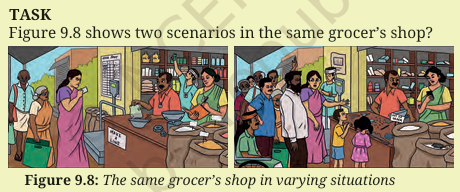
1. Identify three steps in the picture on the left that help the service move smoothly.
Ans: Three steps in the picture on the left that help the service move smoothly:
(i) Customers are standing in a proper queue.
(ii) Price list/information board is displayed clearly.
(iii) The shopkeeper is serving customers one by one calmly and systematically.
2. Identify three missing steps in the picture on the right that cause delay or confusion.
Ans: Three missing steps in the picture on the right that cause delay or confusion:
(i) There is no proper queue; people are crowding together.
(ii) Customers are pushing and talking at the same time, causing confusion.
(iii) There is no organised waiting system or token arrangement.
3. If you had to fix the process in the picture to the right with only one change, what would you choose? Why?
Ans: I would introduce a proper queue system. This would reduce crowding, confusion and arguments, and help the shopkeeper serve customers fairly and quickly.
9.8 Assess your learning
1. You read about several situations in the chapter. In your opinion, which actions (not words) showed a strong service orientation in these examples? Which of these actions would you like to practise while providing a service?
Ans: Actions that showed strong service orientation were helping flood victims respectfully, guiding visitors properly in the health camp, maintaining cleanliness during the Swachhta Abhiyan, and listening patiently to users’ needs. I would like to practise polite communication, teamwork, cleanliness, and helping people patiently while providing a service.
2. Imagine two service spaces – one clean, organised and welcoming, the other messy or confusing. In your view, how does the environment change the feelings and behaviour of persons using the service? Explain using an example from your school or neighbourhood.
Ans: A clean, organised and welcoming service space makes people feel comfortable, safe and happy. A messy or confusing place creates stress, irritation and confusion. For example, in my school library, books are arranged properly and silence is maintained, so students can study peacefully. If books were scattered everywhere, students would waste time and feel frustrated.
3. In your opinion, what adds value to service in a shop, for example, the range of materials, the physical arrangements, décor, interaction, labelling of shelves, etc.? Which actions (for example, clear instructions and polite communication) make the biggest difference in user experience?
Ans: Good arrangement of products, cleanliness, proper labelling, polite behaviour, quick service and reasonable prices add value to a shop. Clear instructions and polite communication make the biggest difference because customers feel respected and can easily find what they need.
4. Identify any two safety or hygiene measures you would ensure during a service provided in the school. Explain their importance.
Ans: (i) Keeping the service area clean and dry to prevent accidents and maintain hygiene.
(ii) Washing hands or using sanitiser before serving food or materials to prevent the spread of germs.
5. During a crowded event, some guests demand to be served first. How will you respond? Are there any actions you could have taken during the preparation stage to prevent this?
Ans: I would politely request the guests to follow the queue and explain that everyone will be served fairly. During preparation, token systems, proper announcements and separate counters could have been arranged to avoid confusion and overcrowding.
6. Imagine you are organising a cloth donation drive in your locality. A big hall is available for collection. Four volunteers are managing the drive and 60 donors are expected in a period of two hours. Plan the event; some guiding questions for the group to think about are given below:
i. How will you arrange the space for collection, sorting and packaging?
Ans: The hall would be divided into three sections — collection, sorting and packaging. Separate tables and labelled boxes would be kept for clothes for men, women and children.
ii. How will you assign roles?
Ans: Volunteer 1: Collect clothes
Volunteer 2: Register donors
Volunteer 3: Sort clothes
Volunteer 4: Package and arrange clothes
iii. What steps will ensure that the process is fast, fair and safe?
Ans: Maintain a queue system.
Keep the hall clean and organised.
Use labels and signs for guidance.
Ensure polite communication.
Provide drinking water and first aid if needed.
7. Every service ends with review and improvement. Imagine you have managed a cultural event in the community during Diwali. What feedback would you collect after the event, how would you collect it and what would you do with the feedback?
Ans: I would collect feedback about cleanliness, decorations, sound system, seating arrangements and overall enjoyment of the event. Feedback could be collected through short forms or verbal interaction. I would use the feedback to improve planning and arrangements for future events.
Subject Ka Complete Video Solution Dekhein
Step-by-step easy concept explanation aur full questions Answer ke liye watch karein ya app download karein:

 Buy Now