
NCERT Class 9 Skill Education Chapter 5 Shaping Materials Solutions English Medium As Per New Syllabus. to each chapter is provided in the list so that you can easily browse through different chapters NCERT Class 9 Skill Education Chapter 5 Shaping Materials Notes and select need one. NCERT Class 9 Skill Education Chapter 5 Shaping Materials Question Answers Download PDF. NCERT Class 9 Skill Education Texbook Solutions.
NCERT Class 9 Skill Education Chapter 5 Shaping Materials
Also, you can read the NCERT book online in these sections Solutions by Expert Teachers as per Central Board of Secondary Education (CBSE) Book guidelines. CBSE Class 9 Skill Education Textual Solutions in English Medium are part of All Subject Solutions. Here we have given NCERT Class 9 Skill Education Notes, CBSE Class 9 Skill Education in English Medium Textbook Solutions for All Chapters, You can practice these here.
Shaping Materials
Chapter: 5
| TEXTUAL SOLUTIONS |
Reading technical drawings
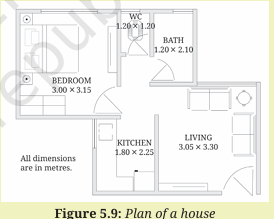
Look carefully at Figures 5.8 and 5.9 and answer the questions.
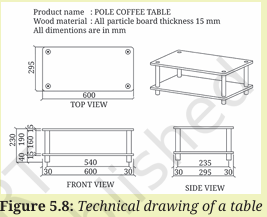
1. What is the total length and breadth of the object?
Ans: Total length = 600 mm
Total breadth = 295 mm
2. State the dimensions of the top of the object.
Ans: Top dimensions = 600 mm × 295 mm
3. How many legs does each table have and what is the length of each leg?
Ans: The table has 4 legs.
Length (height) of each leg = 180 mm
4. What is the distance between two legs?
Ans: Distance between front legs = 540 mm
Distance between side legs = 235 mm
Reading the plan of a house
1. What are the dimensions of the kitchen?
Ans: Kitchen = 1.80 m × 2.25 m
2. How many windows are there in the house?
Ans: There are 4 windows in the house.
3. How many doors are there in the house?
Ans: There are 5 doors in the house.
1. Exploring vocations around us
Look around you and answer the following questions:
a. What kind of work related to shaping materials do you observe around yourself? You can use different sources of information, for example, experts, site visits, libraries, online resources, specific government sites or reports.
Ans: Around us, we observe many kinds of work related to shaping materials such as:
(i) Carpentry (furniture making).
(ii) Construction work.
(iii) Tailoring and stitching
(iv) Pottery.
(v) Plumbing.
(vi) Welding and metal work.
(vii) Food processing.
(viii) Electrical fitting.
b. Briefly describe what the work involves? What are the inputs? What are the key processes and what are the outcomes?
Ans:
| Work | Inputs | Key Processes | Outcomes |
| Carpentry | Wood, nails, tools | Measuring, cutting, joining, polishing | Chairs, tables, furniture |
| Construction | Cement, bricks, sand, steel | Measuring, laying bricks, plastering | Buildings and houses |
| Tailoring | Fabric, thread, sewing machine | Measuring, cutting, stitching | Clothes and garments |
| Pottery | Clay, water, wheel | Moulding, shaping, firing | Pots and decorative items |
| Plumbing | Pipes, fittings, tools | Cutting, joining, fixing | Water supply systems |
2. Mapping resources Do you think it is possible for you to do the work in school? Table 5.7 below will help you decide.
Table 5.7: Mapping resource available to do work
| Work related to making products from materials | Will you be able to complete the work in the time allocated | Do you have adequate space to build structures (a wall)? | Have you identified an expert to help you? | Will you be able to collect the tools, materials and machines needed to complete the work? | Will you be able to do ‘real’ hands-on work? |
Ans:
| Work related to making products from materials | Will you be able to complete the work in the time allocated? | Do you have adequate space to build structures (a wall)? | Have you identified an expert to help you? | Will you be able to collect the tools, materials and machines needed to complete the work? | Will you be able to do ‘real’ hands-on work? |
| Carpentry | Yes | Yes | Yes | Yes | Yes |
| Tailoring | Yes | Yes | Yes | Yes | Yes |
| Pottery | Yes | No | Yes | Yes | Yes |
| Construction | No | No | Yes | No | Limited |
| Plumbing | Yes | Yes | Yes | Yes | Yes |
5.7 Assess your learning
1. You are given clay and wood to make a pen stand. Which one of the two (clay and wood) will you choose? Compare the characteristics and explain your decision.
Ans: would choose wood to make a pen stand because wood is strong, durable and long-lasting. It can hold weight properly and does not break easily. Clay is easy to mould into different shapes, but it becomes brittle after drying and may crack if it falls. Therefore, wood is more suitable for making a strong and durable pen stand.
2. Create a safety symbol to caution people about extremely hot surfaces. Think about the colour and image while you design it.
Ans: According to the safety signage guidelines, your symbol should primarily use the colour yellow, as yellow is the standardized colour used to indicate warnings and physical hazards.
For the design, we should use a triangle (which is commonly used for caution signs) and include a black visual graphic inside—such as stylized wavy heat lines radiating from a flat surface—to clearly communicate the risk of burns without needing words.
3. Your teacher gives you three objects to measure – a pipe’s inner diameter, a cloth length, and the length of the classroom. Which instrument will you use for each and why?
Ans: A pipe’s inner diameter: we should use vernier callipers. This tool has a very low least count (0.02 mm) and is specifically designed to measure the diameter or thickness of small objects with high precision.
A cloth length: You should use a metre tape. A metre tape is ideal for measuring objects up to a few metres long, can easily wrap around or lie flat on fabric, and has a least count of 1 mm, which is perfectly suited for measuring cloth.
The length of the classroom: we should use a distance metre or a surveyor’s tape. A surveyor’s tape is designed for measuring long distances (up to 100 metres), and a distance metre can measure long distances both quickly and accurately.
4. Your group made a wooden tray, but it looks uneven and does not stand flat. On the basis of the common steps of developing a product discussed in the chapter, identify what could be the cause of the error.
Ans: The wooden tray may look uneven because:
(i) Measurements were not taken correctly.
(ii) Wood pieces were cut in different sizes.
(iii) The corners were not joined properly.
(iv) The surface was not checked during assembly.
(v) Finishing and sanding were not done carefully.
Subject Ka Complete Video Solution Dekhein
Step-by-step easy concept explanation aur full questions Answer ke liye watch karein ya app download karein:

 Buy Now