
NCERT Class 9 Skill Education Chapter 7 Apparel Solutions English Medium As Per New Syllabus. to each chapter is provided in the list so that you can easily browse through different chapters NCERT Class 9 Skill Education Chapter 7 Apparel Notes and select need one. NCERT Class 9 Skill Education Chapter 7 Apparel Question Answers Download PDF. NCERT Class 9 Skill Education Texbook Solutions.
NCERT Class 9 Skill Education Chapter 7 Apparel
Also, you can read the NCERT book online in these sections Solutions by Expert Teachers as per Central Board of Secondary Education (CBSE) Book guidelines. CBSE Class 9 Skill Education Textual Solutions in English Medium are part of All Subject Solutions. Here we have given NCERT Class 9 Skill Education Notes, CBSE Class 9 Skill Education in English Medium Textbook Solutions for All Chapters, You can practice these here.
Apparel
Chapter: 7
| TEXTUAL SOLUTIONS |
CHECK YOUR UNDERSTANDING
Look at Figure 7.10 and answer the questions:
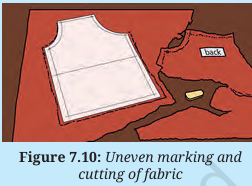
1. On the basis of what you learnt about marking and cutting of fabric, do you observe any errors in the figure?
Ans: Yes, there are some errors in the figure:
The paper pattern is placed unevenly on the fabric.
The fabric has been cut in a rough and zigzag manner instead of along straight marked lines.
Proper seam allowance has not been left.
Fabric wastage is also visible.
2. What problems may occur due to these errors?
Ans: Problems that may occur due to these errors:
The apparel may become uneven or ill-fitting.
Fabric may get wasted.
Stitching may become difficult.
The final product may look untidy and weak.
Pieces may not match properly during sewing.
3. What steps should be followed to correct these mistakes?
Ans: Steps to correct these mistakes:
Place the paper pattern straight along the length of the fabric.
Pin the pattern properly before marking.
Mark neatly using tailor’s chalk and leave 1–2 cm seam allowance.
Cut carefully on a flat surface following the marked lines.
Use long, smooth cuts with scissors.
4. State any two good practices for marking and cutting fabric. How will you apply these good practices in your work?
Ans: Two good practices for marking and cutting fabric:
(i) Keep the scissors parallel to the cutting surface and make long, smooth cuts.
(ii) Place the paper pattern carefully to reduce fabric wastage.
7.13 Assess your learning
1. Your task is to stitch a pajama set suitable for daily use. You can use cotton, polyester or a cotton-polyester, blend. Which fabric will you choose and why?
Ans: I would choose cotton fabric for stitching a pajama set because it is soft, breathable, comfortable, and suitable for daily wear. It absorbs sweat and feels comfortable in all seasons.
2. A learner takes measurements for (i) an apron and (ii) a dress while a person is wearing thick winter clothes. Explain how this may affect the final apparel and suggest steps for correction.
Ans: Taking measurements while a person is wearing thick winter clothing will result in inaccurate sizing because the extra bulk will be added to the measurements. As a result, the final apparel (whether an apron or a dress) will not fit properly and will likely be too loose. To correct this, you must ensure that the person is not wearing thick clothing when taking measurements. For accurate results, the person should stand straight and relaxed, and you should ensure the tailoring tape is kept neither too loose nor too tight.
3. How, in your experience of making an apparel, does preparing a paper pattern before cutting help reduce fabric wastage?
Ans: Preparing a paper pattern helps reduce fabric wastage because it allows you to trace the exact shape and size of the product onto paper first, helping you test the design and avoid mistakes before cutting the actual fabric. Additionally, when it is time to cut, you can strategically place the paper pattern on the fabric (for example, along the edges) to ensure minimum wastage.
4. Why is pre-washing and pressing fabric before cutting considered an essential step? What could happen if this step is skipped?
Ans: Pre-washing (and drying) fabric is an essential step, especially for natural fibres like cotton, linen, and rayon, because it ensures that any natural shrinkage happens before you cut and sew the material. Pressing the fabric with an iron is equally important because it removes wrinkles and creases, creating a smooth surface that allows for accurate marking and cutting. If this step is skipped, the fabric could shrink during its first wash after the garment is fully constructed, permanently ruining the fit. Additionally, cutting wrinkled fabric can lead to uneven, inaccurate shapes.
5. During stitching, a student notices uneven stitch length and that the stitching is loose. What problems could this cause during use and washing, and how can these issues be corrected?
Ans: Uneven and loose stitching can cause significant problems with both the appearance and the strength of the final product. If stitches are loose, particularly at the beginnings and ends of seams, the seam can easily open or come apart during regular use or washing. To correct these issues:
For loose stitches: Ensure consistent tension across all stitches so they are neither too tight nor too loose. Furthermore, always secure your stitching by making a few backstitches at the beginning and end of the seam to prevent the thread from coming undone.
For uneven stitch length: Sew at a steady pace to maintain control. If you sew too inconsistently, the fabric may slip (causing missed stitches) or gather and scrunch up.
Subject Ka Complete Video Solution Dekhein
Step-by-step easy concept explanation aur full questions Answer ke liye watch karein ya app download karein:


 Buy Now