
NCERT Class 9 Skill Education Chapter 2 Rooftop Gardening Solutions English Medium As Per New Syllabus. to each chapter is provided in the list so that you can easily browse through different chapters NCERT Class 9 Skill Education Chapter 2 Rooftop Gardening Notes and select need one. NCERT Class 9 Skill Education Chapter 2 Rooftop Gardening Question Answers Download PDF. NCERT Class 9 Skill Education Texbook Solutions.
NCERT Class 9 Skill Education Chapter 2 Rooftop Gardening
Also, you can read the NCERT book online in these sections Solutions by Expert Teachers as per Central Board of Secondary Education (CBSE) Book guidelines. CBSE Class 9 Skill Education Textual Solutions in English Medium are part of All Subject Solutions. Here we have given NCERT Class 9 Skill Education Notes, CBSE Class 9 Skill Education in English Medium Textbook Solutions for All Chapters, You can practice these here.
Rooftop Gardening
Chapter: 2
| TEXTUAL SOLUTIONS |
CHECK YOUR UNDERSTANDING
On the basis of Figures 2.3 and 2.4, answer the following questions:
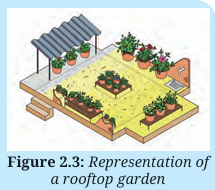
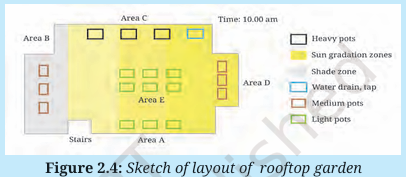
1. Why do you think some pots are placed in area B? Can you give examples of such plants from your geographic region?
Ans: Some pots are placed in Area B because Plants that require less sunlight or partial shade grow better in this area. This helps protect the plants from excessive heat and strong sunlight.
Examples of such plants are:
(i) Spinach.
(ii) Coriander.
(iii) Mint.
(iv) Lettuce.
(v) Ferns and ornamental plants
2. Do you think the pots placed in area C can be placed in area E? Why or why not?
Ans: No, the pots placed in Area C should not be placed in Area E because Area C receives more direct sunlight. Plants placed there are usually sun-loving plants such as tomatoes, chillies, and flowering plants.
Area E receives comparatively less sunlight. If the plants from Area C are shifted there, their growth and yield may reduce because they may not get enough sunlight.
3. If the number of plants is increased, which area of the rooftop garden should be expanded first and why?
Ans: If the number of plants increases, Area E should be expanded first because it is the central open area of the rooftop garden. It provides enough space for arranging additional pots while maintaining walking space for watering and maintenance.
4. Do you think the layout has enough space to accommodate all the plants? Can you imagine any other layout?
Ans: Yes, the layout appears well-organized and has enough space for the plants. The image clearly shows separate sunlight zones, shade zones, walking paths, and water drainage arrangements.
Another possible layout could include:
(i) Vertical gardening near the walls.
(ii) Hanging pots for herbs and flowers.
(iii) Separate sections for vegetables and ornamental plants.
(iv) Shade nets for delicate plants.
(v) Heavy pots near roof beams for safety.
Assess your learning
1. During a site visit, students notice that one rooftop garden uses grow bags, while another uses clay pots.
i. List one advantage and one disadvantage of each container.
Ans: Advantage and disadvantage of each container are:
Grow Bags:
Advantage: They are flexible and very easy to move around the garden.
Disadvantage: Because of their flexible nature, they do not offer the rigid structural support that hard pots do.
Clay Pots (Terracotta):
Advantage: They naturally allow air and moisture to pass through their walls, which is excellent for preventing waterlogging around the plant’s roots.
Disadvantage: They are heavy. Due to this weight, they cannot be placed just anywhere; they must be carefully positioned near the edges of the roof or directly over structural beams so they don’t overload the roof.
ii. Which one would you recommend for your school rooftop garden and why?
Ans: I would recommend Grow Bags for a school rooftop garden. because Since students will be working in the garden, grow bags are the safest and most practical choice because they are flexible and easy to move. They are much lighter than clay pots, which means students can handle them easily without physical strain, and they significantly reduce the overall heavy weight load on the school building’s roof.
2. You have prepared two potting mixes as follows:
i. Mix A: Soil + Compost + Cocopeat
Ans: Mix A is better for rooftop gardening because it is light, porous, and rich in nutrients. Compost provides essential nutrients for healthy plant growth, while cocopeat improves water retention and keeps the soil loose and airy. This allows proper air circulation to the roots and prevents waterlogging. As a result, plants grown in Mix A look healthier and the pots are lighter to carry.
ii. Mix B: Soil only After one month, plants grown in the Mix A potting mix look healthier and are lighter to carry, while plants in Mix B pot are heavy and waterlogged. Explain why Mix A is better for rooftop gardening.
Ans: Mix B contains only soil, which becomes heavy when watered. It holds excess water and reduces air spaces around the roots, causing waterlogging and poor drainage. This can damage roots and slow plant growth.
3. A group of students noticed their tomato plants turning yellow despite regular watering. Later, they found out that the pots were waterlogged due to blocked drainage holes.
i. What went wrong?
Ans: The mistake was that because the drainage holes were blocked, the excess water could not escape, leading to severe waterlogging inside the pots. When soil becomes waterlogged, the soil particles pack tightly together, which prevents air from reaching the plant’s roots. This lack of oxygen suffocate the roots and leads to root rotting, which is why the tomato plants became stressed and turned yellow despite regular watering.
ii. Suggest two preventive measures for the future.
Ans: Two preventive measures for the future are:
(i) Use a well-draining potting mixture: Instead of using ordinary garden soil that easily gets dense and compact, use a potting mix containing materials like cocopeat, compost, and perlite. This keeps the mixture loose and airy, ensuring better aeration for the roots and allowing excess water to drain out easily.
(ii) Place pots on stands or trays: Always place your pots on trays, tiles, or stands. This lifts the pot slightly off the floor, ensuring that the drainage holes at the bottom are never blocked and excess water can flow out completely.
4. A group of students harvests 5 kg of spinach, packs half in plastic bags and half in damp cloth. After two days, the spinach in a damp cloth is fresher.
i. Why did the spinach in a damp cloth stay fresh longer?
Ans: The spinach wrapped in a damp cloth stayed fresh longer because leafy vegetables require a cool, moist environment to prevent them from wilting. The clean, damp cloth provides this necessary moisture while still allowing the leaves to breathe.
ii. What lesson does this give about packaging?
Ans: The main lesson is that fresh produce requires proper aeration to survive. Packing vegetables in tight plastic bags with no air circulation traps excess moisture, which causes the produce to rot quickly. Therefore, packaging should always use breathable materials, ventilated boxes, or damp cloths to maintain freshness and extend the usable life of the harvest.
Subject Ka Complete Video Solution Dekhein
Step-by-step easy concept explanation aur full questions Answer ke liye watch karein ya app download karein:


 Buy Now