
NCERT Class 9 English Chapter 6 Twin Melodies Solutions As Per New Syllabus. to each chapter is provided in the list so that you can easily browse through different chapters NCERT Class 9 English Chapter 6 Twin Melodies Notes and select need one. NCERT Class 9 English Chapter 6 Twin Melodies Question Answers Download PDF. NCERT Class 9 English Kaveri Question Answer.
NCERT Class 9 English Chapter 6 Twin Melodies
Also, you can read the NCERT book online in these sections Solutions by Expert Teachers as per Central Board of Secondary Education (CBSE) Book guidelines. CBSE Class 9 English Kaveri Solutions are part of All Subject Solutions. Here we have given NCERT Solutions For Class 9 English Kaveri, CBSE Class 9 English Kaveri Notes for All Chapters, You can practice these here.
Twin Melodies
Chapter: 6
| Reflect and Respond |
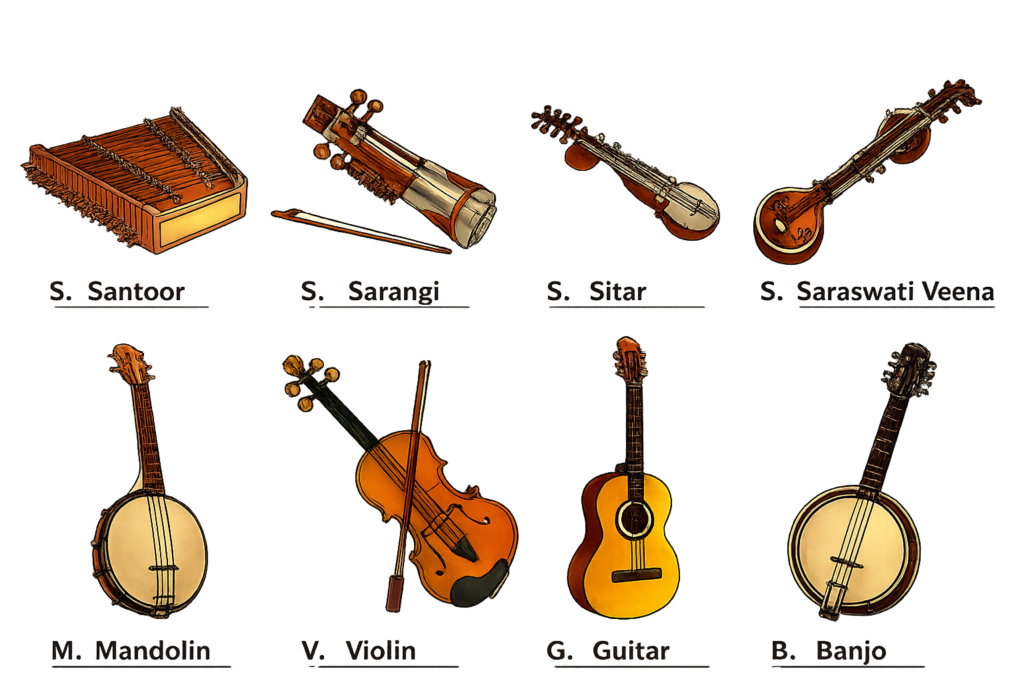
I. Given below are some stringed musical instruments. Work in pairs and identify them by first letter of the spellings of their names.
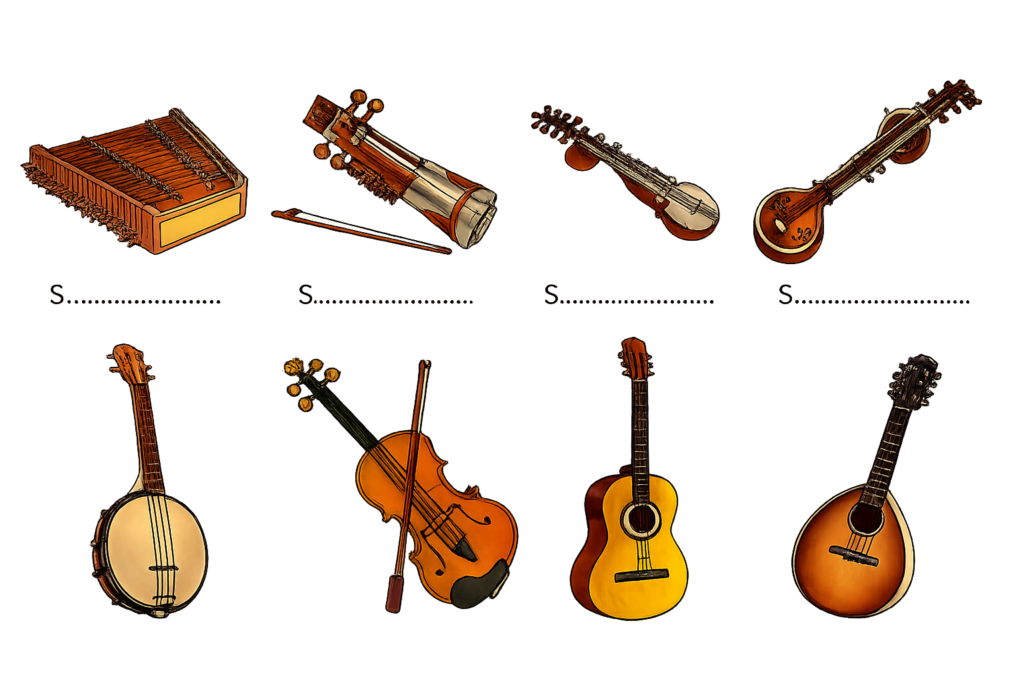
Ans:
II. Do you play a musical instrument? If given a choice, which one would you choose and why?
Ans: No, I do not play a musical instrument. If given a choice, I would choose the violin because it produces sweet and melodious music. I also like its versatility in both classical and modern music.
III. Is there any difference in the choice of music between children and elders? If yes, why? If no, why not?
Ans: Yes, there is a difference in the choice of music between children and elders. Children generally prefer modern, energetic, and fast-paced music, while elders often enjoy classical, devotional, or traditional music. This is because their tastes, experiences, and interests differ.
IV. Work in pairs to complete the paragraph given on the next page by choosing the correct phrases given in the box. Discuss with your teacher whether the following phrases have a literal meaning or a figurative one.
wearing a look of distress, bite the bullet, found words, lost in his thoughts, bring it up, throw a party, winding up, sweating on, come around,
The theatre club was 1. _______________________ their practice. Anil saw Sunny was 2. _______________________ and not speaking to anyone. They had a disagreement in the morning and since then, Sunny was 3. _______________________. Anil did not want to 4. _______________________ and disturb Sunny further but he finally decided to 5. _______________________ and speak to Sunny. He was sure if he apologised first, his friend would 6. _______________________. With a lot of anxiety, he 7. _______________________ to apologise. And finally, Sunny smiled! Everyone clapped and asked them to 8. _______________________ to celebrate.
Ans: The theatre club was (1) winding up their practice. Anil saw Sunny was (2) wearing a look of distress and not speaking to anyone. They had a disagreement in the morning and since then, Sunny was (3) lost in his thoughts. Anil did not want to (4) bring it up and disturb Sunny further but he finally decided to (5) found words and speak to Sunny. He was sure if he apologised first, his friend would (6) come around. With a lot of anxiety, he (7) bite the bullet to apologise. And finally, Sunny smiled! Everyone clapped and asked them to (8) throw a party to celebrate.
| Check Your Understanding |
I. Work in pairs. Identify the true statements. Check the answers with your teacher.
| No. | Statement | True / False |
| 1 | During the rehearsal, Shruti’s parents enter the room and are overjoyed at her performance. | _______ |
| 2 | Shruti initially considers telling her friends that she can’t join them for the performance, after practising one last time. | _______ |
| 3 | Shruti’s father expressed that she had sung a few notes incorrectly during her performance. | _______ |
| 4 | Shruti’s father had followed the family’s tradition of being a violinist and worked very hard to achieve all that he did. | _______ |
| 5 | Shruti’s mother helped her husband realise why he should support their daughter. | _______ |
| 6 | Shruti’s father accepts that he underrated the potential of classical music. | _______ |
Ans:
| No. | Statement | True / False |
| 1 | During the rehearsal, Shruti’s parents enter the room and are overjoyed at her performance. | True |
| 2 | Shruti initially considers telling her friends that she can’t join them for the performance, after practising one last time. | True |
| 3 | Shruti’s father expressed that she had sung a few notes incorrectly during her performance. | False |
| 4 | Shruti’s father had followed the family’s tradition of being a violinist and worked very hard to achieve all that he did. | False |
| 5 | Shruti’s mother helped her husband realise why he should support their daughter. | True |
| 6 | Shruti’s father accepts that he underrated the potential of classical music. | False |
| Critical Reflection |
I. Read the extracts given below and answer the questions that follow.
1. Shruti: There is need to worry Iqbal! You don’t know papa. He is very strict about these things. He will think it a desecration of the violin to be played to Western tunes. Papa firmly believes that Classical Hindustani music, with its ragas and aalaaps, is the only kind of music that an artist of any worth should play. I don’t want papa to feel that I don’t care about his opinions, because I do. It’s just that I want to give this a try too. I just don’t know how to tell him in the right way!
Iqbal: All ways are right ways, Shruti. He is your father, he will understand.
1. Shruti: There is need to worry Iqbal! You don’t know papa…
(i) Select the option that correctly identifies Shruti’s situation.
(A) Confident.
(B) Indifferent.
(C) Content.
(D) In a dilemma.
Ans: (D) In a dilemma.
(ii) What does Shruti mean by ‘the right way’, in the sentence, “I just don’t know how to tell him in the right way!”?
Ans: Shruti means that she wants to explain her feelings to her father politely and carefully so that he understands her without getting angry.
(iii) Complete the following with a suitable reason.
We can say that the extract reflects the generational gap in understanding art and tradition because ____________.
Ans: We can say that the extract reflects the generational gap in understanding art and tradition because Shruti prefers modern fusion music while her father strongly believes only classical Hindustani music should be performed.
(iv) Explain how Iqbal’s words were meant as an assurance to Shruti.
Ans: Iqbal tried to comfort Shruti by telling her that her father would understand her feelings because he loved her.
(v) Fill in the blank with a phrase from the extract.
The critics argued that only films which provoke thoughtful discussion are _________.
Ans: The critics argued that only films which provoke thoughtful discussion are of any worth.
2. Nabin: I underestimated the power of our own music…
(i) Select the suitable option to complete the sentence.
Nabin’s breakthrough in his understanding of artistic freedom, highlights a bridge between ______.
(A) Personal ambition and professional success.
(B) Traditional values and modern expressions.
(C) Strict discipline and casual learning.
(D) Historical techniques and futuristic innovations.
Ans: (B) Traditional values and modern expressions.
(ii) Fill in the blank with a suitable phrase.
The extract uses the word ‘lost’ both in the sense of losing _________ and physical separation.
Ans: The extract uses the word ‘lost’ both in the sense of losing emotional connection and physical separation.
(iii) In the line, ‘Shruti hugs her parents’, which word from those given below, does not show what it conveys?
reconciliation, harmony, duty, acceptance, understanding.
Ans: Duty.
(iv) What can be inferred about Shruti’s future in music following her father’s expression of trust and support?
Ans: Iqbal tried to comfort and encourage Shruti by telling her that her father loved her and would eventually understand her feelings and choices.
(v) Identify the phrase that refers to the uniqueness of each artist’s journey and style.
Ans: The critics argued that only films which provoke thoughtful discussion are of any worth.
II. Answer the following questions.
1. Justify the title ‘Twin Melodies’. How does the play explore the theme of tradition and modernity?
Ans: The title Twin Melodies is suitable because the play presents two different styles of music—Classical Hindustani music and Indo-Western fusion music. These two “melodies” finally come together in harmony. The play explores the theme of tradition and modernity through the conflict between Shruti’s passion for fusion music and her father Nabin’s strong belief in classical music. In the end, mutual understanding and respect unite both viewpoints.
2. What are the different perspectives of Peter, Iqbal, and Avinash regarding confronting figures of authority? How do their attitudes towards Shruti’s dilemma with her father provide insight into their own characters and values?
Ans: Peter, Iqbal, and Avinash encourage Shruti to speak honestly with her father. Peter gives practical advice and supports open communication. Iqbal remains optimistic and assures Shruti that her father will understand her feelings. Avinash believes problems should be faced directly, even if it leads to scolding. Their attitudes show that they value courage, honesty, friendship, and understanding.
3. Analyse the character of Nabin Sharma. How does his attitude towards music evolve throughout the play?
Ans: Nabin Sharma is shown as a strict and disciplined classical musician who strongly believes in traditional Hindustani music. At first, he disapproves of fusion music and refuses to support Shruti’s participation in the concert. However, after attending the rehearsal and hearing the performance, he realises the strength and beauty of fusion music. He remembers his own struggles in choosing the violin against family traditions and becomes more open-minded and supportive of Shruti.
4. How does the play use Shruti’s internal conflict to explore the theme of duty towards family versus personal passion?
Ans: Shruti deeply respects her father and values his opinions, but she also wishes to follow her passion for fusion music. She feels confused and worried because she does not want to hurt her father while also wanting to pursue her dream. Through Shruti’s emotional struggle, the play highlights the challenge of balancing family expectations with personal interests and ambitions.
5. Evaluate the effectiveness of the play’s conclusion. Does it realistically address the conflicts presented?
Ans: Yes, the conclusion is effective and realistic. The misunderstandings between Shruti and her father are resolved through communication, understanding, and emotional support. Nabin’s change in attitude feels natural because he reflects on his own past experiences. The ending gives a positive message that different opinions can be accepted through love and mutual respect.
6. Assess how well the role of cultural diversity contributes to the storyline of the play.
Ans: Cultural diversity plays an important role in the play. The fusion group combines Indian classical music with Western musical styles, creating both conflict and harmony in the story. Different musical traditions and viewpoints help develop the main theme of tradition and modernity. The play shows that cultural diversity can enrich art and bring people together when there is understanding and respect.
| A Friend Found in Music |
| Reflect and Respond |
I. Read the questions given below and share your answers with your classmates and teacher.
1. What kind of music do you prefer to listen to—vocal or instrumental?
Ans: I prefer to listen to both vocal and instrumental music.
2. Name your favourite musician(s).
Ans: My favourite musicians are Arijit Singh, Lata Mangeshkar, and Shreya Ghoshal.
3. Give reasons for your choice.
Ans: I like them because their songs are melodious, emotional, and relaxing. Arijit Singh’s songs touch the heart, Lata Mangeshkar’s voice is sweet and timeless, and Shreya Ghoshal sings beautifully with great expression.
| Check Your Understanding |
I. Read the poem again to complete the poet’s diary about her feelings on music. Fill in the blanks with words from the poem.
Today, I’ve been thinking about how essential music is to me. It is like an ocean that calls me to its 1. ____. Music is the 2. _____ that harmonises with my 3. _____, moving me in ways I can’t explain. When I feel sad or upset about things, music is the 4. _____ that eases the ache. It is amazing how music has the power to lift my 5. ____, and give me strength to pull through difficult times. I know that it is the effect of music whenever I feel 6. ____. Music is the much 7. _______, dependable friend when there is no one to 8. ______. Thank you, my dear music, for being my all-time comfort.
Ans: Today, I’ve been thinking about how essential music is to me. It is like an ocean that calls me to its (1) shore. Music is the (2) rhythm that harmonises with my (3) core, moving me in ways I can’t explain. When I feel sad or upset about things, music is the (4) therapy that eases the ache. It is amazing how music has the power to lift my (5) spirits, and give me strength to pull through difficult times. I know that it is the effect of music whenever I feel (6) cheerful. Music is the much (7) needed, dependable friend when there is no one to (8) care. Thank you, my dear music, for being my all-time comfort.
II. Let us appreciate the poem.
1. The phrase ‘moves me’ in the line ‘That moves me to the core,’ is an example of _____________.
Ans: The phrase ‘moves me’ in the line ‘That moves me to the core,’ is an example of personification.
2. The poet uses metaphors for music. List these metaphors and rewrite them as similes. For example, Music is as ___________ as __________.
Ans: Metaphors and similes:
Music is as vast as an ocean.
Music is as soothing as a therapy.
Music is as caring as a friend.
3. What is the rhyme scheme of the poem? What impact does it have?
Ans: The rhyme scheme of the poem is ABAB CDCD EFEF. This rhyme scheme gives the poem a smooth, musical, and rhythmic flow. It makes the poem pleasant to read and helps express the poet’s deep emotions about music effectively.
4. What is the poet’s purpose in using the word ‘music’ repetitively?
Ans: The poet uses the word “music” repetitively to emphasise its importance in her life. It shows her deep love, dependence, and emotional connection with music.
5. What is the message the poet wishes to convey through the poem?
Ans: The poet wishes to convey that music is a true friend and a source of comfort, happiness, strength, and support during both joyful and difficult times.
6. Identify the mood of the poem from the options given below.
(i) Nostalgic.
(ii) Thoughtful.
(iii) Amused.
(iv) Playful.
Ans: (ii) Thoughtful.
7. Give evidence from the poem to support that the speaker is the poet herself.
Ans: The speaker is the poet herself because she uses personal expressions such as “I need,” “I feel blue,” “lifts my spirits,” and “I’m most cheerful,” which show her own feelings and experiences with music
Subject Ka Complete Video Solution Dekhein
Step-by-step easy concept explanation aur full questions Answer ke liye watch karein ya app download karein:



 Buy Now