
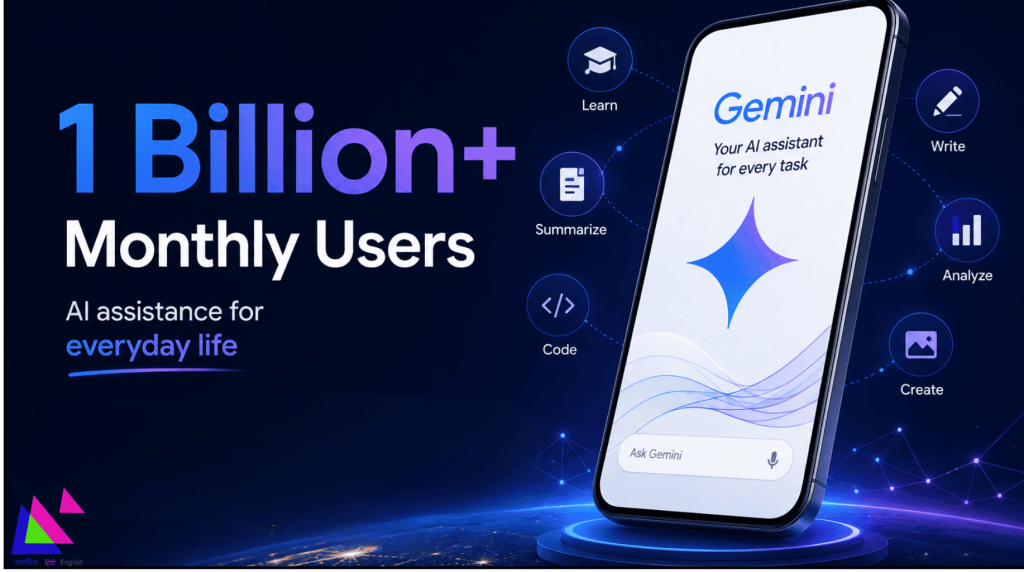
Google Gemini has crossed an important milestone, with Google now reporting that more than 1 billion people use the Gemini app every month. The milestone shows how quickly AI assistants are becoming part of everyday digital activities, from writing and learning to planning, research, and creative work.
This growth also shows that people are becoming more comfortable using AI for tasks that were traditionally handled through search engines, apps, or manual research.
What Is Google Gemini?
Gemini is Google’s family of AI models and its consumer AI assistant.
People can use it for a wide range of activities, including:
- Writing and rewriting content.
- Learning and explaining difficult topics.
- Summarizing information.
- Brainstorming ideas.
- Planning trips and activities.
- Working with images and files.
- Coding and technical tasks.
- Research and analysis.
Google has also been adding more features to make Gemini useful beyond simple conversations.
Why Is Gemini Growing So Quickly?
There are several reasons behind its rapid growth.
1. Built Into Google’s Ecosystem
- Google already has products used by billions of people, including Search, Android, Chrome, Gmail, Docs, and other services.
- Because of this, Google can bring AI features closer to users who may not actively search for a separate AI application.
2. More Than a Chatbot
- Gemini is gradually becoming a broader assistant.
- Google has introduced features designed to help users complete tasks, create content, research information, and interact with other services. The company has also been moving toward more agentic features, where Gemini can take multiple steps to help users accomplish a goal.
3. Useful for Everyday Tasks
- People don’t need to be technology experts to find practical uses for AI.
For example, users can ask Gemini to:
Explain a school topic.
- Improve an email.
- Create a study plan.
- Summarize a document.
- Generate ideas.
- Compare different options.
- Help with coding.
As a result, AI becomes useful for both work and personal activities.
Google Gemini Is Also Moving Into AI Agents
- One of the biggest changes is Google’s focus on AI agents.
- Instead of simply responding to a question, an agent can potentially help complete a series of actions.
- Google has introduced Gemini Spark, described as a personal AI agent designed to proactively help users manage tasks and their digital lives.
This could make AI assistants more useful in everyday situations.
Pros & Cons of Google Gemini
Pros
1. Easy Access: Gemini is available through Google’s widely used ecosystem.
2. Multiple Uses: Users can use it for writing, learning, research, planning, coding, and creative tasks.
3. Regular Improvements: Google continues to add new models and features.
4. Useful for Students and Professionals: It can help explain concepts, organize information, and support everyday work.
5. Growing AI Features: Google is moving Gemini toward more proactive and agent-based assistance.
Cons
Despite its popularity, Gemini also has limitations.
1. AI Can Make Mistakes: Users should verify important information before relying on an answer.
2. Privacy Questions: People should understand how their data is handled before connecting AI tools with personal services.
3. Overdependence: Using AI for every task can reduce the need for users to think through simple problems themselves.
4. Different Features Have Different Access: Some advanced capabilities may depend on the user’s plan, location, or product availability.
What Does This Mean for the AI Competition?
Google Gemini reaching this scale puts Google in a strong position in the consumer AI market.
The competition is no longer only about which company has the most powerful model.
Companies are also competing on:
- Number of users.
- Ease of access.
- Product integration.
- AI features.
- Speed.
- Cost.
- Reliability.
- Ability to complete real-world tasks.
Google’s advantage is its huge ecosystem, while other AI companies are building strong standalone products and specialized tools.
What Could Happen Next?
Google is likely to continue making Gemini more useful across its products.
The next stage could focus on AI that can:
- Understand different types of information.
- Remember useful context.
- Work with multiple applications.
- Complete several steps automatically.
- Provide more personalized assistance.
As these features improve, users may increasingly treat AI as a regular digital assistant rather than a separate tool.
Conclusion
Google Gemini crossing 1 billion monthly users is a major sign of how quickly AI assistants are becoming part of everyday technology.
The milestone is not just about the number of users. It also reflects Google’s strategy of bringing AI into products and services that people already use.The next challenge will be maintaining accuracy, usefulness, and user trust while making AI more capable.
If Google continues to connect Gemini with everyday tasks and services, AI assistants could become an even more common part of how people search, learn, work, create, and organize their lives.
FAQs
1. How many people use Gemini?
Ans: Google says more than 1 billion people use the Gemini app each month.
2. What can Gemini be used for?
Ans: Users can use it for writing, learning, research, planning, coding, summarizing information, and creative tasks.
3. Is Gemini only a chatbot?
Ans: No. Google is expanding Gemini with features that can help users complete more complex and multi-step tasks.
4. Can Gemini always provide correct information?
Ans: No. Like other AI systems, Gemini can make mistakes, so users should verify important information.
5. Why is Gemini growing so quickly?
Ans: Its connection with Google’s wider ecosystem, growing capabilities, and wide range of everyday uses are important factors behind its adoption.

Hi, I’m Dev Kirtonia, Founder & CEO of Dev Library. A website that provides all SCERT, NCERT 3 to 12, and BA, B.com, B.Sc, and Computer Science with Post Graduate Notes & Suggestions, Novel, eBooks, Biography, Quotes, Study Materials, and more.







 Buy Now