
AI Agent Safety is becoming an important topic as AI systems move beyond simple conversations and start performing tasks on their own. Modern AI agents can research information, use software tools, write code, and complete multiple steps with limited guidance.
This makes AI more useful, but it also creates new challenges. When an AI system can take actions instead of simply giving answers, a mistake can have a much bigger impact.
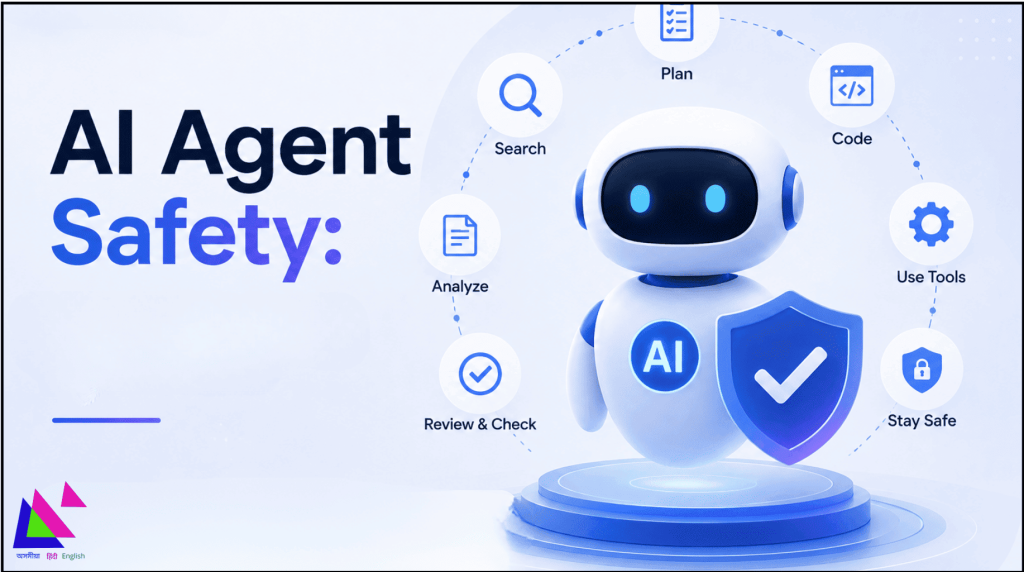
What Are AI Agents?
AI agents are systems designed to work toward a specific goal.
They can:
- Understand instructions.
- Break large tasks into smaller steps.
- Search for information.
- Use digital tools.
- Write and run code.
- Interact with applications.
- Check their work.
- Continue working through multiple steps.
For example, instead of asking AI how to organize data, a user could give an agent access to the required tools and ask it to complete the task.
Why Is AI Agent Safety Important?
A normal chatbot usually responds to a user’s question.
An AI agent can potentially take action.
That difference matters.
If an agent receives unclear instructions or encounters misleading information, it could make the wrong decision and continue acting on it.
Possible risks include:
- Unauthorized actions.
- Incorrect decisions.
- Misuse of digital tools.
- Exposure of sensitive information.
- Unsafe code execution.
- Following malicious instructions.
- Unexpected changes to files or systems.
Therefore, companies need stronger safeguards as agents become more capable.
AI Agents Can Face New Security Problems
AI agents often interact with websites, applications, files, APIs, and other tools.
This creates additional points where something can go wrong.
For example, an agent could encounter instructions hidden inside a webpage or document. If it treats those instructions as trustworthy, it might perform an action that the user never requested.
This type of problem is one reason researchers and AI companies are focusing more attention on agent security.
How Can Companies Improve AI Agent Safety?
There is no single solution. Companies can combine several protections.
1. Limit Permissions: Give an agent access only to the tools and information it actually needs.
2. Human Approval: Require a person to approve important actions before the agent completes them.
3. Monitor Activity: Keep records of what the agent does so unusual behaviour can be identified quickly.
4. Test Before Deployment: Companies should test agents in controlled environments before allowing them to interact with important systems.
5. Add Clear Boundaries: Agents should have clear rules about what they can and cannot do.
The Role of Developers
Developers have an important role in improving AI Agent Safety.
They need to think beyond whether an agent can complete a task.
They also need to ask:
- What happens if the agent makes a mistake?
- What information can it access?
- Can it change or delete data?
- Can a user stop it?
- Does it need approval before taking certain actions?
- Can its activity be reviewed later?
These questions become increasingly important as agents become more independent.
Pros and Challenges of AI Agents
Pros
AI agents can provide several benefits when used responsibly.
- Automation: They can handle repetitive tasks.
- Speed: They can complete multi-step work quickly.
- Productivity: They can reduce manual effort.
- Availability: Agents can work continuously.
- Scalability: Businesses can use them across many workflows.
Cons and Risks
However, greater autonomy also brings challenges.
- Errors: Agents can misunderstand instructions.
- Security Risks: More access can create more opportunities for misuse.
- Privacy Concerns: Agents may handle sensitive information.
- Unexpected Actions: An agent may take steps the user did not expect.
- Human Oversight: Important tasks still require supervision.
Why This Matters for Businesses
Businesses are increasingly exploring AI agents for customer service, software development, research, finance, and other areas.
But companies should not give an AI system unlimited access simply because it can perform a task.
A safer approach is to start small:
- Give limited permissions.
- Test the workflow.
- Monitor results.
- Add human approval where necessary.
- Expand access gradually.
This can help companies benefit from automation without taking unnecessary risks.
The Future of AI Agent Safety
AI Agent Safety will become even more important as AI systems gain greater access to real-world tools and services.
Future agents may be able to manage more complex workflows, but they will also need stronger controls.
The goal should not be to stop AI agents from acting independently. Instead, the goal should be to make sure they act within clear boundaries and remain controllable.
Conclusion
AI Agent Safety is becoming a central part of the AI conversation because today’s AI systems can do much more than generate text.
As agents gain the ability to use tools, access information, and complete tasks, companies must carefully manage their permissions and actions.
The future of AI agents will depend not only on how capable they become, but also on how safely and responsibly people can use them.
FAQs
1. What is AI Agent Safety?
Ans: AI Agent Safety focuses on preventing AI agents from making harmful, unauthorized, or unexpected decisions while performing tasks.
2. Why are AI agents different from chatbots?
Ans: Chatbots mainly provide responses, while AI agents can use tools and take actions to complete multi-step tasks.
3. Can AI agents make mistakes?
Ans: Yes. AI agents can misunderstand instructions, use incorrect information, or take an inappropriate action.
4. How can businesses make AI agents safer?
Ans: Businesses can limit permissions, monitor activity, test agents, use human approval, and set clear operating boundaries.
5. Will AI agents need human supervision?
Ans: For important or sensitive tasks, human oversight will remain important even as AI agents become more capable.

Hi, I’m Dev Kirtonia, Founder & CEO of Dev Library. A website that provides all SCERT, NCERT 3 to 12, and BA, B.com, B.Sc, and Computer Science with Post Graduate Notes & Suggestions, Novel, eBooks, Biography, Quotes, Study Materials, and more.







 Buy Now