
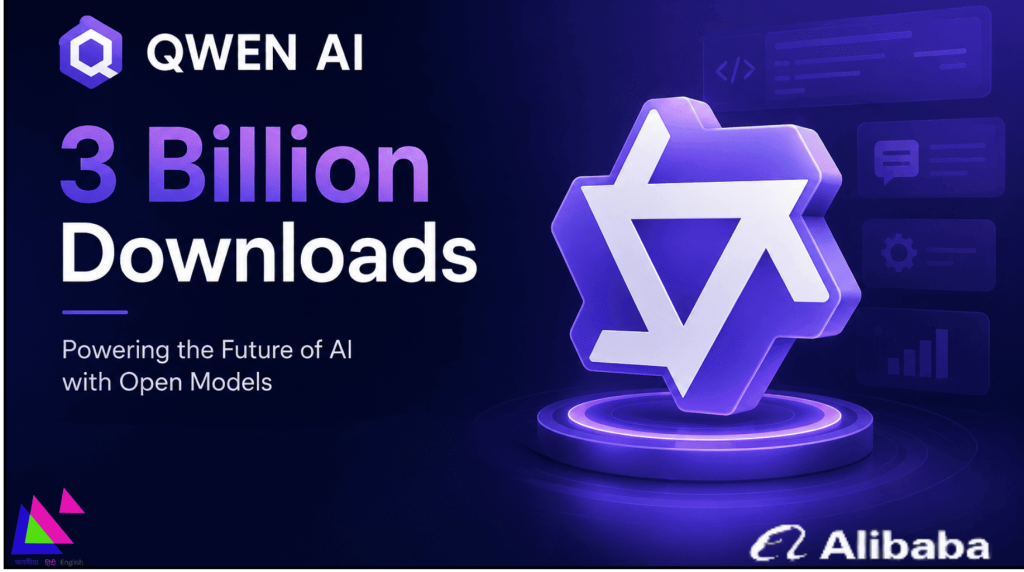
Qwen AI is gaining strong attention in the global AI market. Alibaba says its open-weight models have crossed 3 billion downloads in the past six months. The company also says its Qwen ecosystem now includes more than 460 open models and over 300,000 derivative models.
This growth shows that developers are increasingly interested in AI models they can download, customize, and use for different projects.
What Is Qwen AI?
Qwen is Alibaba’s family of AI models designed for different types of tasks.
It can be used for:
- Coding and software development.
- Writing and content generation.
- Reasoning and problem-solving.
- Research and information processing.
- Business applications.
- Building customized AI tools.
Instead of offering only one model, Alibaba has created a wider ecosystem with models designed for different requirements.
Why Are Developers Choosing Open Models?
Open-weight models can give developers more control over how they use AI.
Some key reasons are:
- Customization: Developers can adapt models for specific needs.
- Flexibility: They can choose how and where to deploy the model.
- Experimentation: Developers can test different versions and configurations.
- Cost Control: Some businesses can reduce dependence on expensive AI services.
- Privacy: Running models in controlled environments can offer more control over sensitive data.
However, the actual benefits depend on the model, hardware, license, and how a company deploys it.
Why Do 3 Billion Downloads Matter?
The 3 billion downloads figure is significant, but it should not be confused with 3 billion individual users.
Downloads can include:
- Different model versions.
- Model files.
- Customized versions.
- Derivative models.
Even so, the number shows the scale of developer interest in Alibaba’s AI ecosystem. Alibaba says Qwen has become the world’s most-downloaded open AI model family by cumulative downloads.
Qwen’s Growing Model Ecosystem
Alibaba is expanding Qwen beyond a single AI model.
The ecosystem includes:
- Large general-purpose models.
- Smaller models.
- Coding-focused models.
- Reasoning models.
- Models designed for specific applications.
- Derivative models created by developers.
Alibaba also introduced Qwen3-Max earlier in August 2026, describing it as its largest and most capable model at the time.
Pros & Cons of Qwen AI
Pros
1. More Developer Flexibility: Developers can experiment with models and build customized applications.
2. Wide Model Selection: Different model sizes and capabilities can suit different projects.
3. Growing Community: The large number of downloads and derivative models shows strong developer interest.
4. Useful for Different Industries: Companies can explore applications in software, business, research, customer service, and other areas.
5. More Competition: Strong open models give developers alternatives to closed AI platforms.
Cons
1. Hardware Requirements: Running larger models locally can require powerful and expensive hardware.
2. Technical Knowledge: Businesses may need skilled developers to deploy and maintain the models.
3. Licensing Differences: Open-weight does not mean every model has the same usage rights. Businesses must check the specific license.
4. Maintenance: Companies using their own deployment may need to handle updates, security, and infrastructure themselves.
5. Not Always the Best Choice: A model’s performance depends on the specific task. Developers should compare different models before choosing one.
Why Does This Matter for Businesses?
Businesses don’t always need the biggest AI model.
They may prefer a smaller model that can handle a specific task efficiently.
Possible business uses include:
- Customer support.
- Document processing.
- Data analysis.
- Coding assistance.
- Internal knowledge tools.
- Research.
- Content generation.
As a result, open-weight models can give companies more choices when building AI-powered products.
What Does This Mean for the AI Market?
The growth of Qwen AI shows that the AI competition is no longer limited to a few major chatbot platforms.
Companies such as Alibaba, Meta, Google, and others are developing models that developers can access and build around.
This competition could lead to:
- More affordable AI tools.
- More model choices.
- Faster innovation.
- Better customization.
- More AI applications for businesses.
Conclusion
Qwen AI crossing 3 billion downloads is an important development in the open AI model market. The number does not represent 3 billion users, but it does show significant interest from developers around the world.
Alibaba’s growing model ecosystem also shows how quickly open-weight AI is developing.For developers and businesses, the biggest benefit is choice. They can compare different models and select one that fits their budget, technical requirements, and specific use case.The next stage of the AI race may therefore depend not only on who builds the most powerful model, but also on which models developers actually choose to build with.
FAQs
1. What is Qwen AI?
Ans: Qwen AI is Alibaba’s family of AI models designed for coding, reasoning, writing, research, and other applications.
2. Has Qwen really crossed 3 billion downloads?
Ans: Yes. Alibaba says its open-weight Qwen models crossed 3 billion global downloads in the past six months.
3. Does 3 billion downloads mean 3 billion users?
Ans: No. Downloads can include different model versions, files, and derivative models.
4. Are Qwen models free to use?
Ans: Availability and usage rights depend on the specific model and its license. Developers should check the applicable terms before commercial use.
5. Why are open AI models becoming popular?
Ans: They can give developers more flexibility, customization options, and control over how they build and deploy AI applications.

Hi, I’m Dev Kirtonia, Founder & CEO of Dev Library. A website that provides all SCERT, NCERT 3 to 12, and BA, B.com, B.Sc, and Computer Science with Post Graduate Notes & Suggestions, Novel, eBooks, Biography, Quotes, Study Materials, and more.







 Buy Now