
In today’s dynamic business environment, information plays a vital role in decision-making. One of the most important sources of financial information for any organisation is accounting information. Accounting information provides systematic, accurate, and timely data about the financial performance and position of a business. It helps various stakeholders such as management, investors, creditors, government, and employees to make informed decisions.


The effective use of accounting information is essential for planning, controlling, and evaluating business activities. This article explains the meaning of accounting information, its users, objectives, types, uses, limitations, and its role in managerial decision-making.
Meaning of Accounting Information
Accounting information refers to financial data processed through the accounting system and presented in a meaningful form, such as financial statements, reports, and ratios. It includes information related to income, expenses, assets, liabilities, profits, losses, and cash flows of a business.
In simple words, accounting information tells:
- How much profit or loss a business has made
- What assets and liabilities it owns
- How efficiently resources are being used
This information is generated through the accounting process, which includes recording, classifying, summarising, and interpreting financial transactions.
Objectives of Accounting Information
The main objectives of accounting information are as follows:
- To Provide Financial Information
It supplies reliable data about the financial position and performance of a business. - To Assist Decision-Making
It helps management and other users take sound economic decisions. - To Measure Profit or Loss
Accounting information determines the net result of business operations. - To Show Financial Position
It reveals the financial strength and solvency of the business. - To Ensure Accountability
It helps in evaluating how effectively management has used business resources.
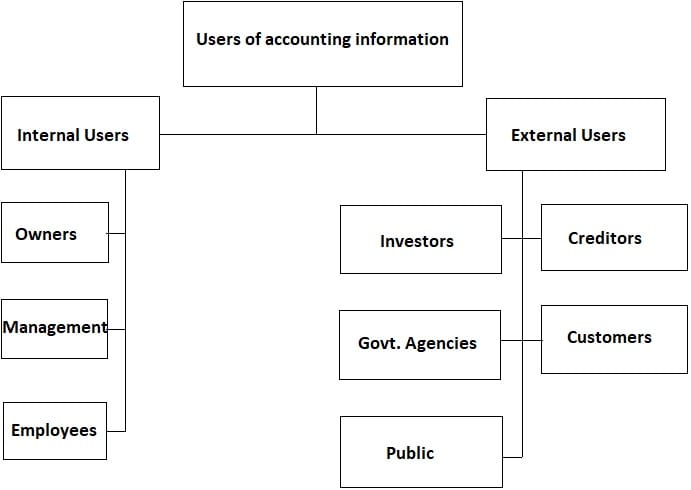
Users of Accounting Information
Accounting information is used by a wide range of internal and external users.
1. Internal Users
a) Management
Management uses accounting information for planning, controlling, budgeting, and performance evaluation.
b) Employees
Employees use it to assess job security, wage negotiations, and bonus decisions.
2. External Users
a) Investors and Shareholders
They use accounting information to assess profitability, risk, and return on investment.
b) Creditors and Lenders
Banks and financial institutions analyse accounting data to judge creditworthiness.
c) Government
Government authorities use it for taxation, regulation, and economic planning.
d) Customers and Suppliers
They assess the financial stability of the business before entering into long-term contracts.
Types of Accounting Information
Accounting information can be broadly classified into the following types:
1. Financial Accounting Information
This information is provided through financial statements such as:
- Trading Account
- Profit and Loss Account
- Balance Sheet
- Cash Flow Statement
It mainly caters to external users and follows standard accounting principles.
2. Management Accounting Information
Management accounting provides information for internal decision-making. It includes:
- Budgets
- Cost reports
- Break-even analysis
- Variance analysis
This information helps management in planning and controlling business operations.
3. Cost Accounting Information
Cost accounting focuses on cost-related data such as:
- Cost of production
- Cost control
- Cost reduction
It helps in pricing decisions and improving operational efficiency.
Uses of Accounting Information
Accounting information is used in various areas of business decision-making.
1. Planning and Budgeting
Accounting data helps management prepare budgets, forecast future performance, and allocate resources efficiently. Past financial information serves as a base for future planning.
2. Decision-Making
Management uses accounting information to make decisions such as:
- Make or buy decisions
- Pricing of products
- Expansion or diversification
- Investment appraisal
Accurate accounting data reduces uncertainty and risk.
3. Performance Evaluation
Accounting information helps in comparing actual results with planned targets. It assists in identifying deviations and taking corrective actions.
4. Financial Control
Through tools like ratio analysis, cash flow analysis, and variance analysis, accounting information ensures effective financial control.
5. Determination of Profit and Loss
Accounting information accurately calculates profit or loss, which is essential for:
- Dividend decisions
- Tax calculation
- Measuring business success
6. Assessment of Financial Position
The Balance Sheet provides information about assets, liabilities, and capital, helping users assess solvency and liquidity.
7. Credit and Loan Decisions
Banks and lenders rely on accounting information to evaluate the repayment capacity of the business.
Role of Accounting Information in Management
Accounting information plays a crucial role in managerial functions:
- Planning – Setting objectives and strategies
- Organising – Allocation of resources
- Directing – Guiding business activities
- Controlling – Monitoring performance and costs
Without proper accounting information, effective management becomes difficult.
Qualitative Characteristics of Good Accounting Information
For accounting information to be useful, it must possess certain qualities:
- Relevance – Useful for decision-making
- Reliability – Free from bias and errors
- Accuracy – Correct and precise
- Comparability – Enables comparison over time
- Timeliness – Available when required
- Understandability – Easy to comprehend
Limitations of Accounting Information
Despite its usefulness, accounting information has certain limitations:
- Based on Historical Data
It records past transactions and may not reflect current market conditions. - Ignores Non-Monetary Factors
Factors like employee morale, brand value, and customer satisfaction are not recorded. - Subject to Estimates
Depreciation, provisions, and valuation involve personal judgement. - Possibility of Manipulation
Window dressing may distort true financial position. - Inflation Effect Ignored
Accounting records may not reflect changes in purchasing power.
Accounting Information and Decision-Making
Accounting information acts as the backbone of rational decision-making. It provides quantitative data that supports both short-term and long-term decisions. However, it should be used along with qualitative factors, experience, and professional judgement.
For example:
- A profitable firm may still face liquidity problems
- High sales do not always mean high profits
Hence, accounting information should be interpreted carefully.
Importance of Using Accounting Information Responsibly
The usefulness of accounting information depends not only on its preparation but also on how it is used. Ethical use of accounting information ensures transparency, trust, and long-term sustainability of the business.
Management should avoid manipulation and present a true and fair view of financial results.
Conclusion
Accounting information is an indispensable tool for business decision-making. It provides valuable insights into the financial performance and position of an organisation. By using accounting information effectively, businesses can plan better, control costs, improve efficiency, and achieve long-term objectives.
However, accounting information has certain limitations and should not be used in isolation. When combined with managerial judgement and non-financial information, it becomes a powerful instrument for informed decision-making and sustainable growth.

Hi, I’m Dev Kirtonia, Founder & CEO of Dev Library. A website that provides all SCERT, NCERT 3 to 12, and BA, B.com, B.Sc, and Computer Science with Post Graduate Notes & Suggestions, Novel, eBooks, Biography, Quotes, Study Materials, and more.





 Buy Now
