
Costing plays a crucial role in managerial decision-making, cost control, pricing, and profitability analysis. Different industries require different costing methods depending on the nature of production and operations. Among the various costing techniques, Process Costing and Activity-Based Costing (ABC) are two important methods widely used by organizations.
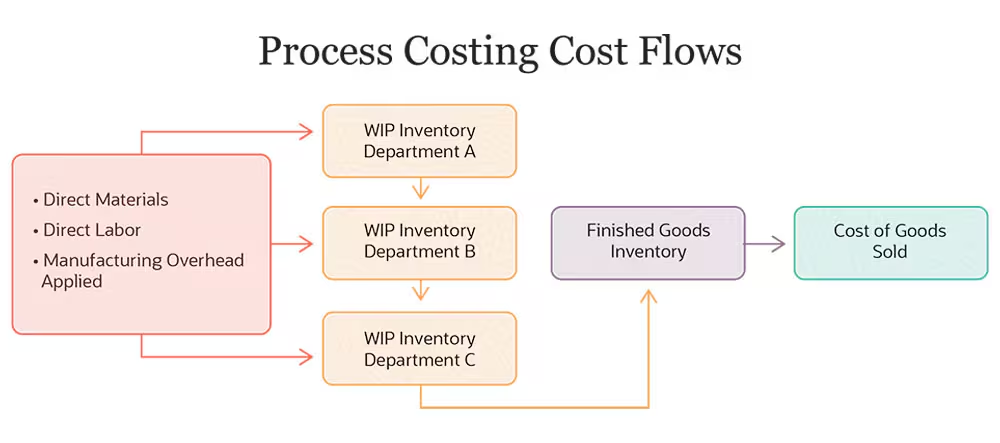
Process costing is a traditional costing method suitable for industries with continuous and homogeneous production, while activity-based costing is a modern technique designed to allocate overheads more accurately based on activities performed. This article explains the meaning, features, procedures, advantages, limitations, and differences between process costing and activity-based costing in detail.
Part A: Process Costing
Meaning of Process Costing
Process costing is a method of costing used in industries where production is continuous and units produced are identical. In this method, costs are accumulated for each process or department over a specific period, and the average cost per unit is calculated.
It is commonly used where it is difficult to identify the cost of individual units because production flows through a series of processes.
Industries Using Process Costing
Process costing is suitable for industries such as:
- Cement
- Sugar
- Paper
- Textile
- Chemicals
- Oil refining
- Steel
Features of Process Costing
The main features of process costing are:
- Production is continuous and large-scale
- Output is homogeneous (identical units)
- Costs are collected process-wise
- The average cost per unit is calculated
- Transfer of costs from one process to another
- Existence of normal and abnormal losses
Procedure of Process Costing
The steps involved in process costing are as follows:
- Collection of costs
All costs, such as materials, labour, and overhead, are collected separately for each process. - Assignment of costs to processes
Costs are assigned to each process or department. - Accounting for losses
Normal loss and abnormal loss are calculated and treated accordingly. - Calculation of equivalent production
When work-in-progress exists, equivalent units are calculated. - Computation of cost per unit
Total process cost is divided by the number of units produced. - Transfer of cost
The cost of output from one process is transferred to the next process.
Advantages of Process Costing
- Simple and easy to understand
- Suitable for mass production industries
- Economical due to low clerical work
- Helps in cost control by process-wise comparison
- Facilitates the pricing of products
Limitations of Process Costing
- Average costing may hide inefficiencies
- Not suitable for customized production
- Difficult to control the costs of individual units
- Inefficient processes may not be easily identified
Part B: Activity-Based Costing (ABC)
Meaning of Activity-Based Costing
Activity-Based Costing (ABC) is a modern costing technique that allocates overhead costs to products based on the activities that generate costs. Instead of using a single overhead rate, ABC identifies various activities and assigns costs using appropriate cost drivers.
The main objective of ABC is to provide more accurate product costing and better cost control.
Need for Activity-Based Costing
Traditional costing methods often allocate overheads using volume-based measures such as labour hours or machine hours. This can lead to inaccurate product costs, especially in complex and diversified organizations.
ABC was introduced to:
- Improve the accuracy of overhead allocation
- Identify cost-driving activities
- Eliminate non-value-added activities
- Support strategic decision-making
Features of Activity-Based Costing
- Focus on activities rather than products
- Uses multiple cost drivers
- Accurate allocation of overheads
- Identifies value-added and non-value-added activities
- Supports cost reduction and efficiency
Steps in Activity-Based Costing
- Identification of activities
Activities involved in production or service delivery are identified. - Classification of activities into cost pools
Similar activities are grouped together. - Identification of cost drivers
Cost drivers are factors that cause costs, such as number of setups or purchase orders. - Collection of costs for each activity
Overhead costs are assigned to activity cost pools. - Calculation of activity rates
Activity cost ÷ Cost driver units. - Allocation of costs to products
Costs are assigned to products based on their usage of activities.
Advantages of Activity-Based Costing
- More accurate product costing
- Better overhead control
- Helps in identifying inefficiencies
- Improves pricing and profitability analysis
- Supports strategic planning and decision-making
Limitations of Activity-Based Costing
- Expensive and time-consuming to implement
- Requires detailed data collection
- Complex to understand and maintain
- Not economical for small organizations
Process Costing vs Activity-Based Costing
| Basis | Process Costing | Activity-Based Costing |
|---|---|---|
| Nature | Traditional costing method | Modern costing method |
| Cost unit | Process | Activity |
| Suitability | Continuous, homogeneous production | Complex and diversified operations |
| Overhead allocation | Average basis | Activity-based |
| Accuracy | Moderate | High |
| Cost control | Limited | Strong |
| Implementation cost | Low | High |
Role in Managerial Decision-Making
Both costing methods play an important role in management:
- Process costing helps in controlling process-wise costs, pricing, and inventory valuation.
- Activity-based costing helps management understand cost behavior, improve efficiency, eliminate waste, and make strategic decisions related to product mix and pricing.
Use in Modern Business Environment
In today’s competitive market:
- Manufacturing firms with standardized products prefer process costing.
- Service organizations and diversified manufacturers increasingly adopt activity-based costing for better cost visibility.
Many organizations use a combination of both methods depending on operational requirements.
Conclusion
Process costing and activity-based costing are two important costing techniques designed to meet different business needs. Process costing is best suited for industries with continuous and uniform production, offering simplicity and economy. On the other hand, activity-based costing provides a more accurate and strategic approach to cost allocation by focusing on activities and cost drivers.
In an environment where cost control and efficiency are critical for survival, selecting the appropriate costing method is essential. Organizations that understand and apply these costing techniques effectively can achieve better pricing decisions, improved profitability, and long-term competitive advantage.

Hi, I’m Dev Kirtonia, Founder & CEO of Dev Library. A website that provides all SCERT, NCERT 3 to 12, and BA, B.com, B.Sc, and Computer Science with Post Graduate Notes & Suggestions, Novel, eBooks, Biography, Quotes, Study Materials, and more.
Subject Ka Complete Video Solution Dekhein
Step-by-step easy concept explanation aur full questions Answer ke liye watch karein ya app download karein:




 Buy Now