
SEBA Class 7 English Chapter 4 Some Hearts Speak Best Through Art Solutions As Per SCERT New Syllabus to each chapter is provided in the list so that you can easily browse through different chapters SEBA Class 7 English Chapter 4 Some Hearts Speak Best Through Art Notes and select need one. SEBA Class 7 English Chapter 4 Some Hearts Speak Best Through Art Notes Download PDF. SCERT Class 7 English (Rainbow) Solutions.
SEBA Class 7 English Chapter 4 Some Hearts Speak Best Through Art
Also, you can read the SCERT book online in these sections Solutions by Expert Teachers as per State Council of Educational Research and Training (SCERT) Book guidelines. SCERT Class 7 English (Rainbow) Notes All Subject Solutions. Here we have given SCERT Class 7 English Notes for All Chapters, You can practice these here.
Some Hearts Speak Best Through Art
Chapter: 4
| TEXTUAL QUESTION ANSWER |
Look at the following pictures. Imagine that you are in each situation. What would you do? Share your thoughts with your classmates.
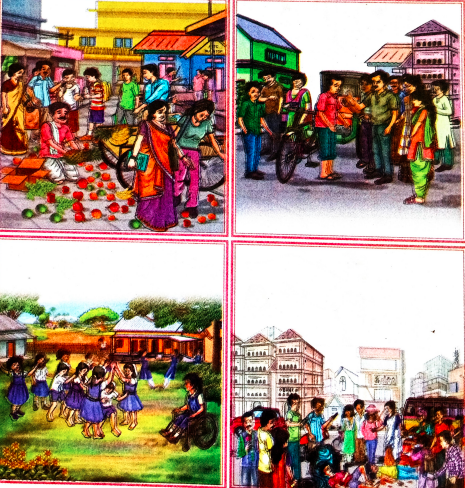
Ans: (i) I would help the old woman collect the fruits that fell on the road.
(ii) I would help the visually impaired person cross the road safely.
(iii) I would join my friends, play happily, and include everyone in the game.
(iv) I would help the elderly and women board the bus in an orderly manner and wait patiently for my turn.
| ACTIVITIES |
1. Let’s check how much we have understood:
Answer the following questions:
(i) Who was referred to as ‘the silent queen’ by Dipu?
Ans: Medha.
(ii) Who was Shreya?
Ans: Shreya was Medha’s new friend.
(iii) What did Tanya notice about Medha when others were playing?
Ans: Tanya noticed that Medha was sitting alone and sketching.
(iv) What inspired Medha to draw the pelican?
Ans: She had read about the pelican the previous day.
(v) What message did the teacher try to convey by observing ‘Kindness Week”?
Ans: The teacher encouraged everyone to be kind, include others, and support classmates instead of hurting or bullying them.
(vi) What do you think, “Tanya stood for me”, means in the lesson?
Ans: It means Tanya supported Medha, defended her, and treated her with kindness.
2. Match the names of the persons in Part A with their character given in Part В:
| Part A | Part B |
| Medha | Medha’s friend, a cheerful and brave girl |
| Tanya | Dipu’s partner who also teases others |
| Dipu | A loud, tough boy who mocks others |
| Vimal | A quiet, artistic girl who enjoys sketching |
Ans:
| Part A | Part B |
| Medha | A quiet, artistic girl who enjoys sketching. |
| Tanya | Medha’s friend, a cheerful and brave girl. |
| Dipu | A loud, tough boy who mocks others. |
| Vimal | Dipu’s partner who also teases others. |
4 (b) Choose the appropriate adjectives of quality from the box and fill in the blanks to complete the given sentences:
| Lonely | Kind | Empathetic | Rude | Grateful |
(i) Medha felt __________ When no one talked to her during lunch.
Ans: Lonely.
(ii) We should always be ____________ to those who are being bullied.
Ans: Empathetic.
(iii) Medha was __________ to Tanya.
Ans: Grateful.
(iv) We should not be _______ to others.
Ans: Rude.
(v) Tanya was a ________ girl who spoke for Medha.
Ans: Kind.
5. Read the following sentences and put a tick on the one/ones which define/defines you:
(i) Mocking and bullying others make me smart.
Ans: ✗.
(ii) I always stand up for someone who is suffering silently.
Ans: ✓.
(iii) I never interfere when a group of persons bully a shy person.
Ans: ✗.
(iv) I know about a person only by his/her appearance.
Ans: ✗.
(v) I always treat others with kindness and respect.
Ans: ✓.
7. Think and answer the following question:
Tanya stood for me. She listened to me. I felt seen. This changed everything.”
What did Medha mean when she thought in this way?
You may use the following opening lines, supporting lines and concluding lines along with your own ideas to write the answer in a few lines.
| Opening lines | Supporting ideas | Concluding lines |
| Tanya stood for me. She listened to me. I felt seen. This changed everything.” By the above sentences, Medha meant that……. | ➤Tanya understood Medha’s condition…… ➤Tanya paid attention, and not only understood what is being said but also what is left unsaid the emotions and fears……. ➤ Medha felt included and it changed a lot in her. ➤ She felt loved and appreciated. | The small act of Tanya made a big difference in Medha’s life. Now…… |
Ans: By the above sentences, Medha meant that Tanya supported her and listened to her with care. Tanya understood Medha’s feelings and made her feel included. Because of Tanya’s kindness, Medha felt loved, respected, and appreciated. This small act of kindness made a big difference in Medha’s life. Now, she felt happy, confident, and accepted by her classmates.
8. (a) Read the following speech on ‘The Art of Listening’ by a renowned communication skill trainer.
Good morning dear teachers, students and all members of Model High School. Today I am going to talk about “The Art of Listening’. I hope my speech will be meaningful and engaging.
In a world full of noise and distractions, genuine listening has become rare. It requires patience, focus, and empathy. When we listen with attention, we not only understand what is being said but also what is left unsaid- the emotions, fears, and hopes behind the words.
Listening is more than just hearing words – it is a powerful skill that allows us to truly connect with others. Let us know the difference between hearing and listening. Hearing is when our ears notice a sound. For example, we hear birds chirping or a car blowing the horn. Whereas listening is when we pay attention to the sound and try to understand it. It’s just like we listen to our teacher explaining a lesson.
Good listeners do not interrupt or judge. They give the speaker space to express. knowing that every person wants to be heard and valued. Whether in friendship, families, or classrooms, good listening builds trust and strengthens relationships. It shows respect and makes people feel understood.
Mastering the art of listening can lead to better communication, deeper it is a gift we can offer to relationships, and a kinder world. It is not just a skill everyone around us.
Thank you all for your patient listening.
8. (b) Now, try to give an oral presentation of the speech on ‘The Art of Listening’.
Ans: Good morning respected Principal, teachers and my dear friends.
Today, I am going to talk about “The Art of Listening.” Listening is an important life skill. It helps us understand the feelings and ideas of others. A good listener pays attention without interrupting or judging. Listening builds trust, respect, and strong relationships. It also makes people feel valued and understood. So, let us all become good listeners and make our school and society a better place.
Thank you.
8. (c) Read the following situations carefully. These are some situations from our daily life.
(i) Barking of dogs at night.
(ii) Teacher giving instruction in the class.
(iii) Thunderstorms.
(iv) Your friend sharing his feelings with you.
(v) Chirping of birds.
(vi) An announcement at the railway station about your train.
Now, decide which of the given situations you would consider as listening and which as hearing.
Write the situations under the appropriate heading in the table below:
| Listen | Hear |
Ans:
| Listen | Hear |
| (ii) Teacher giving instruction in the class. | (i) Barking of dogs at night. |
| (iv) Your friend sharing his feelings with you. | (iii) Thunderstorms. |
| (vi) An announcement at the railway station about your train. | (v) Chirping of birds. |
8. (d) On the occasion of ‘Kindness Week’, you are asked to give a speech at the morning assembly on the topic ‘Kindness Makes the World a Better Place’.
While preparing the speech, keep the following points in mind:
- Plan what you are going to speak.
- Know your audience and the occasion.
- Collect information and organise your ideas.
- Use formal language, short and simple sentences to express your ideas clearly.
- Speak slowly with pauses at times.
- Maintain eye contact with your audience.
- Begin your speech with the following expressions:
I’m going to talk about……./I’d like to talk about……..
Firstly/Secondly/Next/finally/ in addition to/ also
- You should avoid reading out a speech.
Now, write down your speech in your notebook and practise.
Ans: Good morning respected Principal, teachers and my dear friends.
Today, I would like to talk about “Kindness Makes the World a Better Place.”
Firstly, kindness means caring for others and helping those in need. A kind word or a small act of help can make someone feel happy and valued.
Secondly, we should treat everyone with respect and never bully or make fun of others. Kindness creates friendship, trust, and happiness.
Finally, if each one of us shows kindness every day, our school and society will become a better and more peaceful place.
Thank you all for listening.
9. (a) Let’s learn about finite and non-finite verbs:
Read the given sentences and notice the underlined verbs:
(i) Mr Mohan drives to school.
(ii) They drive very fast.
(iii) I am driving down the lane.
In the above sentences, the verb ‘drive’ is governed by the person and the number of the subjects, ‘I’, ‘Mr. Mohan’ and ‘They’ respectively. Such verbs are called finite verbs. Finite verbs are governed by the person and the number of the subject.
Now let’s read these sentences and notice the underlined verbs.
(i) I want to eat something delicious.
(ii) Mr. Mohan has to eat apples every day.
(iii) They want to eat eggs for breakfast.
In the above sentences, the verb ‘eat’ does not change even though the person and number of the subject change. These verbs are called non-finite verbs.
Non-finite verbs do not change their form even when the person and the number of the subject changes.
We know now that verbs can be divided into two categories: Finite and non-finite verbs.
9. (b) Read each sentence carefully. Fill in the blanks with the correct verb form given in brackets. Write F for finite and NF for non-finite in the space provided:
(i) Medha enjoys ________ stories to children. (tell) ____ (F/NF).
Ans: Telling – NF.
(ii) They _________ to school every day by bus. (go) ______ (F/NF).
Ans: Go – F.
(iii) Dipu saw him _________ in the park. (run) _______ (F/NF).
Ans: Run – NF.
(iv) Rahul __________ his homework before going out. (finish) ________(F/NF).
Ans: Finished – F.
10. (b) Fill in the blanks with the infinitive form of the verb given in the brackets.
(i) Do you want (come) to the shop with me?
Ans: To come.
(ii) Don’t forget (take) your umbrella with you.
Ans: To take.
(iii) My parents are planning. (go) abroad.
Ans: To go.
(iv) They are planning (give) me a surprise.
Ans: To give.
(v) How long do you expect (stay) in Guwahati?
Ans: To stay.
(vi) (learn) English quickly is not an easy thing.
Ans: To learn.
(vii) She promised (give) it as soon as possible.
Ans: To give.
(viii) He is looking forward (meet) all his friends again.
Ans: To meeting.
10. (c) Fill in the blanks with an ‘-ing’ form or a ‘to-infinitive’ form of the verb given in the box.
| Listen | Miss | Travel | Drive | Take | Carry |
(i) I prefer _______ by train.
Ans: Travelling.
(ii) Would you like _________ a shower now?
Ans: To take.
(iii) I would hate _________ any of the fun.
Ans: To miss.
(iv) The taxi-driver refused ___________ my luggage up the stairs.
Ans: To carry.
(v) Tanya offered ________ us to the station.
Ans: To drive.
(vi) Medha likes _________ to the radio while she irons the clothes.
Ans: Listening.
11. Listen to the text read out to you by your teacher. As you listen, write down the answers to the given questions:
A. Choose the correct option:
What does the word “Netiquette” mean?
(i) Being quick online.
(ii) Being respectful online.
(iii) Avoiding the internet.
(iv) Typing fast.
Ans: (ii) Being respectful online.
B. Put a tick (✔) in the correct box:
We should forward any photo or message we receive without asking permission.
True.
False.
Ans: False.
C. Fill in the blank:
Behind every screen is a real person with real ___________.
Ans: Feelings.
D. What should we think before we share something online?
Ans: We should think whether it is true, kind, and respectful before sharing it online.
Subject Ka Complete Video Solution Dekhein
Step-by-step easy concept explanation aur full questions Answer ke liye watch karein ya app download karein:


 Buy Now