
SEBA Class 7 English Chapter 1 Nature Around Us Solutions As Per SCERT New Syllabus to each chapter is provided in the list so that you can easily browse through different chapters SEBA Class 7 English Chapter 1 Nature Around Us Notes and select need one. SEBA Class 7 English Chapter 1 Nature Around Us Notes Download PDF. SCERT Class 7 English (Rainbow) Solutions.
SEBA Class 7 English Chapter 1 Nature Around Us
Also, you can read the SCERT book online in these sections Solutions by Expert Teachers as per State Council of Educational Research and Training (SCERT) Book guidelines. SCERT Class 7 English (Rainbow) Notes All Subject Solutions. Here we have given SCERT Class 7 English Notes for All Chapters, You can practice these here.
Nature Around Us
Chapter: 1
| TEXTUAL QUESTION ANSWER |
Close your eyes for a moment and visualise a gentle breeze blowing away the leaves of a tree into the air.
Now, answer the following questions:
(a) How do you feel?
Ans: I feel calm, peaceful, and relaxed.
(b) Where do you think the leaves go?
Ans: I think the leaves float through the air and fall on the ground or in a nearby garden.
(c) Do you hear any sound?
Ans: Yes, I hear the soft rustling sound of the leaves and the gentle breeze.
(d) Do you think the wind and the leaves are whispering to each other? What might they have been whispering about?
Ans: Yes, I think they are whispering to each other. They might be talking about their beautiful journey through nature and enjoying the cool breeze together.
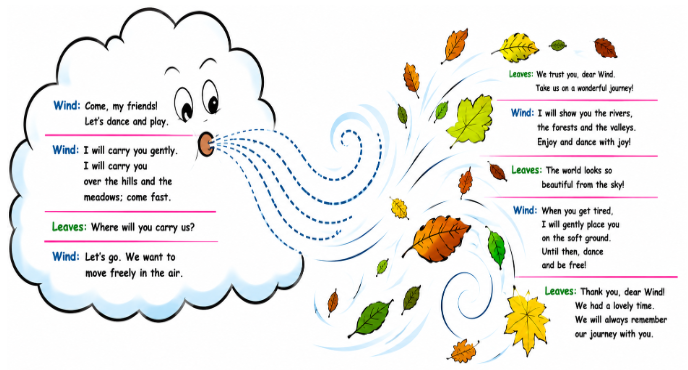
What else do you think the wind and the leaves might say to each other? Share your thoughts in the class and write them down in the space below:
Ans:
| ACTIVITIES |
1. (b) Give the meanings of the following words. You can use a dictionary.
| Words | Meanings |
| (i) Meadow | |
| (ii) Fluttering | |
| (iii) Cold | |
| (iv) Loud | |
| (v) Summer | |
| (vi) Cricket |
Ans:
| Words | Meanings |
| (i) Meadow | A field covered with grass and wild flowers. |
| (ii) Fluttering | Moving or flying lightly and quickly. |
| (iii) Cold | Having a low temperature; not warm. |
| (iv) Loud | Making a strong or high sound. |
| (v) Summer | The hottest season of the year. |
| (vi) Cricket | A small insect that makes a chirping sound. |
Now, make sentences using these words and write them in your notebook.
Ans: (i) Meadow: The cows are grazing in the green meadow.
(ii) Fluttering: The butterflies are fluttering around the flowers.
(iii) Cold: The water is very cold in winter.
(iv) Loud: We heard a loud noise outside.
(v) Summer: We enjoy eating mangoes in summer.
(vi) Cricket: A cricket is chirping in the garden.
1. (c) Read the poem and find the words that are similar in meaning to the following words:
Breeze _________.
Ans: Wind.
Wear ___________.
Ans: Put on.
Grasslands _________.
Ans: Meadows.
Leave ____________.
Ans: Go away.
1. (d) These are a few words to describe friendship:
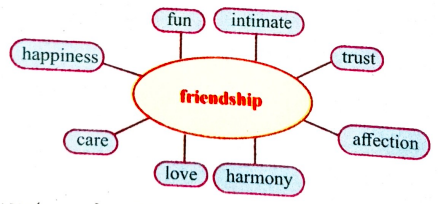
Write a few sentences describing the friendship between the wind and the leaves.
Ans: Here are a few simple sentences describing the friendship between the wind and the leaves:
The wind and the leaves are good friends.
The wind gently blows, and the leaves dance happily.
They play together in the meadows and forests.
The wind takes care of the leaves and makes them flutter with joy.
Their friendship is full of happiness, love, trust, and harmony.
They enjoy each other’s company and make nature beautiful.
2. (a) Read the first stanza of the poem carefully. Underline the last word of each line.
“Come, little leaves.” said the wind one day,
“Come o’er the meadows with me, and play;
Put on your dress of red and gold.
Summer is gone, and the days grow cold.”
Now, write the rhyming words in pairs:
Ans: (i) Day – Play.
(ii) Gold – Cold.
2. (b) Let’s learn about rhyme scheme:
Read again the first stanza of the poem. Notice the letter given in brackets:
“Come, little leaves,” said the wind one day. (A)
“Come o’er the meadows with me, and play: (A)
Put on your dress of red and gold-(B)
Summer is gone, and the days grow cold” (B)
In the above stanza of the poem, the last words of the first and the second lines rhyme. The lines follow the same rhyme scheme – AA.
The last words of the third and the fourth lines rhyme. The lines follow the same rhyme scheme BB.
Therefore, the rhyme scheme of this stanza is AA BB.
| A rhyme scheme is the ordered pattern of rhyming words at the end of each line or stanza of a poem. The rhyme scheme of a poem is written using letters. |
2. (c) Now, give the rhyme scheme of the following stanza:
The sun is shining warm and bright,
Come and shelter beneath the tree.
The weary wind whirls soft and light,
A While birds sing wild and free.
Ans: The sun is shining warm and bright. (A)
Come and shelter beneath the tree. (B)
The weary wind whirls soft and light. (A)
While birds sing wild and free. (B)
2. (d) Fill in the blanks and complete the poem, choosing the right word from the box to match the rhyme scheme AABB.
| Tree, Trees, Hills, Hill |
The wind blows gently through the _______.
Flowers flutter, buzzing bees.
Leaves and wind twirl over _________.
Come one, come all swirl with thrills.
Ans: The wind blows gently through the trees. (A)
Flowers flutter, buzzing bees. (A)
Leaves and wind twirl over hills. (B)
Come one, come all, swirl with thrills. (B)
3. (a) Choose the correct answer:
(i) Which one of the following means ‘moving lightly and quickly’?
(a) Dancing.
(b) Playing.
(c) Fluttering.
(d) Singing.
Ans: (c) Fluttering.
(ii) What dress does the wind ask the leaves to put on?
(a) Dress of brown.
(b) Dress of red and gold.
(c) Dress of brown and red.
(d) Dress of green.
Ans: (b) Dress of red and gold.
(iii) How did the leaves respond to the loud call of the wind?
(a) By fluttering down one by one.
(b) By wearing a dress of red and gold.
(c) By singing a farewell song.
(d) By bidding goodbye to all.
Ans: (a) By fluttering down one by one.
(iv) Who heard the wind’s loud call?
(a) The meadows.
(b) The brook.
(c) The leaves.
(d) The cricket.
Ans: (c) The leaves.
3. (b) Answer the following questions:
(i) What does the wind ask the leaves to do?
Ans: The wind asks the leaves to come over the meadows and play.
(ii) Why did the wind ask the leaves to wear a dress of red and gold?
Ans: The wind asks the leaves to wear a dress of red and gold because summer is over and autumn has arrived.
(iii) Give the movement words used for the leaves in the poem.
Ans: The movement words used for the leaves are fluttering, danced, and flew.
(iv) What did the leaves do after hearing the wind’s loud call?
Ans: After hearing the wind’s loud call, the leaves came fluttering down and danced over the fields.
(v) What season is mentioned in the poem?
Ans: The season mentioned in the poem is summer.
(vi) Which line in the poem indicates the passing of summer?
Ans: The line that indicates the passing of summer is: “Summer is gone, and the days grow cold.”
4. (a) Read the following line from the poem:
“Come, little leaves,” said the wind one day.
Here, the poet has given human qualities to the wind and the leaves and has made them human like. This is known as personification.
Now, read the poem again and write down the lines where the activities of the wind and the leaves resemble human actions:
Ans: (i) “Come, little leaves,” said the wind one day.
(ii) “Come o’er the meadows with me, and play;”
(iii) “Put on your dress of red and gold—”
(iv) “Soon as the leaves heard the wind’s loud call.”
(v) “Over the brown fields they danced and flew.”
(vi) “Singing the soft little songs they knew.”
(vii) “Cricket, good-bye, we’ve been friends so long;”
(viii) “Little brook, sing us your farewell song—”
(ix) “Say you are sorry to see us go;”
(x) “Ah! you will miss us, right well we know.”
4. b) You have already learnt about alliteration in your previous class. There are some alliterations in the poem ‘The Wind and the Leaves’. Find them and write below:
(i) _____________.
(ii) ____________.
Ans: (i) Little leaves.
(ii) Brown fields.
6. Read the poem and write down the explanation of each stanza. The first stanza is done for you:
1. In the first stanza of the poem, the wind is inviting the leaves to come and play in the meadows, wearing bright shades of red and gold. The wind also tells the leaves about the changes of the seasons, from summer to autumn. It tells them that cold days are ahead.
Ans: 2. Second Stanza: In the second stanza, the leaves hear the wind’s loud call and come fluttering down together. They dance and fly over the brown fields, happily singing their soft little songs as they move with the wind.
3. Third Stanza: In the third stanza, the leaves say goodbye to the cricket and the little brook, who have been their friends for a long time. They ask the brook to sing a farewell song and believe that their friends will miss them after they leave.
7. (b) The student visited the library and found an interesting book on the Greater Adjutant Stork.
Here is a page from the book that the student read. Read it aloud and share
what you have learnt:
| The endangered Greater Adjutant Stork is known to breed only in Cambodia and the Indian state of Assam, at present. There is a massive decline in its population due to habitat loss and environmental changes. It is a huge bird standing tall and is among the largest of all living storks. It is known for its distinct appearance. It has a long neck with a neck pouch, a large beak and a bald head. It preys on fish, frogs, insects, reptiles, etc. It prefers to live in a wetland area. This bird is locally known as ‘Hargila’. or ‘Bortokola’. |
Ans: I learnt that the Greater Adjutant Stork, locally known as Hargila or Bortokola, is an endangered bird. It now breeds only in Assam and Cambodia. Its population is decreasing because of habitat loss and environmental changes. It is one of the largest living storks with a long neck, a large beak, a neck pouch, and a bald head. It lives in wetlands and feeds on fish, frogs, insects, and reptiles. We should protect its habitat to save this rare bird.
8. Sit in pairs. Choose any one of the following topics and discuss with your partner. Share your opinions with others.
Here are some cues to present your opinions:
I think we should save the Greater Adjutant Stork because _________.
If the Greater Adjutant Stork becomes extinct then __________.
We must spread awareness on the preservation of nature as ___________.
Topic 1: Ways to protect the Greater Adjutant Stork from extinction.
Ans: I think we should save the Greater Adjutant Stork because it is an important part of nature. If it becomes extinct, the ecological balance will be disturbed. We should protect its natural habitat, stop cutting trees, preserve wetlands, reduce pollution, and spread awareness about the importance of this bird. By working together, we can help protect the Hargila and ensure its survival for future generations.
Topic 2: Ways to preserve nature.
Ans: We should preserve nature because it provides us with clean air, water, food, and a healthy environment. We can protect nature by planting more trees, saving forests and wetlands, reducing pollution, conserving water, and protecting wildlife. We should also avoid wasting natural resources and encourage others to care for the environment. By preserving nature, we can maintain ecological balance and create a better future for all living beings.
9. Solve the crossword puzzle. Clues are given below.
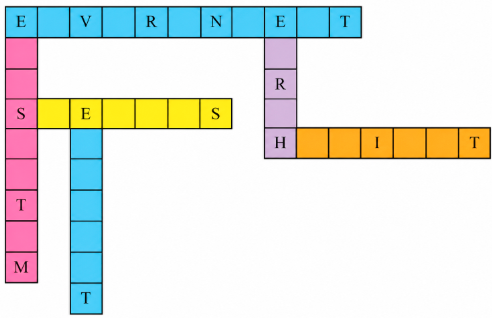
Across:
1. The natural world around us.
2. Group of similar organisms.
3. The home of an organism.
Down:
4. A community of interacting organisms and their environment.
5. Something that no longer exists.
6. The third planet in the solar system.
Ans: Across:
1. Environment.
2. Species.
3. Habitat.
Down:
4. Ecosystem.
5. Extinct.
6. Earth.
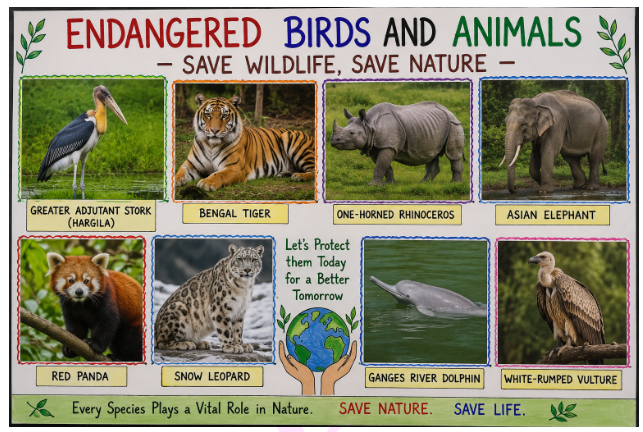
10. You have read how the Greater Adjutant Stork is facing the threat of extinction. More such species in wildlife are facing the danger of extinction. Collect pictures of such birds or animals and make a collage. Take help from the internet, and work under your teacher’s guidance.
Ans:
12. Read these words aloud:
| Cinema | Clever | City | Cat |
| Came | Coat | Ice | Pace |
| Face | Care | Experience | Clay |
Now, in Box ‘A’, write down the words in which the letter ‘c’ is pronounced as in ‘cat’. In Box ‘B’, write down the words in which the letter ‘c’ is pronounced as in ‘ice’,One is done for you:
| Box A | Box B |
| Care | Experience |
Ans:
| Box A | Box B |
| Care | Experience |
| Cat | Cinema |
| Came | City |
| Coat | Ice |
| Clever | Pace |
| Clay | Face |
Subject Ka Complete Video Solution Dekhein
Step-by-step easy concept explanation aur full questions Answer ke liye watch karein ya app download karein:

 Buy Now