
NIOS Class 12 Psychology Chapter 10 Emotion Solutions English Medium As Per New Syllabus to each chapter is provided in the list so that you can easily browse throughout different chapters NIOS Class 12 Psychology Chapter 10 Emotion Notes and select need one. NIOS Class 12 Psychology Chapter 10 Emotion Solutions English Medium Download PDF. NIOS Study Material of Class 12 Psychology Notes Paper Code: 328.
NIOS Class 12 Psychology Chapter 10 Emotion
Also, you can read the NIOS book online in these sections Solutions by Expert Teachers as per National Institute of Open Schooling (NIOS) Book guidelines. These solutions are part of NIOS All Subject Solutions. Here we have given NIOS Class 12 Psychology Notes, NIOS Senior Secondary Course Psychology Solutions in English for All Chapter, You can practice these here.
Emotion
Chapter: 10
| PART – I |
| Module – 2: Basic Psychological Processes |
INTEXT QUESTIONS 10.1
Fill in the blanks:
1. _________________ is a part of the brain involved in controlling of physiological expressions of emotions such as fear, anger and pleasure.
Ans: Hypothalamus.
2. The involuntary body functions such as heartbeat, breathing, blood flow and digestion are regulated by _________________.
Ans: Autonomic Nervous System.
3. The Schachter-Singer theory of emotion suggests that emotions compose of ____________________ and cognitive factors.
Ans: Physiological factor.
4. _____________________ is one of the most important non verbal body cues.
Ans: Facial expression.
5. The _________________ component of emotion is expressed in the form of facial expression & gestures.
Ans: Behaviour.
INTEXT QUESTIONS 10.2
State which of the following statements are ‘true’ or ‘false’.
1. The parasympathetic nervous system regulates our body for emergency actions.
Ans: False.
2. Verbal and non verbal communications are interdependent on each other.
Ans: True.
3. The James-Lange theory of emotion suggests that emotional experience arise from physiological changes.
Ans: True.
4. “I” message technique is for expressing intensely positive emotions.
Ans: False.
5. Anxiety can sometimes help us to take certain action to avoid dangerous situation.
Ans: True.
INTEXT QUESTIONS 10.3
Multiple Choice Questions:
(i) Which of the following is not Eckman’s basic emotion:
(a) Happiness.
(b) Love.
(c) Surprise.
(d) Sadness.
Ans: (b) Love.
(ii) What are the main component (s) of emotion:
(a) physiological.
(b) cognitive.
(c) behavioral.
(d) all of the above.
Ans: (d) all of the above.
(iii) Happiness is a psychological state characterized by:
(a) an increased positive affect.
(b) a decrease in negative affect.
(c) life satisfaction.
(d) All of the above.
Ans: (d) All of the above.
(iv) Jealousy is an emotion, predominated by:
(a) love.
(b) happiness.
(c) fear of loss.
(d) disgust.
Ans: (c) fear of loss.
(v) The statement “Emotion we feel is due to the cognitive interpretation of aroused bodily state” was given by:
(a) James-Lange.
(b) Cannon-Bard.
(c) Schachter and Singer.
(d) Eckman.
Ans: (b) Cannon-Bard.
| TERMINAL EXERCISES |
1. Why do we have emotions? What role do they serve?
Ans: Emotions play an important role in our daily lives. They help us express ourselves, communicate with others, and build social connections. Emotions such as happiness, sadness, anger, and fear allow people around us to understand how we feel and respond appropriately. For example, when we express sadness, others may offer us comfort and support.
Emotions also help us survive and adapt to different situations. They guide us in understanding our experiences, making decisions, and responding to challenges. Fear can protect us from danger, while guilt may encourage us to seek forgiveness and improve our behaviour. Therefore, emotions are essential for communication, adaptation, survival, and overall well-being.
2. What are your primary emotions? What emotions do you think you express most freely and frequently?
Ans: Universal Basic Emotions: According to psychologist Paul Ekman, there are six basic emotions that are universally experienced and recognized across all human cultures: happiness, sadness, fear, surprise, disgust, and anger. Other emotions are experienced as a combination of these primary emotions.
Self-Reflection:
Freely expressed emotions: For most individuals, expressing positive emotions like happiness or pleasure (which bring satisfaction and positive affect) is relatively easy and freely done.
Restrained emotions: On the other hand, expressing negative emotions like sadness, anger, disappointment, or rejection can be more challenging. You can reflect on whether you tend to hide these feelings or express them openly. For example, if you frequently feel motivated to prepare for challenges, you might be experiencing and expressing moderate anxiety frequently.
3. Explore the effects of anxiety on your life.
Ans: Anxiety is characterized by feelings of tension, constantly recurring intrusive thoughts, and physical changes like increased blood pressure.
It acts as an “emotional alarm signal” warning us of threat or danger, and its effects on your life can be looked at in two ways:
Positive/Motivational Effects (Moderate Anxiety): When threats are real, a moderate level of anxiety is highly constructive. For example, the fear of examinations acts as a motivator that encourages you to study, prepare well, and take necessary actions to avoid trouble.
Negative/Impairing Effects (High Anxiety): High levels of anxiety are detrimental. Excessive anxiety can distort your perception and thinking, which ultimately impairs your performance and leads to difficulties in responding appropriately to situations.
4. When you feel jealous, how do you usually express and behave?
Ans: When I feel jealous, I may initially experience disappointment, anger, or insecurity because I fear losing an important relationship to someone else. However, instead of reacting with hostility or anger, I try to understand the reason behind my feelings and communicate openly with the other person. I believe jealousy can act as a warning signal that encourages us to protect valuable relationships, rebuild trust, and maintain strong social bonds in a positive and constructive way.
5. Explain the different theories of emotions with diagram.
Ans: The three major theories of emotions are:
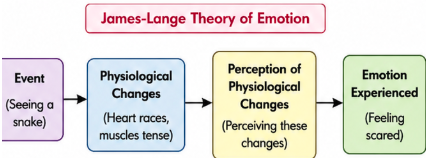
(i) James-Lange Theory of Emotion: The James-Lange theory suggests that emotional experience arises from our perception of physiological changes. For example, when a person sees a snake, his/her heart races and muscles become tense, and thus he/she feels scared.
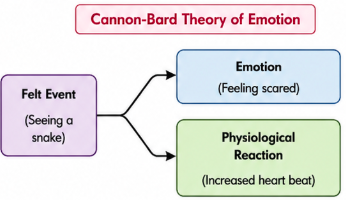
(ii) Cannon-Bard Theory of Emotion: The Cannon-Bard theory states that physiological arousal and emotional experience occur simultaneously, but they are independent of each other. For example, on seeing a snake, a person feels scared and, at the same time, his/her heartbeat increases.
(iii) Schachter-Singer Theory of Emotion: The Schachter-Singer theory states that emotions consist of two factors: physiological arousal and cognitive interpretation. The emotion we feel is due to the cognitive interpretation of the aroused bodily state.
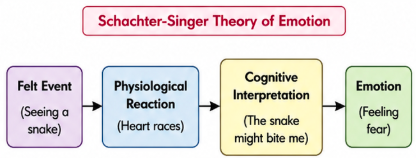
For example, on seeing a snake, a person’s heart races and he/she thinks that the snake might bite. Both reactions contribute to the emotion of fear.
6. Analyze the Autonomic Nervous System and what role does it play?
Ans: The Autonomic Nervous System (ANS) is the part of the peripheral nervous system responsible for regulating involuntary body functions like heartbeat, breathing, blood flow, and digestion. It plays a primary role in regulating the body’s strong physiological responses to emotions like excitement, anger, or fear.
It is divided into two distinct subsystems:
(i) The Sympathetic Nervous System:
Role: It regulates the fight-or-flight response and prepares the body for emergency actions during aroused emotional states.
Actions: It activates the body for extensive action by speeding up heart rate, raising blood pressure, dilating eye pupils, and raising blood sugar levels. For example, if you see a snake, the sympathetic system quickly activates your body to flee.
(ii) The Parasympathetic Nervous System:
Role: It is active when the body is in a calm and relaxed state, working to store energy and conserve physical resources.
Actions: It slows down the heart rate, decreases blood pressure, constricts eye pupils, and maintains blood sugar levels. Once a threat (like the snake) has passed, it slowly returns the body to its resting state.
7. What are the different ways by which we can manage our emotions?
Ans: While we cannot directly control our raw emotional feelings, we can control our reactions to those feelings through several techniques:
The “I” Message Technique (Gordon and Sand, 1984): Used to express intensely negative emotions politely so that others listen and cooperate. It consists of four steps:
First: State the specific, objectionable behavior that hurt you in a non-judgmental way.
Second: Politely explain how that behavior has affected you.
Third: Share how you feel in terms of emotions (e.g., say “I feel hurt” instead of blaming “You hurt me” ).
Fourth: Clearly tell the person what you would like them to do to correct the situation.
Enhancing Self-Awareness: Recognizing your feelings and identifying the bodily changes you are experiencing when intense emotions (like anger or anxiety) arise.
Appraising Situations Objectively: Re-evaluating the emotional situation from a balanced and neutral perspective.
Self-Monitoring: Actively tracking and regulating your emotional reactions to ensure they are appropriate for the context, which helps in achieving “emotional competence”.
Subject Ka Complete Video Solution Dekhein
Step-by-step easy concept explanation aur full questions Answer ke liye watch karein ya app download karein:

 Buy Now