
NIOS Class 12 Environmental Science Chapter 9 Deforestation Solutions to each chapter is provided in the list so that you can easily browse throughout different chapters NIOS Class 12 Environmental Science Chapter 9 Deforestation Notes and select need one. NIOS Class 12 Environmental Science Chapter 9 Deforestation Question Answers Download PDF. NIOS Study Material of Class 12 Environmental Science Paper Code 333.
NIOS Class 12 Environmental Science Chapter 9 Deforestation
Also, you can read the NIOS book online in these sections Solutions by Expert Teachers as per National Institute of Open Schooling (NIOS) Book guidelines. These solutions are part of NIOS All Subject Solutions. Here we have given NIOS Class 12 Environmental Science Chapter 9 Deforestation Solutions, NIOS Senior Secondary Course Environmental Science Solutions for All Chapter, You can practice these here.
Deforestation
Chapter: 9
Module 3: Human Impact on Environment
Textual Question Answer
INTEXT QUESTIONS 9.1
1. Make the list of plants used for medical purposes along with the botanical names and the disease for which they are used.
Ans:
| Plant | Medicinal use | |
| a. | Cinchona Officinalis | Treatment of malaria |
| b. | Digitalis purpurea | Treatment of chronic heart disease |
| c. | Vinca rosea | Treatment of cancer |
| d. | Taxus brevifolia | Treatment of cancer |
2. What are the main functions of forests?
Ans: Protective function, productive function and regulative function.
3. List various timber based industries.
Ans: Plywood manufacture, saw milling, paper and pulp, composite word, matches, man made fibres, furniture, sport goods and particle boards.
INTEXT QUESTIONS 9.2
1. List the causes for deforestation.
Ans: Agriculture, shifting cultivation, demand for fire wood and timber, development projects requiring land and raw materials.
2. Where is Tehri power project?
Ans: The Tehri power project is located near Tehri town, at the junction of the Bhagirathi and Bhilangana rivers.
3. List the names of the Indian states, where shifting cultivation is still practised.
Ans: Manipur, Meghalaya, Mizoram, Nagaland, Tripura, Andman and Nicobar Islands.
4. Give reasons how the travel communities were able to live in forest without harming it.
Ans: Tribal people used ecologically sound agricultural practices and the knowledge of such practices were passed on to the next generations for centuries.
(i) They grew multiple crops simultaneously for some years and then plots were left to recover and grew back into forests
(ii) They have cultural and economic ties with the forest they live in and have the ability to sustain it and protect it.
5. What percentage of total wood produced in developing countries is utilised for fuel requirement?
Ans: 82%.
INTEXT QUESTIONS 9.3
1. Name an endangered species in India.
Ans: Lion tailed monkey.
2. List the main causes for the depletion of wild life.
Ans: (i) Commercial exploitation.
(ii) Introduction of exotic species.
(iii) Habitat loss/ disturbance in habitat.
(iv) Domestication.
(v) Use of pesticides.
3. Name the mammal that is already extinct from India.
Ans: Cheetah.
4. Name the mammal that was once common in Asia is now found in few hundred kilometer at Gir forest in India?
Ans: Asiatic Lion.
5. Define biological diversity.
Ans: All forms of life including plants, animals and micro organisms in nature constitute biological diversity.
INTEXT QUESTIONS 9.4
1. What is ‘desertification’?
Ans: Destruction of the biological potential of the land which can lead to desert-like conditions.
2. List any three human activities that have resulted into desert formation.
Ans: Over exploitation/ indiscriminate felling of trees / intensive and uneconomic exploitation of water resource leading to fall in water table.
3. Name the two states where most of the deserts found in India.
Ans: Rajasthan and Gujarat.
4. Name a mammal, a bird and a plant that were once found in large numbers in thar desert but are now in the list of endangered species.
Ans: Wild boar/wild ass – Mammal.
Great Indian bustard – Bird.
Khejri – Plant.
| TERMINAL EXERCISE |
1. Write any three functions of the forest, which function you think, is the most important and why?
Ans: The three major functions performed by trees include providing us clean, breathable air, wood that we use is obtained from trees in the forest, and forest provides shelter and home to 80 percent of flora and fauna. The most important function of the forest is to provide oxygen because every lIving organism is dependent on oxygen that is released by trees.
2. Discuss why deforestation is one of the most important factors for wild life loss in the whole world.
Ans: Deforestation is one of the most important factors for wild loss in the whole world because forests provide shelter and home to 80 percent of flora and fauna. Every living organism is, directly and indirectly, dependent on trees for its survival. Therefore, deforestation results in the loss of wildlife.
3. Match the definition of words given in column A with column B.
| Column A | Column B |
| (a) Rare species | (i) A species is considered endangered when its numbers are few and its homeland is very small, or both and if special protection is not given it may become extinct. |
| (b) Indeterminate species | (ii) These are those species whose number is few or they live in such small areas or such unusual environment (endemics), that they could quickly disappear. |
| (c) Endangered species | (iii) These are the species whose numbers are greatly reduced from those of the recent past, and they are continuing to decrease. |
| (d) Depleted species | (iv) Those species that seem to be in danger. |
Ans:
| Column A | Column B |
| (a) Rare species | (ii) These are those species whose number is few or they live in such small areas or such unusual environment (endemics), that they could quickly disappear. |
| (b) Indeterminate species | (iv) Those species that seem to be in danger. |
| (c) Endangered species | (i) A species is considered endangered when its numbers are few and its homeland is very small, or both and if special protection is not given it may become extinct. |
| (d) Depleted species | (iii) These are the species whose numbers are greatly reduced from those of the recent past, and they are continuing to decrease. |
4. Make a project on ‘habitat destruction and wildlife loss’ by giving at least an example of five animal species and five plant species, try to give photograph/drawing of the species.
Ans: The habitat of a species is destroyed due to human activities mainly such as industrialization, urbanization, deforestation, cultivation at forest land, hunting, etc are the major reasons for the destruction of the habitat and loss of wildlife. There are many species of plants and animals whose habitat is destroyed due to human activities. Examples of such species are orangutan, Sumatran tiger, etc.
Diagram with labelling:
Five animal species whose natural habitat is destroyed due to human activities are Rhino, Orangutan, Sumatran tiger, Elephants and Leopard.
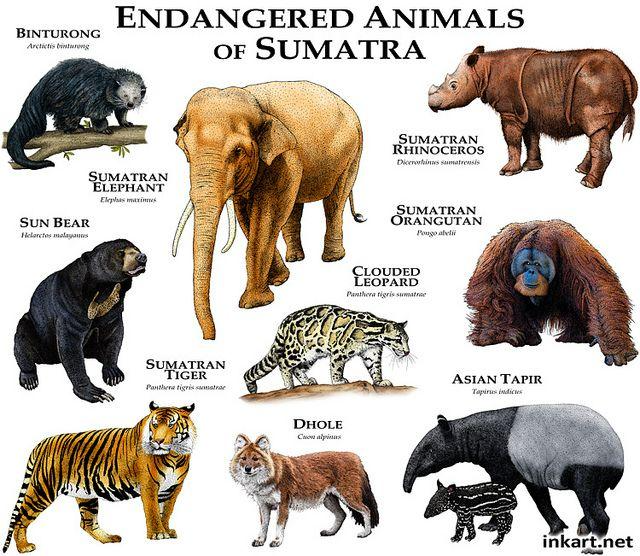
Five plant species whose natural habitat is destroyed due to human activity are Calamites, Rhynia, Saint Helena Olive, Cooksonia, Silphium, and Franklinia.

5. Make a list of extinct animal and plant species from India by going through various books and magazine.
Ans: List of Extinct Animal and Plant Species from India:
| Category | Species Name | Remarks |
| Animals | Cheetah (Acinonyx jubatus venaticus) | Extinct from India since 1952. |
| Lesser Indian Rhinoceros (Javan Rhino subspecies) | Once found in Assam and Bengal, now extinct. | |
| Pink-headed Duck (Rhodonessa caryophyllacea) | Not seen since 1940s, considered extinct. | |
| Himalayan Quail (Ophrysia superciliosa) | Last seen in 19th century, believed extinct. | |
| Indian Aurochs (Bos primigenius namadicus) | Wild ancestor of cattle, extinct centuries ago. | |
| Plants | Sterculia khasiana | A tree from Khasi Hills, Meghalaya, now extinct. |
| Limnophila limnophiloides | Aquatic plant from Bhushi Lake, Maharashtra, extinct. |
6. ‘The development projects have harmed the tribal society the most’ give your views on the above given statement.
Ans: The development project harms the tribal community as the industrialization, urbanization, etc disturbed the tribal habitat, culture, and lives. They are sometimes also forced to give up their lands. The developmental projects such as new product service, the establishment of factories and industries, urbanization have harmed the tribal society the most because establishing new factories, or industries built upon forest land over cutting down the trees disturbed the habitat of the tribal community. Sometimes, in the name of industrialization or urbanization, the tribal are made to leave their habitat and forced to move to different places. This also causes difficulties to the tribal community.
7. Discuss “deforestation results in desertification”.
Ans: Deforestation results in desertification as the removal of trees left the soil particles loose. This results in the removal of the upper layer of the soil through wind or water and eventually leads to desertification. Deforestation is caused due to the cutting down of trees on a large scale. The roots of the trees in the forest are used to hold up the soil particles firmly. If the trees are being cut down, then there will be no medium to hold on to the soil particles firmly. Therefore, soil particles can be easily moved away via wind, rain, flood, etc. This eventually results in desertification.
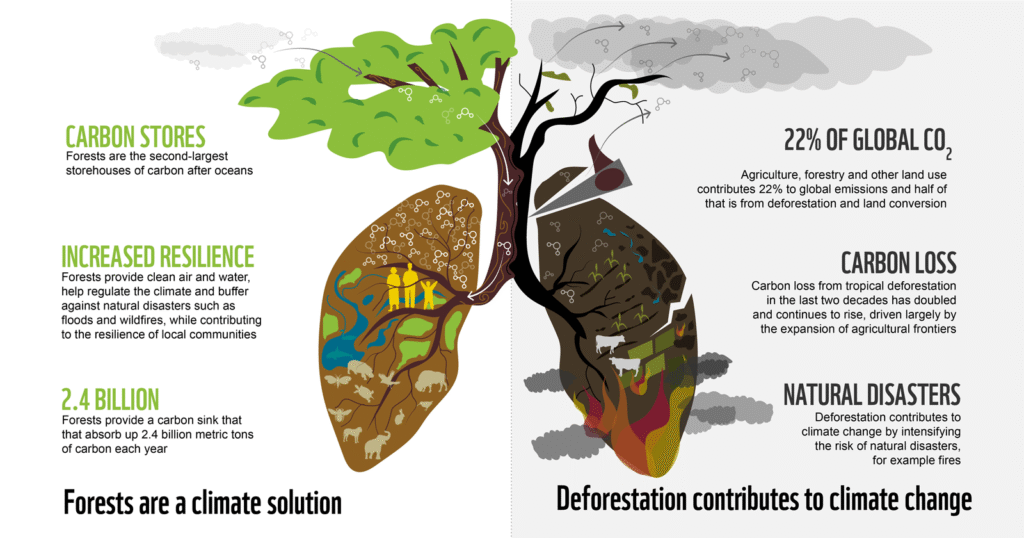
8. Write an essay on the importance of forest in human life. Support your answer with diagram.
Ans: Forests are the green lungs of our planet and play a vital role in human life. They purify the air by absorbing carbon dioxide and releasing oxygen, which is essential for survival. Forests maintain the water cycle, bring rainfall, prevent soil erosion, and reduce the impact of floods and droughts. They provide us with timber, fuelwood, paper, rubber, fruits, medicinal plants, and many other resources that support industries and livelihoods. Forests are home to more than 80% of terrestrial biodiversity and provide shelter, food, and breeding grounds for countless plants and animals. Many tribal communities depend directly on forests for their culture, economy, and survival. Forests also regulate climate by acting as carbon sinks and controlling global warming. Thus, forests are indispensable for ecological balance, economic growth, and human well-being, and it is our duty to conserve them for the future.

Hi, I’m Dev Kirtonia, Founder & CEO of Dev Library. A website that provides all SCERT, NCERT 3 to 12, and BA, B.com, B.Sc, and Computer Science with Post Graduate Notes & Suggestions, Novel, eBooks, Biography, Quotes, Study Materials, and more.
Subject Ka Complete Video Solution Dekhein
Step-by-step easy concept explanation aur full questions Answer ke liye watch karein ya app download karein:

 Buy Now