
NIOS Class 12 Environmental Science Chapter 13 National Environmental Issues Solutions to each chapter is provided in the list so that you can easily browse throughout different chapters NIOS Class 12 Environmental Science Chapter 13 National Environmental Issues Notes and select need one. NIOS Class 12 Environmental Science Chapter 13 National Environmental Issues Question Answers Download PDF. NIOS Study Material of Class 12 Environmental Science Paper Code 333.
NIOS Class 12 Environmental Science Chapter 13 National Environmental Issues
Also, you can read the NIOS book online in these sections Solutions by Expert Teachers as per National Institute of Open Schooling (NIOS) Book guidelines. These solutions are part of NIOS All Subject Solutions. Here we have given NIOS Class 12 Environmental Science Chapter 13 National Environmental Issues Solutions, NIOS Senior Secondary Course Environmental Science Solutions for All Chapter, You can practice these here.
National Environmental Issues
Chapter: 13
Module 4: Contemporary Environment issues
Textual Question Answer
INTEXT QUESTIONS 13.1
1. What does the statement, “some Indian flora and fauna are endemic”, mean,?
Ans: Those plant and animal species that are local i.e. not found anywhere else.
2. Which part of India holds the ‘granaries’ and which part is mineral – rich?
Ans: The northern plains (granaries) and peninsular plateau (mineral rich).
3. List five major forest types of India.
Ans: Tropical rain forest, tropical deciduous forest, temperate broad leaf forests, temperate needle leaf or coniferous forest alpine and tundra vegetation.
4. Name any three materials that forest provide to us.
Ans: Wood, gums, dyes, tannins, fibres, medicines, food (any three)
INTEXT QUESTIONS 13.2
1. Define population.
Ans: As a group of individuals living in the given area and capable of inbreeding and sharing genetic material.
2. List four major periods of human population growth.
Ans: The four major periods of human population growth include:
(i) An early period of hunters and gatherers: At that time the total population was less than a few million.
(ii) The period of rise of agriculture: This period led to greater density of people and caused the first major rise in the human population.
(iii) The industrial revolution: This resulted in better food supply, improved healthcare which, in turn, led to rapid rise in the population, and
(iv) The present: When the population is slowing down in the wealthy and industrialized nations but is still growing rapidly in poorer and developing and underdeveloped nations.
3. List major parameter for the study of demography.
Ans: Size, growth, age-structure, fertility, birth rate, death rate, standard of living, Migration etc.
4. Define exponential growth.
Ans: Growth at a constant rate of increase per unit time is termed as exponential growth.
5. Why internal migration within a country does not affect its total population size? What kind of migration does affect the population size of a country?
Ans: Because it is still within a country; emigration, and immigration.
INTEXT QUESTIONS 13.3
1. Name at least three countries which have higher population density than India.
Ans: Japan, Malta, and Bangladesh.
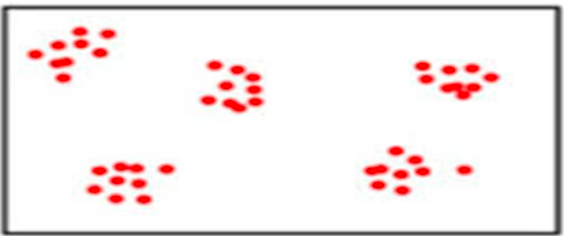
2. Prepared a dispersion map of your locality.
Ans: Dispersion map of locality shows clumped distribution.
Diagram with labelling:
3. Why is age structure data of a pollution so important.
Ans: The age structure of a country helps to predict future population growth. The shape of an age structure diagram depicts whether the population is increasing, stationary, or shrinking.
4. What does poor sex-ratio of a state/country is suggestive of?
Ans: The poor sex ratio demonstrates the discrimination against female child, social pressure; female foeticide, etc.
INTEXT QUESTIONS 13.4
1. Enumerate at least three human activities that cause lasting impact on the environment.
Ans: The following human activities cause lasting impact on the environment:
(i) Large-scale agriculture and deforestation.
(ii) Industrialization and urbanization.
(iii) Over-exploitation of natural resources like land, water, minerals, and forests.
2. List three parameters that characterize the standard of living of a population.
Ans: A population is also characterized by certain parameters, such as:
(i) life expectancy (should be high).
(ii) infant mortality rate (should be low).
(iii) income per head (should be high).
3. When we modified environment, what are the problems generally failing by us?
Ans: Attributed to the modification of the environment has led to various problems.
Some of the problems encountered are;
(i) Food shortage: It could be attributed to less agricultural production, improper and inadequate storage, or economic poverty to purchase food.
(ii) Inadequate shelter: Not every single individual can afford safe shelter and is subjected to extremes of high and cold temperatures of the atmosphere, and falling prey to wild animals.
(iii) Diseases: Malnutrition, lack of medical facilities, inadequate sanitation, increased vulnerability to disease, particularly among young and old, as well as invasion and mutation of the pathogens, leads to epidemics.
(iv) Calamities: Natural catastrophes like floods, and earthquakes, uproot human settlements and damage property.
(v) Miscellaneous: These include human-made accidents involving explosions, fire, pollution, shipwrecks, air, and road accidents that wipe out lives.
INTEXT QUESTIONS 13.5
1. How does one classify water as fresh, brackish or marine?
Ans: Salt content <5 ppt: Fresh water.
Salt content >5 but more than <35 ppt: Brackish water.
Salt content >35 ppt: Marine water.
2. List four major causes those results in scarcity of fresh water in urban areas?
Ans: Careless attitude, waste in agriculture, lowering of water table; increase in demand; water pollution.
3. How does the improper sewage system in the cities affect quality of water?
Ans: (a) Domestic affluents contain pathogens that cause diseases.
(b) Affluent contain nitrates and phosphates; these help growth of aquatic organisms; make water unfit for human consumption.
4. Define flood. How does it affect human lives?
Ans: Flood is a body of water that covers normal dry lands.
Consequences of most floods are as follows. They:
(i) destroy homes and valuable property.
(ii) carry top fertile soil, leaving the land barren.
(iii) destroy both food and cash crops.
(iv) cause huge losses to human –lives and cattle.
(v) cause landslide in the hilly-areas.
(vi) cause dam burst.
5. List three preventive methods to over come the miseries caused by flood.
Ans: (i) Improper water, storage capacity.
(ii) Migrate people to safer places.
(iii) Store enough tool and fodder in good times.
(iv) Aggressive afforestation.
(v) Effective /proper water shed/catchments area management.
6. Name three major kind of energy generating plants in our country. What are their relative contributions towards our electric energy needs?
Ans: Hydroelectric (21%), Thermal (75%), Nuclear (3%).
7. List some of measures that you would adopt to prevent the wasteful expenditure of electrical energy in your household.
Ans: The three methods to prevent that can be adopted to prevent the wasteful expenditure of electrical energy in your household are turning off the light unnecessary, using a power strip to reduce your plug load, eliminating the vampire power.
8. How does urbanization leads to pollution?
Ans: Urbanization leads to pollution because of the establishment of factories, industries that release air pollutants such as carbon monoxides, carbon dioxide, etc.
| TERMINAL EXERCISE |
1. “Environment has no geographical boundaries” Explain.
Ans: Environment has no geographical boundaries because environmental problems such as air pollution, water pollution, climate change, global warming, ozone depletion, and loss of biodiversity are not confined to a particular region or country. The air, water, and atmosphere are shared globally, so pollutants released in one place can affect other regions. For example, acid rain, melting of glaciers, or greenhouse gas emissions in one country can influence the climate and ecosystems of the whole world. Hence, the environment is continuous and boundary-less, beyond man-made political divisions.
2. How does increase in population leads to depletion and degeneration of natural resources?
Ans: The increment in population leads to the depletion and degradation of natural resources as if there are many people. The consumption of natural resources will also increase-overconsumption of natural resources by the large population results in the depletion and degradation of natural resources.
3. List major environmental issues that confront us?
Ans: The major environmental issues that confront us include air pollution, water pollution, land pollution, deforestation, overfilling landfills, emission of greenhouse gases, depletion of the ozone layer, gas emission etc.
4. Enumerate the various climate factors that determine vegetation of a region?
Ans: Various climate factors determine the vegetation of a region as the temperature and humidity of regions severs the main factors of a region’s vegetation. For example, the region with a high temperature has the evergreen forest whereas, a region with a lower temperature serves as the needle leaf-like trees to reduce the transpiration.
5. Look at the figure 13.2 and answer the following questions:
(a) What kind of forest-type dominate Western India?
Ans: Tropical Deciduous Forests dominate Western India.
(b) Which region of our country has alpine/tundra vegetation?
Ans: A region such as the Himalayas, Karakoram are covered with alpine and tundra forest and vegetation.
(c) Which kind of forest type is maximally distributed in India?
Ans: Tropical Deciduous forest largely distributed in India.
(d) In which part of the country tropical rain-forest found?
Ans: The tropical rainforests is found in the region like Andaman and Nicobar Island, western ghats, the northeastern states, some regions of Odisha etc.
6. Define: Death rate, birth rate, natality, mortality, growth rate, migration.
Ans: (i) Death Rate: The number of deaths in a population per 1,000 individuals per year.
(ii) Birth Rate: The number of live births in a population per 1,000 individuals per year.
(iii) Natality: The ability of a population to reproduce; usually expressed as the number of births per unit of population per unit of time.
(iv) Mortality: The number of deaths occurring in a population per unit of population per unit of time.
(v) Growth Rate: The rate at which a population increases in size during a given period, calculated as the difference between the birth rate and death rate, plus migration.
(vi) Migration: The movement of people from one place to another, either temporarily or permanently, usually in search of better living conditions, employment, or safety.
7. When would a region be called over populated?
Ans: A region is considered as overpopulated when it exceeds its sustainable size within a particular environment or habitat. It is caused due to the increment of the birth rate and decrement in the death rate.
8. Draw the population curve and explain the different phases of the curve?
Ans: Diagram with labelling:

Forms increase and decrease in the population form a curve, which is also called a population curve. There are three different phases of the population curve: young and growing, elderly and shrinking and stationary, little or no population growth.
9. Define census. How does this help a country?
Ans: Census is the process of enumerating the people of the country. It helps the country to enumerate, acquire, and record the people of the countries. It also helps the country to acquire the number of citizens residing outside the country.
10. Why should the sex-ratio of a population remain more or less constant/balanced?
Ans: The sex ratio of a population remains constant/balanced because, in the human species, the ratio between males and females at birth is slightly biased towards the male sex. Therefore, the birth on average, there are 105 males for every 100 females.
11. Discuss urbanization and social-economical factors.
Ans: Urbanization is stated when the rural shift to urban cities due to social-economic factors. Social-economic factors include a search for better jobs, better life, unemployment, financial crisis etc.
12. Visit the various households in your locality (a) and interact with people, interview them and prepare status of energy/water requirement/need and availability. (b)What measures would you propose at local level so that wasteful expenditure of energy and water is avoided?
Ans: (a) Description of Ashok Nagar Locality:
(i) Status of energy – 70-75% is consumption.
(ii) Water requirement- Through Municipal cooperation tapline.
(iii) Availability – 2 times a day.
(b) Some measures at local level so that wasteful expenditure of energy and water is avoided are:
(i) Always check your pipes for leaks.
(ii) Must take shorter showers.
(iii) Turn off the water while brushing your teeth.
(iv) Stop Pre-Rinsing Dishes.
(v) Reuse water.
(vi) Apply rain water harvesting.
(vii) Shutdown your computer properly.
(viii) Turn off the lights.
(ix) Unplug idle electronics.
(x) Choose the right light.
(xi) Use power strips.
13. (a) List as many as possible the harmful and hazardous materials from different sources that occur/accumulate in your locality and (b) Suggest measures to minimize this kind of pollution in your locality.
Ans: (a) Toilet cleaning products such as phenyl, rat killing poison, mosquito repellent, chlorine etc.
(b) To avoid throwing them openly remains of these hazardous chemicals, one must discharge them properly.
14. Differentiate between floods and drought.
Ans:
| Flood | Drought |
| Overflow of water beyond normal limits. | Shortage of water for a prolonged period. |
| Caused by heavy rains, melting of snow, or ocean waves. | Caused by little or no rainfall for a long time. |
| Leads to submergence of land, damage to crops, and property loss. | Leads to crop failure, famine, and scarcity of drinking water. |
15. List four diseases caused by contaminated home discharged water.
Ans: The four diseases which are caused by contaminated home discharged water are cholera, typhoid, diarrhea and dysentery.
16. How is regular supply of water is maintained on earth?
Ans: The evaporated water from oceans and the surface of land get holed by the atmosphere and fall back on earth in precipitation. Then this water goes underground, and this is how the groundwater is restored. Thus, the regular supply of water is maintained on Earth.

Hi, I’m Dev Kirtonia, Founder & CEO of Dev Library. A website that provides all SCERT, NCERT 3 to 12, and BA, B.com, B.Sc, and Computer Science with Post Graduate Notes & Suggestions, Novel, eBooks, Biography, Quotes, Study Materials, and more.
Subject Ka Complete Video Solution Dekhein
Step-by-step easy concept explanation aur full questions Answer ke liye watch karein ya app download karein:

 Buy Now