
NCERT Class 9 Social Science Chapter 9 The Price Puzzle: What Drives the Market Solutions English Medium As Per New Syllabus. NCERT Class 9 Social Science Chapter 9 The Price Puzzle: What Drives the Market Notes to each chapter is provided in the list so that you can easily browse throughout different chapter NCERT Class 9 Social Science Chapter 9 The Price Puzzle: What Drives the Market Question Answer Download PDF and select needs one.
NCERT Class 9 Social Science Chapter 9 The Price Puzzle: What Drives the Market
Also, you can read the CBSE book online in these sections Solutions by Expert Teachers as per (CBSE) Book guidelines. NCERT Class 9 Social Science Textual Solutions. These solutions are part of NCERT All Subject Solutions. Here we have given NCERT Class 9 Social Science Notes in English Medium Solutions for All Subject, You can practice these here.
The Price Puzzle: What Drives the Market
Chapter – 9
| Part – I: Economics |
| Textual Question Answer |
The Big Questions
1. What are the factors that influence the demand for and supply of goods and services in a market?
Ans: The demand and supply of goods and services are influenced by several factors. Demand depends on the price of the product, consumer income, tastes and preferences, prices of related goods (substitutes and complementary goods), population, seasonality, and future price expectations. Supply is affected by the price of the product, cost of production, technology, prices of related goods, number of sellers, availability of resources, weather conditions, and future expectations of producers. These factors determine how much consumers are willing to buy and how much producers are willing to sell, thereby influencing market prices and availability of goods and services.
2. How are prices of goods and services determined through demand and supply interactions?
Ans: Prices of goods and services are determined by the interaction of demand and supply in the market. When the demand for a product is greater than its supply, prices tend to rise because more buyers compete for limited goods. On the other hand, when the supply of a product exceeds its demand, prices fall as sellers reduce prices to attract buyers. The price at which the quantity demanded equals the quantity supplied is called the market equilibrium price. At this point, there is neither a shortage nor a surplus, and the market remains stable until changes in demand or supply occur.
3. What is market equilibrium, and does it exist in the real world?
Ans: Market equilibrium is the point where the quantity demanded by consumers is equal to the quantity supplied by producers. At this price, there is neither a shortage nor a surplus of goods, so prices remain stable. However, in the real world, market equilibrium is not permanent because demand and supply keep changing due to factors such as technology, income, weather, consumer preferences, government policies, and unexpected events like pandemics or natural disasters. Therefore, markets are always adjusting to new conditions, and equilibrium is continuously shifting rather than remaining fixed.
4. How and why does the government intervene in the market?
Ans: The government intervenes in the market to ensure fairness, protect consumers, and promote public welfare. It regulates unfair practices such as monopolies, hoarding, black marketing, and overpricing by setting price ceilings for essential goods and price floors such as minimum wages. The government also provides public goods and services like roads, schools, hospitals, and sanitation, which private firms may not supply adequately. During emergencies, it controls prices and ensures the availability of essential goods. Through these measures, the government aims to maintain market stability, protect vulnerable groups, and ensure equal access to essential goods and services.
LET’S EXPLORE
1. Create your own demand schedule for buying notebooks at different prices. At what price would you buy the most? At what price would you stop buying altogether? What could be the reason behind your choices?
| Price of Notebook (₹) | Quantity I Would Buy |
| 100 | 1 |
| 80 | 2 |
| 60 | 3 |
| 40 | 5 |
| 20 | 8 |
(i) I would buy the most at ₹20 because the notebooks are the cheapest.
(ii) I would stop buying at ₹120 or above because the price is too high for my budget.
(iii) Reason: As the price decreases, I can afford to buy more notebooks. When the price increases, I buy fewer notebooks or stop buying because they become too expensive.
2. Ask your family members if they postponed or advanced buying any product because of future expectations of changes in price.
Ans: Yes, my family postponed buying a television until the festive season because they expected discounts during Diwali sales. As expected, the price was lower, and they bought it at a better deal. This shows that future expectations of lower prices can delay current purchases, while expectations of higher prices may encourage people to buy earlier.
3. Have you ever seen or heard of the government fixing prices or wages (for example, bus fares, medicines, or minimum wages)? Share an example and why you think it was done.
Ans: Yes, I have heard of the government fixing the prices of essential medicines under the National Pharmaceutical Pricing Authority (NPPA). The government sets a maximum price for many life-saving medicines to ensure they remain affordable for everyone. This is done to protect consumers from overpricing and to make essential healthcare accessible, especially for low-income families. Such price controls help prevent exploitation and ensure that people can purchase necessary medicines at fair prices.
4. From your surroundings, list two goods or services that are provided by the government (for example: roads, streetlights, parks, police, and so on.). Choose one of the goods you listed and answer:
Ans: Two government-provided goods/services:
Roads
Streetlights
Chosen Service: Roads
1. Who benefits from it?
Ans: Everyone in the community benefits from roads, including students, workers, farmers, shopkeepers, and emergency services such as ambulances and fire brigades.
2. Why would it be difficult for a private company to provide this service on its own?
Ans: Building and maintaining roads requires a huge amount of money and serves the entire public. A private company may not earn enough profit because it cannot charge every person who uses the roads.
3. Imagine the government stops providing this service. What problems might people in your area face?
Ans:People would face poor transportation, traffic problems, delayed emergency services, difficulty in reaching schools and hospitals, and higher travel costs. Trade and daily life would also be seriously affected.
LET’S RECALL
In the chapter ‘Democracy’, you have read that a democratic government is accountable to the people and is expected to act in their interest.
1. According to you, how should a democratic government decide when and how much it should intervene in markets to protect people’s welfare?
Ans: A democratic government should intervene in the market only when necessary, such as during shortages, unfair pricing, monopolies, or emergencies. Its intervention should protect consumers, ensure fair competition, and make essential goods and services affordable without discouraging producers or businesses.
2. Whose voices should a democratic government consider while making such decisions—consumers, producers, workers, or others? Why?
Ans: A democratic government should consider the views of consumers, producers, workers, and experts. Consumers need affordable goods, producers require fair profits, workers deserve fair wages and safe working conditions, and experts can provide informed advice. Considering all these voices helps the government make balanced decisions that promote the welfare of the entire society.
Questions and activities
1. An increase in income always leads to a rise in demand for goods. Defend or refute, giving reasons.
Ans: Refute. An increase in income does not always lead to a rise in demand for all goods. While higher income usually increases the demand for normal goods such as better clothes, electronics, and healthy food, it may reduce the demand for inferior goods such as low-quality products because people prefer better alternatives. Therefore, the effect of higher income depends on the type of good and consumer preferences.
2. If petrol prices double, what happens to:
(a) Demand for diesel cars:
(b) Demand for electric cars:
(c) Demand for car accessories:
(d) Demand for public transport:
Ans: (a) Demand for diesel cars: The demand for diesel cars is likely to increase because they are generally more fuel-efficient than petrol cars.
(b) Demand for electric cars: The demand for electric cars is likely to increase as people look for cheaper alternatives to petrol vehicles.
(c) Demand for car accessories: The demand for car accessories is likely to decrease because fewer people may buy new cars due to higher fuel costs.
(d) Demand for public transport: The demand for public transport is likely to increase because it becomes a more affordable option compared to using private petrol vehicles.
4. During online festival sales, the prices of many products are very low. Use the concept of demand and supply to explain why the sellers sell at such a low price. What happens to the equilibrium when the price is lowered? Does this benefit only consumers or sellers as well? Explain.
Ans: During online festival sales, sellers reduce prices to attract more customers and increase the demand for their products. Lower prices encourage consumers to buy larger quantities, helping sellers clear old stock and increase overall sales. When the price is lowered, the quantity demanded increases, and the market moves toward a new equilibrium where more goods are sold. These sales benefit both consumers and sellers. Consumers save money by buying products at discounted prices, while sellers increase their sales, attract new customers, and earn higher overall revenue despite lower prices.
5. Suppose the government sets a maximum sale price for an essential vaccine below the market-driven price. What is likely to happen?
(a) Surplus.
(b) Shortage.
(c) No effect
(d) Fall in demand
Ans: (b) Shortage
Explanation:
When the government fixes the maximum price of an essential vaccine below the market equilibrium price, producers may reduce production because they earn lower profits. At the same time, more consumers want to buy the vaccine because it is cheaper. As a result, demand becomes greater than supply, leading to a shortage of the vaccine in the market.
6. Other goods where price controls have been set in place. What are the reasons?
Ans: Some other goods where the government has set price controls include essential medicines, LPG cooking gas, and fertilizers. These price controls help keep essential goods affordable for everyone, especially low-income families. They also prevent overpricing, ensure a steady supply of important goods, and protect consumers during emergencies or periods of high inflation.
7. Can excessive government regulation hurt markets?
Ans: Yes, excessive government regulation can hurt markets. Strict price controls and complicated rules may reduce producers’ profits and discourage businesses from investing or increasing production.
8. In the table below, different prices of guava are given.
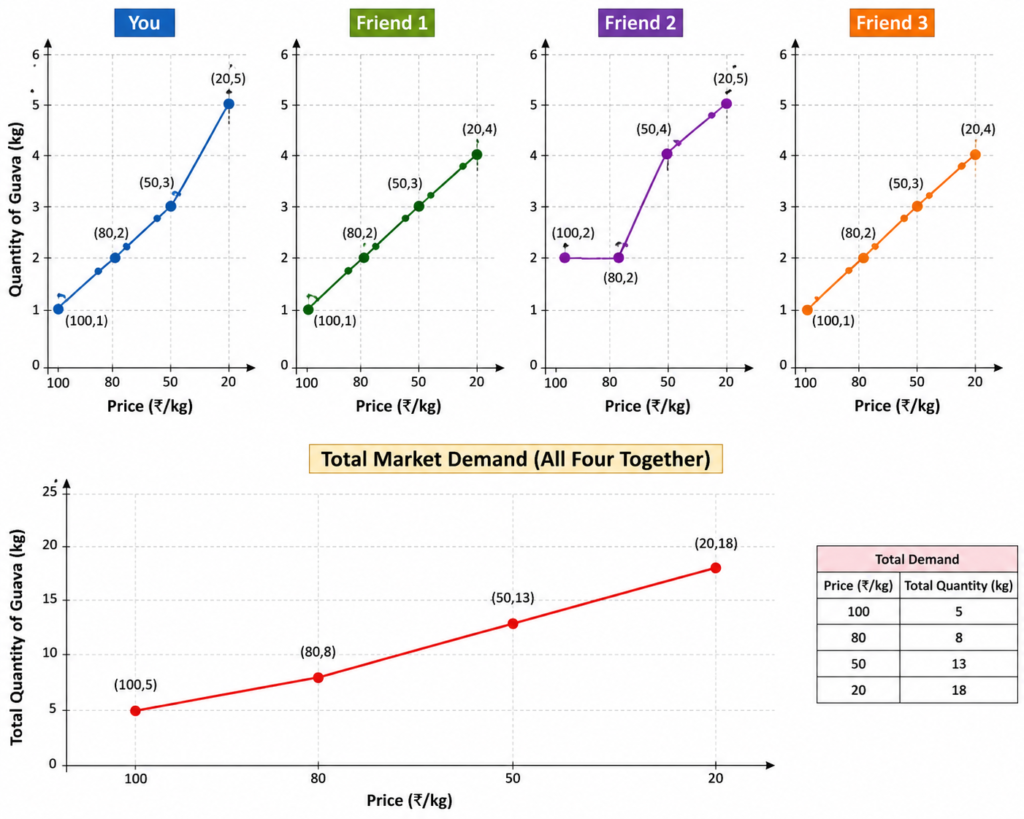
(a) Think and write how much guava you will buy at each price.
(b) Ask the same question to three of your friends and fill in the table.
(c) Also make a graph for each one of you and one final graph for the total quantity.
| Price | You | Friend 1 | Friend 2 | Friend 3 | Total |
| ₹100/kg | |||||
| ₹80/kg | |||||
| ₹50/kg | |||||
| ₹100/kg |
Ans:
| Price (₹/kg) | You | Friend 1 | Friend 2 | Friend 3 | Total (kg) |
| ₹100 | 1 | 1 | 2 | 1 | 5 |
| ₹80 | 2 | 2 | 2 | 2 | 8 |
| ₹50 | 3 | 3 | 4 | 3 | 13 |
| ₹20 | 5 | 4 | 5 | 4 | 18 |
9. Visit the nearby vegetable market and try to find answers to the following questions.
(a) Who decides the prices of different vegetables in the vegetable market?
Ans: The prices are decided by the interaction of demand and supply in the market.
(b) Sometimes the prices of a few vegetables are too high, and sometimes too low. Why is this?
Ans: Prices change due to seasonal production, weather, demand, and supply.
(c) The price of tomatoes is high in the morning and eventually gets lower by the evening. Have you ever noticed this? Comment.
Ans: Yes. Sellers lower the price in the evening to sell the remaining stock because tomatoes are perishable.
10. Categorise the following combination of goods into substitute goods and complementary goods.
(a) Movie ticket in the cinema hall and popcorn
(b) Eraser and pencil
(c) Laptop and computer
(d) Air Conditioner and cooler
(e) Notebook and pen
(f) Apple and banana
(g) Mobile and earphones
Ans:
| Combination of Goods | Category |
| (a) Movie ticket and popcorn | Complementary Goods |
| (b) Eraser and pencil | Complementary Goods |
| (c) Laptop and computer | Substitute Goods |
| (d) Air Conditioner and cooler | Substitute Goods |
| (e) Notebook and pen | Complementary Goods |
| (f) Apple and banana | Substitute Goods |
| (g) Mobile and earphones | Complementary Goods |
11. Based on Fig. 9.8, answer the following questions:
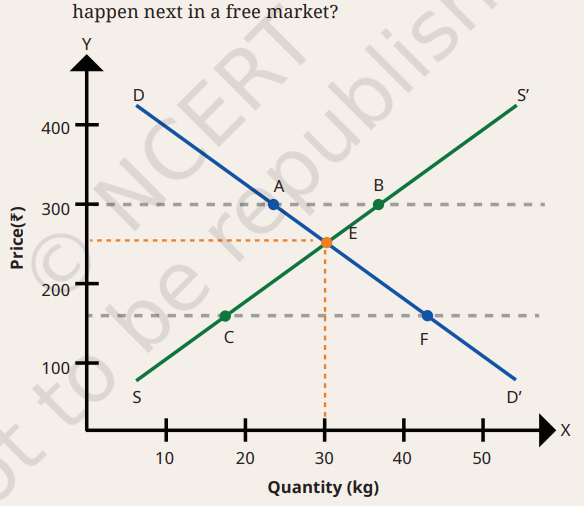
(a) What does point E represent in this market?
Ans: Point E represents the market equilibrium, where demand equals supply.
(b) What is the equilibrium price and equilibrium quantity at point E?
Ans: Equilibrium Price: ₹250
Equilibrium Quantity: 30 kg
(c) Point A lies on DD’. Point B lies on SS’. What do the points A and B indicate? What does the gap between A and B represent?
Ans: Point A shows the quantity demanded, and point B shows the quantity supplied at the higher price (₹300). The gap between A and B represents excess supply (surplus).
(d) Point F lies on DD’. Point C lies on SS’. What do the points F and C indicate? What does the gap between C and F represent?
Ans: Point F shows the quantity demanded, and point C shows the quantity supplied at the lower price (₹170). The gap between C and F represents excess demand (shortage).
(e) If the price stays at the lower dashed line, what could happen next in a free market?
Ans: The price is likely to increase until the market reaches the equilibrium point because demand is greater than supply.
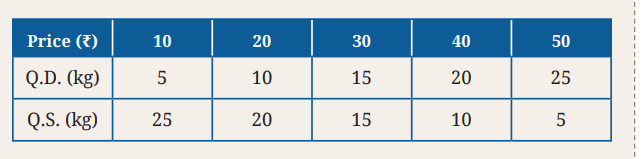
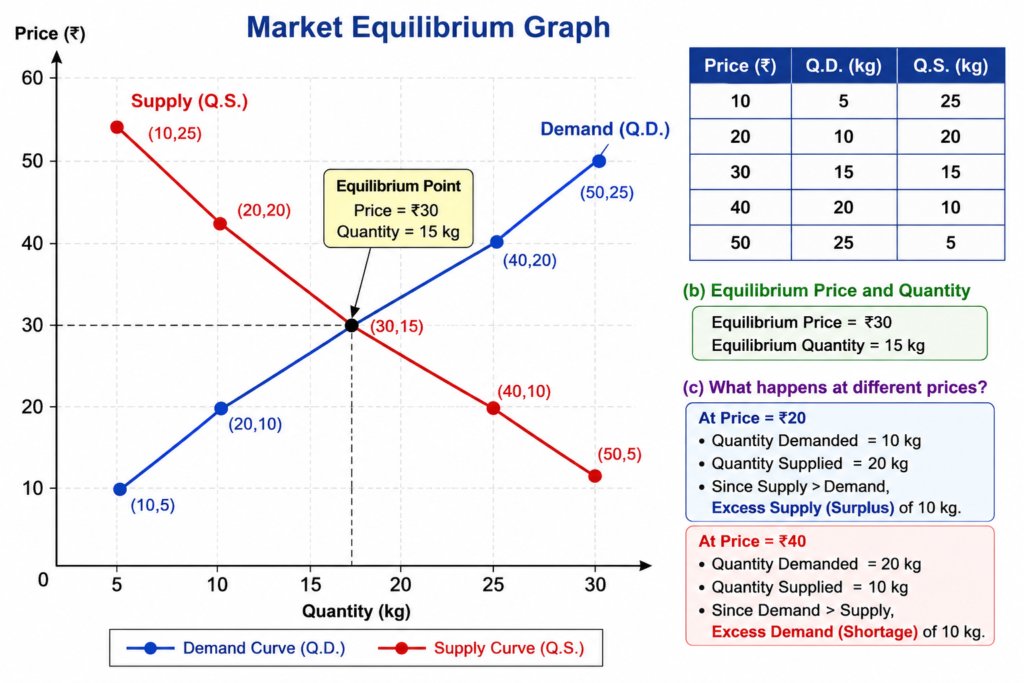
12. Draw a market equilibrium graph using the following demand schedule.
(a) Plot the demand and supply curve using the above data.
(b) Identify the equilibrium price and quantity.
(c) Observe the above data and analyse what happens if the price is set at ₹20 or ₹40.

 Buy Now