
NCERT Class 9 Social Science Chapter 13 Governance and Public Policy Solutions English Medium As Per New Syllabus. NCERT Class 9 Social Science Chapter 13 Governance and Public Policy Notes to each chapter is provided in the list so that you can easily browse throughout different chapter NCERT Class 9 Social Science Chapter 13 Governance and Public Policy Question Answer Download PDF and select needs one.
NCERT Class 9 Social Science Chapter 13 Governance and Public Policy
Also, you can read the CBSE book online in these sections Solutions by Expert Teachers as per (CBSE) Book guidelines. NCERT Class 9 Social Science Textual Solutions. These solutions are part of NCERT All Subject Solutions. Here we have given NCERT Class 9 Social Science Notes in English Medium Solutions for All Subject, You can practice these here.
Governance and Public Policy
Chapter – 13
| Part – II: Understanding Society India and Beyond |
| Textual Question Answer |
1. What is governance, and how have its meaning and practice evolved over time?
Ans: Governance is the process through which decisions are made, implemented, and monitored for the welfare of people. It involves the government, citizens, media, civil society, and private organisations. Earlier, governance was mainly associated with the authority of rulers and traditional institutions. During colonial rule, many traditional systems were replaced by colonial institutions. After Independence in 1947, India adopted its Constitution and adapted traditional values to the needs of a modern democracy. Today, democratic governance emphasises transparency, accountability, participation, the rule of law, and public welfare.
2. What is public policy? How does it affect our day-to-day lives, and what makes it ‘public’?
Ans: Public policy is a course of action adopted by the government to solve public problems, meet people’s needs, and promote social welfare. It affects our daily lives through services such as education, healthcare, transportation, clean drinking water, electricity, sanitation, and public safety. It is called ‘public’ because it addresses issues affecting society, is formulated by the government, promotes public welfare, and often uses public money collected through taxes.
3. What are the various stages of policy-making and policy implementation?
Ans: The major stages of policy-making and implementation are:
(i) Policy Desirability: Identifying the needs and problems that require attention.
(ii) Prioritising Policy: Deciding which issues should be addressed first.
(iii) Policy Formulation: Consulting stakeholders, preparing a draft policy, and assessing its financial feasibility.
(iv) Policy Adoption: Approving the policy and framing the necessary laws, rules, and guidelines.
(v) Policy Implementation: Putting the policy into action through government departments, local bodies, organisations, and citizens.
(vi) Policy Monitoring: Measuring progress, ensuring accountability, and identifying shortcomings.
(vii) Policy Evaluation: Assessing the results and impact of the policy and collecting feedback for improvement.
4. Who are the major contributors to policy-making and implementation?
Ans: The major contributors to policy-making and implementation are:
(i) Citizens: Identify problems, vote, offer suggestions, participate in discussions, and provide feedback.
(ii) Elected Representatives: Represent people, raise public issues, participate in law-making, and approve budgets.
(iii) Government Officials and Departments: Prepare and implement policies, coordinate activities, deliver public services, and monitor progress.
(iv) Civil Society Organisations, NGOs, Experts, Researchers, and Media: Study problems, suggest solutions, create awareness, and monitor programmes.
(v) Private Sector: Provides technical knowledge, innovation, resources, and expertise.
(vi) International Organisations: Provide technical assistance, international experience, and financial support.
5. What role do citizens play in shaping public policy and strengthening good governance?
Ans: Citizens play an important role in shaping public policy and strengthening good governance. They identify public problems, vote in elections, participate in consultations, express their concerns, offer suggestions, and provide feedback on implemented policies. They also follow laws, hold public officials accountable, and participate in community activities. Through active participation, citizens help make governance more transparent, responsive, inclusive, and effective.
Questions and activities
1. “Good governance is the responsibility of the government alone. Do you agree with this statement? Give reasons to support your answer.
Ans: I do not agree with the statement that good governance is the sole responsibility of the government. While the government has the formal authority to make laws, allocate resources, and provide public services, good governance is fundamentally a partnership between the government and society.
Some Reasons:
Role of Citizens: Citizens play an indispensable role by electing representatives, obeying laws, raising local concerns, and providing feedback on public service delivery.
Role of Civil Society and NGOs: Civil society organizations and NGOs work closely with communities to raise awareness on social issues, conduct grassroots development, and monitor government programs.
Role of the Media: The media keeps citizens informed about key issues, brings critical matters to public attention, and holds public authorities accountable.
Role of the Private Sector: Private businesses contribute through economic investment, technological innovation, and executing projects via Public-Private Partnerships (PPP).
Need for Collective Action: Complex public challenges—such as disaster relief, sanitation, traffic management, and environmental protection—cannot be solved by government orders alone; they require inter-departmental coordination and active community participation.
2. Do you think students can contribute to good governance? Write a short note describing any five ways in which students can become more responsible and active citizens.
Ans: Yes, students can actively contribute to good governance. Good governance starts at the school and community level, where students learn civic duties and practice active citizenship.
Here are five ways students can become responsible and active citizens:
(i) Promoting Environmental Responsibility: Leading initiatives like creating a “Plastic-Free Campus,” segregating waste at source, and conserving water and electricity at school and home.
(ii) Highlighting Local Issues: Identifying ground-level problems—such as traffic congestion near school gates, non-functional streetlights, or lack of accessibility—and reporting them to school leaders or local representatives.
(iii) Participating in Community and School Schemes: Actively taking part in civic and sports initiatives (like, Khelo Bharat Niti, cleanliness drives, tree plantation campaigns).
(iv) Obeying Laws and Civic Rules: Respecting traffic regulations, caring for public property, maintaining civic discipline, and resisting misinformation.
(v) Engaging in Civic Consultations and Feedback: Participating in student representative bodies, contributing ideas during policy consultations (similar to student inputs for NEP 2020), and giving feedback on public facilities.
3. Choose any one public policy [for example, Right to Education (RTE), Swachh Bharat Mission, PM POSHAN, Ayushman Bharat, Digital India, or Jal Jeevan Missio) and prepare a chart showing the following aspects:
The problem it addresses
The major stakeholders involved
How different actors coordinate How
The role of citizens in its success
Present your findings to the class.
Ans:
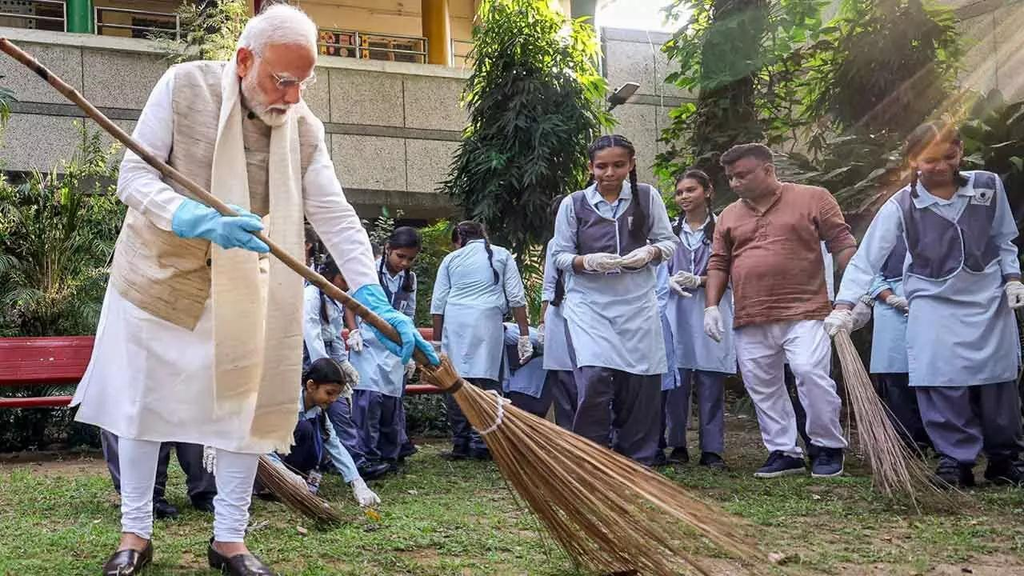
Open defecation, poor sanitation, improper waste disposal, and unhygienic surroundings.
Central Government, State Governments, local bodies, sanitation workers, NGOs, schools, and citizens.
The Central Government provides policies and support. State Governments implement programmes. Municipalities and village panchayats manage waste and sanitation. Schools and NGOs spread awareness.
Citizens should use toilets, avoid littering, segregate waste, reduce plastic use, participate in cleanliness drives, and encourage others to maintain hygiene.
4. Answer the following in one or two sentences.
a. What is governance?
Ans: Governance is the system and process of making, implementing, and monitoring decisions to manage public affairs and ensure the welfare of society.
b. How is governance different from government?
Ans: Government refers to the formal institutions that hold political power, whereas governance refers to the functional process of decision-making and implementation involving government, citizens, civil society, and the private sector.
c. What is meant by public policy?
Ans: Public policy is a planned course of action or set of decisions adopted by the government to resolve public issues, meet community needs, and promote public welfare.
d. Name any four principles of good governance.
Ans: Four core principles of good governance are:
(i) Transparency.
(ii) Accountability.
(iii) Participation.
(iv) The Rule of Law.
5. Compare the following and present your answer in a tabular form.
a. Government and governance
Ans:
| Aspect | Government | Governance |
| Definition | The formal institutions and authorities that exercise political power | The overall process of decision-making, implementation, and monitoring in the public interest |
| Composition | Consists strictly of government branches: Legislature, Executive, and Judiciary | Includes government, citizens, civil society, media, and private organizations |
| Primary Focus | Focuses on who governs | Focuses on how governing is carried ou |
b. Policy and public policy
Ans:
| Aspect | Policy | Public Policy |
| Scope and Application | Applies to a specific organization, institution, or limited group (like, a school’s mobile phone policy or a company’s WFH policy) | Applies to society as a whole across a nation, state, or municipality (like, NEP 2020 or National Health Policy) |
| Formulating Authority | Created by private entities, administrative boards, companies, or individual institutions | Formulated and enacted by public government authorities |
| Funding and Objective | Financed by private funds to guide internal operations and goals | Financed using public resources/taxes to address societal issues and promote general public welfare |
6. Imagine you have been appointed to advise the district administration on improving governance. You have proposed six points (given below), but the administration decides to prioritise only three areas for improvement. Which three would you recommend as priority areas, and which one out of the three do you feel is the most important?
a. Improve drinking water facilities in schools.
b. Improve sanitation and public toilets in schools and market areas.
c. Provide tricycles for orthopaedically challenged students.
d. Install open-area swings and open-air gym in public parks.
e. Ensure the vaccination of stray dogs to prevent rabies.
f. Ensure distribution of iron and folic acid tablets for female students in schools.
Ans: If appointed to advise the district administration on improving governance, I would recommend prioritizing three areas that address essential public health, hygiene, and foundational welfare needs of the most vulnerable groups in society:
a. Improve drinking water facilities in schools: Access to clean, safe drinking water is a fundamental human necessity that directly impacts child health, reduces waterborne illnesses, and ensures regular school attendance.
b. Improve sanitation and public toilets in schools and market areas: Clean sanitation facilities prevent widespread health hazards, maintain public hygiene, and ensure safety and dignity, especially for female students and workers in busy public hubs.
f. Ensure distribution of iron and folic acid tablets for female students in schools: Adolescent health and nutrition directly affect long-term developmental outcomes, making targeted health interventions crucial for educational growth and equality.
7. Match the policy action point to its corresponding stage in the policy cycle.
| S.no. | Policy action point | Stage of policy cycle |
| 1. | Assessing the impact of the policy | Policy implementation |
| 2. | Putting the policy into action | Policy evaluation |
| 3. | Framing the legislation | Policy adoption |
| 4. | Multi-dimensional consultation with stakeholders | Policy formulation |
| 5. | Addressing a new need of the people | Policy desirability (problem identification) |
Ans:
| S.no. | Policy action point | Stage of policy cycle |
| 1. | Assessing the impact of the policy | Policy evaluation |
| 2. | Putting the policy into action | Policy implementation |
| 3. | Framing the legislation | Policy adoption |
| 4. | Multi-dimensional consultation with stakeholders | Policy formulation |
| 5. | Addressing a new need of the people | Policy desirability (problem identification) |
8. Read the following case and answer the given questions.The government launches a programme to plant one lakh trees in a city. Funds are allocated, but only a few saplings survive because they are not watered or protected.
a. Which stage of the policy cycle appears to be weak?
Ans: The Policy Implementation and Policy Monitoring stages appear to be weak. Although the policy was formulated and funds were allocated, actual ground-level execution failed because saplings were neither watered nor protected, and there was a lack of post-launch monitoring to track progress and survival.
b. Which organisations should coordinate to improve the programme?
Ans: The municipal corporation, Forest Department, local administration, NGOs, community organisations, and local residents should coordinate to improve the programme.
c. Suggest two measures that could improve the outcome.
Ans: Arrange regular watering, fencing, and proper care of the saplings.
Involve local residents, schools, and community organisations in monitoring the growth and survival of the trees.
9. Read each statement carefully. Do you agree or disagree? Give reasons for your answer.
a. A good public policy can fail if it is not implemented properly.
Ans: Agree.
Reasons: A policy provides broad goals and directions, but its real-world success relies on translating those goals into concrete schemes, allocating operational responsibilities, and coordinating across departments. If implementation lacks monitoring, inter-departmental coordination, or resource management, even the best-designed policy will fail to deliver results.
b. Citizen participation sometimes makes decision-making slower, but it can improve governance.
Ans: Agree.
Reasons: Consulting citizens, holding public meetings, and processing large-scale feedback (such as analyzing over 200,000 public suggestions during the drafting of NEP 2020) requires extra time. However, this inclusive process ensures the policy accurately reflects ground-level needs, builds public trust, enhances transparency, and prevents costly execution errors or public resistance later.
c. Technology alone cannot ensure good governance.
Ans: Agree.
Reasons: While digital platforms and e-governance make public service delivery faster and more transparent, technology is merely a tool. Good governance ultimately depends on digital literacy, inclusive access across rural and marginalized groups, responsive officials, accountable leadership, and active civic participation.
10. Design a public policy.
You are a member of your school’s student representative body. Identify one issue, for example, plastic waste, water wastage, road safety, energy conservation, or littering in public places. Prepare a simple policy proposal that includes the following aspects of policymaking:
The reason for selecting the issue
Your proposed solution
Who should implement it?
How will students participate?
How will you know whether the policy has succeeded?
Present your proposal to the class as a chart or slideshow presentation.
Ans: Reason for selecting the issue: Plastic waste causes pollution and makes the school environment dirty. It can also harm animals and affect human health.
Proposed solution: Ban single-use plastic in school and encourage students to use reusable water bottles, lunch boxes and cloth bags. Place separate dustbins for waste collection.
The school principal, teachers, student representatives and school management should implement the policy.
Students will avoid single-use plastic, use reusable items, participate in cleanliness drives and spread awareness among their classmates.
The policy will be successful if plastic waste decreases, the school remains clean and more students use reusable items.
Subject Ka Complete Video Solution Dekhein
Step-by-step easy concept explanation aur full questions Answer ke liye watch karein ya app download karein:

 Buy Now