
NCERT Class 9 Social Science Chapter 12 Resistance and Resilience (1000-1700 CE) Solutions English Medium As Per New Syllabus. NCERT Class 9 Social Science Chapter 12 Resistance and Resilience (1000-1700 CE) Notes to each chapter is provided in the list so that you can easily browse throughout different chapter NCERT Class 9 Social Science Chapter 12 Resistance and Resilience (1000-1700 CE) Question Answer Download PDF and select needs one.
NCERT Class 9 Social Science Chapter 12 Resistance and Resilience (1000-1700 CE)
Also, you can read the CBSE book online in these sections Solutions by Expert Teachers as per (CBSE) Book guidelines. NCERT Class 9 Social Science Textual Solutions. These solutions are part of NCERT All Subject Solutions. Here we have given NCERT Class 9 Social Science Notes in English Medium Solutions for All Subject, You can practice these here.
Resistance and Resilience (1000-1700 CE)
Chapter – 12
| Part – II: Understanding Society India and Beyond |
| Textual Question Answer |
1. How did Indian rulers use resistance and alliances to safeguard their lands?
Ans: Indian rulers adopted a strategic combination of direct confrontation, adaptive warfare, and diplomacy to protect their territory and sovereignty.
Military Resistance and Guerrilla Warfare: When facing superior military forces, rulers leveraged local geography rather than engaging in open battles. For instance, Maharana Pratap of Mewar utilized the rugged Aravalli terrain for guerrilla raids and surprise attacks against Mughal forces, while the Marathas under Chhatrapati Śhivājī built a network of hill forts as strategic nuclei for swift, multi-directional attacks. In Assam, Ahom commanders used river warfare with light, fast bachari boats on the Brahmaputra to defeat invading Mughal fleets.
Diplomacy and Strategic Alliances: Resistance also took political forms. Some Rajput states, such as the Kachhwahas of Amber, negotiated cooperative relationships with the Mughals, obtaining mansabs while preserving local administrative autonomy. Mewar’s persistent defiance eventually forced the Mughals to negotiate a treaty that explicitly exempted Mewar’s leadership from personal attendance at the Mughal court, recognizing their continuing autonomy. The Marathas similarly constructed wide networks of tributary relationships across regions to extend their control and influence.
2. What factors contributed to the resilience of different kingdoms and communities during this period?
Ans: The resilience of different kingdoms and communities was supported by strong leadership, military skills, strategic alliances, knowledge of local geography, guerrilla warfare, and the preservation of cultural and spiritual traditions. Examples include the Ahoms, Rajputs, Marathas, and Sikhs.
3. How did the Bhakti tradition foster a sense of solidarity?
Ans: The Bhakti tradition fostered solidarity by emphasising personal devotion to God, social equality, inclusivity, and simplicity. Through devotional hymns in local languages, it brought people from different castes and communities together and promoted unity and mutual respect.
4. How did the expansion of agriculture, trade, and commerce keep the economy sound?
Ans: The expansion of agriculture increased food production and generated surplus revenue. Trade and commerce encouraged the exchange of goods, supported artisans and merchants, and helped towns and markets flourish. Together, these activities strengthened the economy and supported the prosperity of kingdoms.
Questions and activities:
1. Choose the most appropriate answer.
Resistance and resilience are closely connected because:
a. Resistance always involves warfare.
b. Resilience enables communities to endure difficulties and sustain resistance.
C. Resistance is possible only when a kingdom has a large army.
d. Resilient societies avoid all forms of conflict.
Ans: b. Resilience enables communities to endure difficulties and sustain resistance.
2. Why and how did groups such as the Sikhs, Marathas, and Rajputs assert their political power and identity during periods of changing political authority?
Ans: The Sikhs, Marathas, and Rajputs asserted their political power to protect their territories, traditions, and independence. The Sikhs organised themselves under their Gurus and later formed the Khalsa. The Marathas, under Chhatrapati Shivaji, fought for Swarajya or self-rule. The Rajputs resisted powerful rulers through military campaigns, strategic alliances, and diplomacy.
3. Why did some Rajput rulers decide to negotiate alliances with the Mughal power?
Ans: Some Rajput rulers negotiated alliances with the Mughals to protect their kingdoms, maintain political stability, and gain important positions in the Mughal administration. The Mughals also benefited from Rajput military strength, loyalty, and administrative skills. These alliances helped both sides strengthen their power.
4. Imagine a market in a port town of India such as Surat, Masulipatnam, or Puducherry. You are a foreign trader from Italy or France and want to make a deal of cotton textiles. How would you secure the product in the local market? Whose help would you seek and what kind of challenges would you face in terms of language, quality of product, prices of commodities, etc.?
Ans: As a foreign trader, I would seek the help of local merchants, brokers, translators, and textile weavers to purchase cotton textiles. I would examine the quality of the cloth, compare prices in the market, negotiate the rates, and arrange safe transportation. I might face challenges such as language barriers, differences in measurement systems, variations in product quality, fluctuating prices, and transportation costs. With the help of local traders and translators, I would try to overcome these difficulties and complete the deal successfully.
5. Watch any video at the given link (https://www.indianculture.gov.in/forts-of-india/tales-of-forts) and analyse the various functions of forts and fortresses. How did rulers perceive the importance of forts in terms of strategic concerns.
Ans: Functions and Strategic Importance of Forts:
Functions of Forts: Forts served as military outposts, centers of administration, judicial seats, fallback capitals during territorial loss, and protected storage hubs for water, food, and armouries.
Strategic Perception by Rulers: Rulers viewed forts as indispensable for defensive depth and self-sufficiency. In hilly regions, forts acted as strategic bases for guerrilla warfare, allowing smaller forces to conduct surprise strikes and safely retreat. Features like narrow, easily defensible gateways enabled small garrisons to defend against massive invading armies during prolonged sieges.
6. What architectural changes occurred in temple construction during the period under study? How do these changes reflect upon the resilient nature of Indian civilisation?
Ans: Architectural Changes: From the 16th century onward, many new temples were constructed in less visible locations, along narrow back lanes, with unpretentious entrances. Elaborate exterior carvings and tall shikharas were often avoided; instead, structures frequently resembled ordinary residential houses—a style historians refer to as ‘havelī temples’.
Reflection of Resilience: These architectural shifts showed how communities adapted to socio-political threats and temple destruction by shifting focus away from vulnerable, grand physical structures. By integrating places of worship into inconspicuous residential forms, Indian society preserved its sacred traditions and continuous spiritual life.
7. A kingdom has limited military resources but possesses fertile agricultural land, strong local support, and detailed knowledge of its terrain.
Explain two ways in which these resources could contribute to the kingdom’s resilience when faced with a threat.
Ans: If a kingdom has limited military troops but possesses fertile land, strong local support, and deep terrain knowledge, it can build resilience in two main ways:
(i) Guerrilla Strategy and Terrain-Based Defense: Detailed knowledge of hills, forests, or rivers allows a smaller force to avoid open-field battles, executing surprise raids, ambushes, and retreats that exhaust larger invading armies.
(ii) Sustained Endurance via Agrarian and Community backing: Fertile agricultural land provides continuous food and revenue to withstand prolonged blockades, while strong local community support ensures steady supplies, intelligence, and volunteer recruits during crises.
8. Consider the following statement:
“A tradition becomes more resilient when people can carry it with them.”
Do you agree? Explain using examples from the Bhakti tradition.
Ans: Yes, this statement accurately describes how traditions survive when detached from static physical infrastructure.
Examples from the Bhakti Tradition:
Non-Material Worship: When physical temples faced restrictions or destruction, devotees turned to non-material practices like nām kīrtan and satsang, which required no fixed buildings and could be practiced anywhere.
Oral and Vernacular Literature: Literature composed in regional dialects—such as Tulsidas’s Rāmcharitmānas in Awadhi or Lāl Ded’s vakhs—was easily memorized, sung, and transmitted orally within individual households across generations.
9. Voices from the Past
Choose any two of the following and write a short first-person account explaining what resilience means from that person’s perspective:
A Bhakti saint
A Rajput soldier
An Ahom commander
A Maratha administrator
A merchant
A Jat leader
Ans: Voices from the Past:
(i) A Bhakti Saint: I believe that true devotion to God is more important than caste, wealth, or social status. Through my songs and teachings, I spread the message of love, equality, and unity. For me, resilience means remaining faithful to my beliefs and inspiring people to live together in harmony despite difficulties.
(ii) An Ahom Commander: As an Ahom commander, my duty is to protect my kingdom and its people from invaders. I use my knowledge of rivers, forests, and local terrain to plan effective military strategies. For me, resilience means showing courage, adapting to challenges, and never giving up the fight to protect my homeland.
10. Design a Fort
You are a military architect advising a ruler.
Draw a simple, labelled plan of a fort that includes the following:
Residential complex
Defensive walls
Water source
Food storage
Escape route
Watchtower
Administrative area
Now, write a few sentences explaining how your design would help the kingdom withstand a long siege.
Ans:
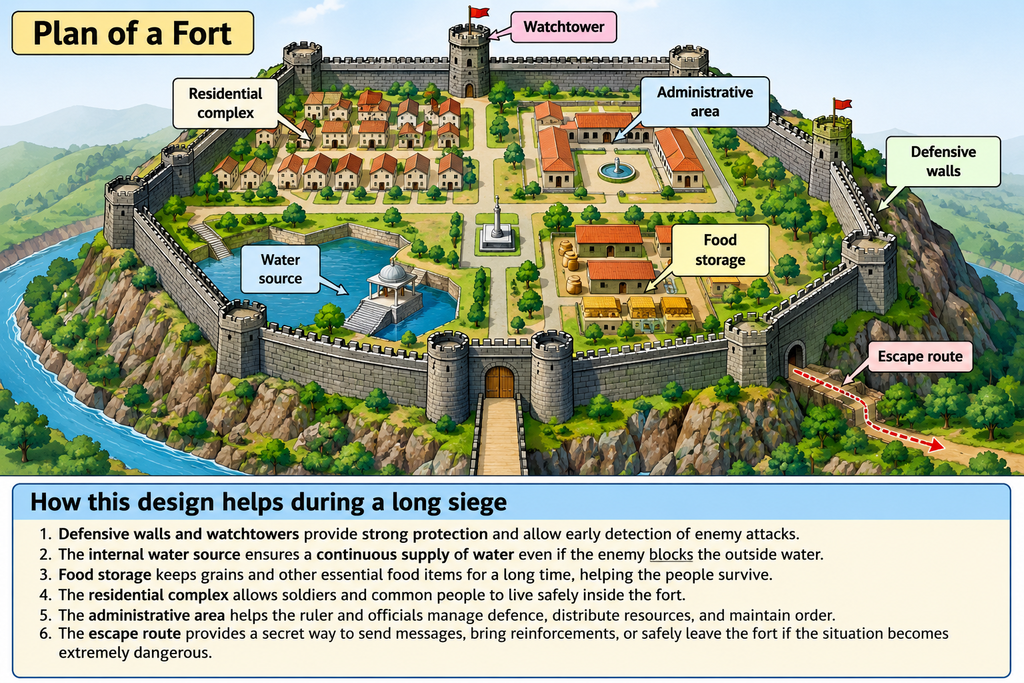
The diagram above shows a fort with all seven required parts: residential complex, defensive walls, water source, food storage, escape route, watchtower, and administrative area.
The defensive walls and watchtowers would protect the kingdom and help soldiers detect enemy attacks early. The internal water source and food storage would provide enough water and food during a long siege. The residential complex would provide shelter for soldiers and ordinary people, while the administrative area would help the ruler manage defence and distribute resources. Finally, the secret escape route would provide a way to send messages or escape in an emergency. These features would help the kingdom remain safe and survive a long siege.
Subject Ka Complete Video Solution Dekhein
Step-by-step easy concept explanation aur full questions Answer ke liye watch karein ya app download karein:

 Buy Now