
NCERT Class 9 Social Science Chapter 11 Life on Earth Solutions English Medium As Per New Syllabus. NCERT Class 9 Social Science Chapter 11 Life on Earth Notes to each chapter is provided in the list so that you can easily browse throughout different chapter NCERT Class 9 Social Science Chapter 11 Life on Earth Question Answer Download PDF and select needs one.
NCERT Class 9 Social Science Chapter 11 Life on Earth
Also, you can read the CBSE book online in these sections Solutions by Expert Teachers as per (CBSE) Book guidelines. NCERT Class 9 Social Science Textual Solutions. These solutions are part of NCERT All Subject Solutions. Here we have given NCERT Class 9 Social Science Notes in English Medium Solutions for All Subject, You can practice these here.
Life on Earth
Chapter – 11
| Part – II: Understanding Society India and Beyond |
| Textual Question Answer |
1. How do physiography and climate shape life on Earth?
Ans: Physiography and climate play an important role in shaping life on Earth. Physiography includes physical features such as mountains, plains, plateaus, and valleys. Climate includes temperature and rainfall. These factors determine the types of plants and animals that can survive in a region. For example, deserts support drought-resistant plants and animals, while tropical rainforests support dense vegetation and diverse wildlife.
2. How are humans and other life forms interconnected?
Ans: Humans, plants, animals, and microorganisms depend on one another for survival. Plants provide food and oxygen, while animals help in pollination and seed dispersal. Microorganisms recycle nutrients in the environment. Humans depend on nature for food, water, medicine, and shelter. Therefore, all living beings are interconnected and help maintain ecological balance.
3. What is the importance of preserving various life forms, and how can we contribute to their conservation?
Ans: Preserving different life forms is important because biodiversity maintains ecological balance and supports human survival. We can contribute to conservation by planting trees, protecting wildlife, reducing pollution, avoiding deforestation, conserving water, and using natural resources sustainably. We should also support national parks, wildlife sanctuaries, and community-based conservation programmes.
Questions and Activities
1. Why does India have diverse biomes? How does the local geography connect to the diversity?
Ans: India’s immense geographical range—encompassing high-altitude Himalayan mountains, tropical coastal zones, fertile plains, salt deserts, and rainforest regions—creates diverse microclimates, rainfall levels, and topographies. This geographical variation directly shapes global biodiversity hotspots like the Western Ghats, Himalayas, North-East India, and Andaman & amp; Nicobar Islands, where unique species adapt to localized habitats.
2. Make a list of economically valuable native plants in your region and comment on their abundance.
Ans: Example for Assam:
| Plant | Economic Importance | Abundance |
| Bamboo | Used in construction, handicrafts, and furniture. | Common in many parts of Assam. |
| Tea | Provides employment and income through tea cultivation and processing. | Widely cultivated in suitable areas. |
| Areca nut | Used for household and commercial purposes. | Common in many rural areas. |
| Betel leaf | Used for traditional and commercial purposes. | Cultivated in many localities. |
| Hollong | Valuable timber tree and an important part of forest ecosystems. | Found in forest areas; requires protection from overexploitation. |
| Neem | Used in traditional medicine and other household applications. | Found in gardens and some localities. |
| Tezpur Litchi | Valuable fruit crop known for its distinctive colour and pulp. | Cultivated in the Tezpur region. |
3. Prepare a map of your state or Union Territory showing national parks and sanctuaries.
Ans:
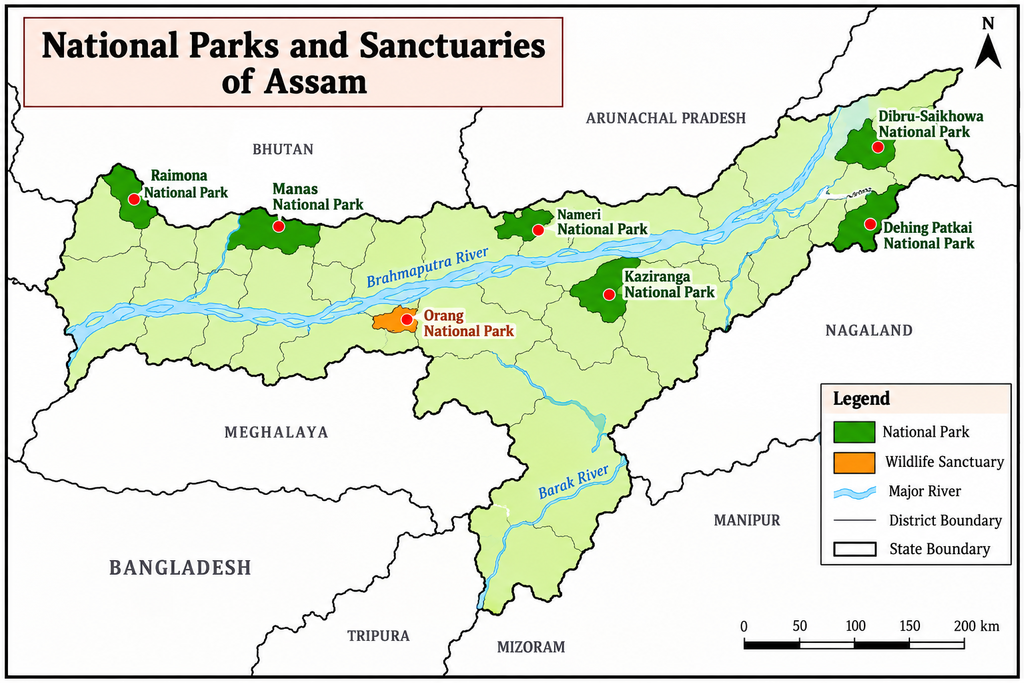
4. Study the impact of forest fires on people dependent on forests. Try to include the causes, losses, and preventive measures.
Ans: Causes: Triggered by severe climate conditions combined with human activities. Approximately 36% of India’s forest cover is fire-prone.
Losses: Destroys critical NTFPs (honey, tendu leaves, bamboo), timber, and grazing lands; causes severe air pollution; damages homes; and threatens the livelihoods and safety of forest communities.
Preventive Measures: Creating cleared fire lines/firebreaks, organizing community fire patrols, and utilizing satellite monitoring.
5. Why are forests often called the ‘lungs of the Earth’?
Ans: Forests absorb large quantities of carbon dioxide and release oxygen through photosynthesis, while regulating global atmospheric gases and balancing climatic conditions.
6. If large forest areas continue to be destroyed, what do you think would be its long-term effect on the global climate?
Ans: Destroying large forest areas disrupts the global carbon-oxygen balance, releasing stored carbon and accelerating global climate change. It shrinks shared ecological commons, increases natural disasters like floods and landslides, reduces biodiversity in vital gene banks, and leads to extreme temperature variations.
7. Discuss some traditional forest conservation methods with your grandparents or an elderly person.
Ans: Some traditional forest conservation methods are:
Sacred groves: Protecting forest patches because of religious and cultural beliefs.
Community protection: Local people collectively preventing illegal tree cutting and hunting.
Controlled collection: Collecting fruits, honey, leaves, and medicinal plants without damaging the forest.
Traditional rules: Restricting the cutting of certain trees or protecting particular areas.
Tree planting: Planting trees to restore degraded land.
8. How do forest dwellers contribute to the protection and conservation of forests?
Ans: Traditional Knowledge Holders: They preserve deep ecological knowledge of local herbs, plants, and sustainable harvesting techniques.
Community Forest Management: Villages like Mendha Lekha exercise self-governance through Gram Sabhas to regulate tree cutting, harvest bamboo renewably, and guard against illegal exploitation and forest fires.
Active Protection Movements: Leading physical conservation efforts, such as the Bishnoi and Chipko tree-protection movements.
Sacred Preservation: Maintaining sacred groves and practicing cultural traditions that limit resource extraction.
9. What is a forest fire? Prepare a plan for prevention and mitigation of forest fires.
Ans: An uncontrolled fire occurring in forest vegetation that rapidly spreads across dry undergrowth, causing severe damage to flora, fauna, and human settlements.
Prevention and Mitigation Plan:
(i) Community Watch and Patrols: Form local monitoring squads to patrol dry forest areas during peak summer months.
(ii) Fire Line Creation: Clear dry leaf litter, brushwood, and fallen branches along designated boundary strips to create firebreaks.
(iii) Early Warning Integration: Track active hot spots using satellite mapping tools.
(iv) Public Awareness: Educate tourists and local gatherers against discarding burning matchsticks or leaving unattended campfires near dry vegetation.
(v) Emergency Response Preparedness: Maintain community firefighting tools and local water stores for swift suppression.
Subject Ka Complete Video Solution Dekhein
Step-by-step easy concept explanation aur full questions Answer ke liye watch karein ya app download karein:

 Buy Now