
Why Are Kidney Stones Increasing Among Young Indians?
Talk to any urologist who’s been practicing for fifteen or twenty years and ask what’s changed. They won’t hesitate. The patients are younger. A lot younger. What used to be a problem you saw in someone’s fifties is now walking into clinics at twenty-five, sometimes younger, doubled over with the same pain their grandparents used to describe. Nobody expected that shift, and honestly, most people are still catching up to what caused it.
What Are Kidney Stones?
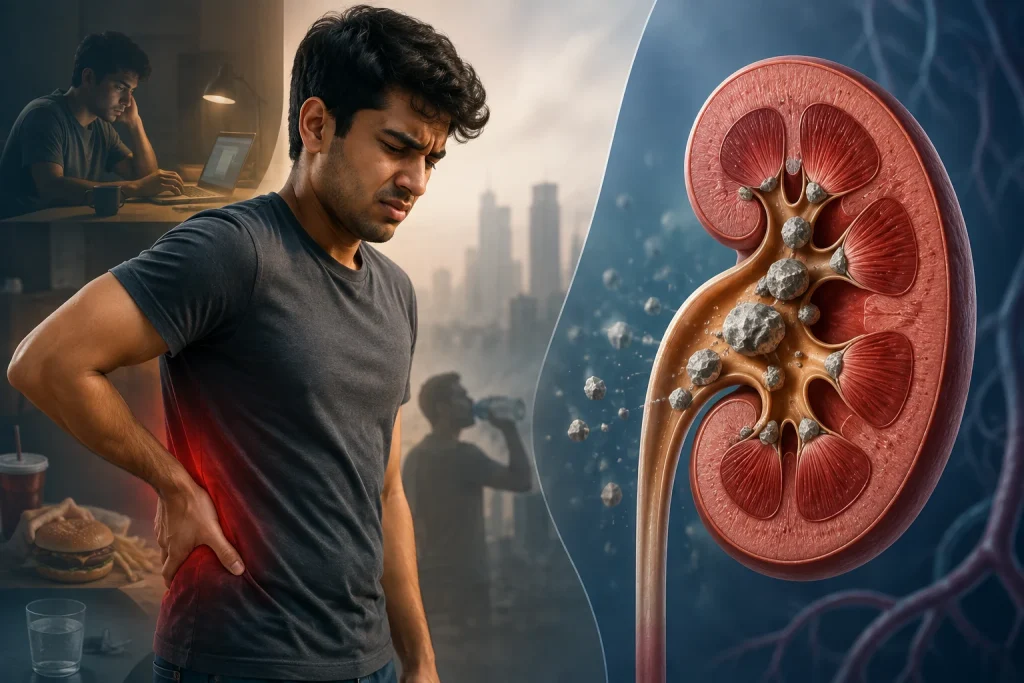
Strip away the medical language and a kidney stone is just a hard little clump, minerals and salts that crystallize inside the kidney when urine gets too concentrated. Calcium oxalate shows up most often, though uric acid stones and a few rarer types exist too. Some stay tiny and pass without anyone noticing much. Others don’t. They grow, they get stuck, and anyone who’s had one will tell you it’s not an experience you forget.
Why Are More Young Indians Developing Kidney Stones?
Blame the desk. Seriously- long hours sitting, air-conditioned offices, commutes that eat two or three hours a day, none of it does much to remind a person to drink water. Compare that to a generation that worked outdoors, sweated, and drank water almost on reflex. Chronic dehydration is probably doing more damage here than anything else on this list, and most people drinking two cups of water a day have no idea that’s the problem.
Then there’s food. Ultra-processed meals, too much salt, sugary drinks standing in for actual hydration, protein-heavy diets with almost no fiber- all of it pushes urine toward exactly the kind of concentration that lets stones form. Throw in Indian summers, which are brutal for months at a stretch, and you’ve got even more fluid loss through sweat on top of everything else.
Genetics still matter, to be clear. Family history raises the odds. But it rarely acts alone- it’s more like genetics load the gun and lifestyle pulls the trigger. Someone with a family history who drinks enough water and eats reasonably might never get a stone in their life. Someone with no family history at all, dehydrated and living on packaged food, might get one at twenty-three.
Early Signs and Symptoms of Kidney Stones
Here’s the frustrating part- small stones usually give no warning whatsoever. Silent, sitting there, doing nothing. Trouble starts once a stone moves or lodges somewhere it shouldn’t. That’s when the pain shows up, and it’s not subtle: sharp, cramping, usually in the back or side below the ribs, and it has a habit of migrating toward the groin as the stone shifts.
Blood in the urine is common- sometimes you can see it, sometimes it only turns up on a test. Nausea and vomiting tend to ride along with the pain. A burning feeling while urinating isn’t unusual either, particularly once the stone gets closer to the bladder, and some people notice they’re going more often, or passing less each time.
Who Is at Higher Risk of Kidney Stones?
Dehydration, again, tops the list. It hits hardest among people who just don’t drink enough during the day- packed schedules, forgetting, or simply not feeling thirsty even when the body needs fluid. Obesity and a sedentary routine raise the risk too, and so do diets loaded with sodium, animal protein, and oxalate-heavy foods like spinach and certain nuts.
Family history counts. So does having already had one stone- recurrence is common enough that a single episode should put someone on alert for the next one. A handful of medical conditions, including some metabolic disorders and recurring urinary tract infections, add to the risk as well. Men have historically had higher rates than women, though that gap isn’t as wide as it used to be.
How Are Kidney Stones Diagnosed?
Imaging is where diagnosis usually starts. A CT scan gives the clearest picture- size, exact location, everything a doctor needs- though ultrasound often comes first, especially when there’s a reason to limit radiation exposure. Urine tests help figure out what the stone is actually made of, which matters a lot for both treatment and preventing the next one.
Blood work sometimes gets added too, mostly to check kidney function and rule out metabolic issues underneath the surface. A proper consultation with a urologist in Bangalore ties all of it together- symptoms, history, imaging- into an actual plan instead of guesswork.
Treatment Options for Kidney Stones
Small stones, roughly under 4mm, often pass on their own given enough water and a bit of patience, sometimes with medication to help relax the urinary tract along the way. Don’t underestimate the pain management side of this, though- a stone that’s going to pass without any procedure can still be brutal in the meantime.
Bigger stones need more than waiting. Shock wave lithotripsy breaks a stone apart using sound waves, letting the smaller pieces pass on their own- non-invasive, and usually the first thing tried when a stone won’t move by itself. For stones that are larger, or sitting somewhere inconvenient, ureteroscopy or percutaneous procedures let a surgeon go in and deal with it directly, generally with a reasonably fast recovery.
Which route makes sense isn’t something to figure out from an article. It depends on size, location, composition- and that calls for an actual evaluation, not a guess.
When to Consult a Urologist for Kidney Stone Symptoms
Sudden, severe pain in the back or side- especially if it comes in waves and creeps toward the groin- means get seen, and soon. Same goes for blood in the urine, fever alongside the pain, or nausea and vomiting that won’t quit. Fever paired with stone symptoms especially shouldn’t be brushed off; it can mean infection, and that needs urgent attention, not a wait-and-see approach.
Even without those warning signs, anyone dealing with stones that keep coming back, or milder symptoms that recur again and again, is better off getting properly evaluated instead of just riding it out each time on their own. The best urology hospital in Bangalore should have both the diagnostic tools and the full range of treatment options- from simply monitoring a small stone to handling something surgical- and getting ahead of it early really does make the whole thing less painful. In every sense.
Read More:
- Water Importance in the Human Body: Key Roles of Water in the Human Body, Consequences of Water Deficiency, Factors Affecting Water Requirement
- Benefits and Uses of Beetroot (Beta vulgaris)
- Health Benefits and Uses of Ashoka Tree

Hi, I’m Dev Kirtonia, Founder & CEO of Dev Library. A website that provides all SCERT, NCERT 3 to 12, and BA, B.com, B.Sc, and Computer Science with Post Graduate Notes & Suggestions, Novel, eBooks, Biography, Quotes, Study Materials, and more.
Subject Ka Complete Video Solution Dekhein
Step-by-step easy concept explanation aur full questions Answer ke liye watch karein ya app download karein:



 Buy Now