
NIOS Class 12 Psychology Chapter 12 Life Span Perspective on Development Solutions English Medium As Per New Syllabus to each chapter is provided in the list so that you can easily browse throughout different chapters NIOS Class 12 Psychology Chapter 12 Life Span Perspective on Development Notes and select need one. NIOS Class 12 Psychology Chapter 12 Life Span Perspective on Development Solutions English Medium Download PDF. NIOS Study Material of Class 12 Psychology Notes Paper Code: 328.
NIOS Class 12 Psychology Chapter 12 Life Span Perspective on Development
Also, you can read the NIOS book online in these sections Solutions by Expert Teachers as per National Institute of Open Schooling (NIOS) Book guidelines. These solutions are part of NIOS All Subject Solutions. Here we have given NIOS Class 12 Psychology Notes, NIOS Senior Secondary Course Psychology Solutions in English for All Chapter, You can practice these here.
Life Span Perspective on Development
Chapter: 12
| PART – I |
| Module – 3: Human Development |
INTEXT QUESTIONS 12.1
Put the following words into the most appropriate columns based on whether they are associated with growth or development:
- Quantitative.
- Qualitative.
- Growing tall.
- Becoming heavier in weight.
- Change in body proportions.
- Maturity.
- Management of emotions.
- Continues throughout lifespan.
- Disappearance of baby teeth.
| Growth | Development |
Ans:
| Growth | Development |
| Quantitative | Qualitative |
| Growing tall | Maturity |
| Change in body proportions | Continues throughout lifespan |
| Becoming heavier in weight | Management of emotions |
| Disappearance of baby teeth |
2. Match the following:
| Column A | Column B |
| 1. Quantitative | (a) Lifespan |
| 2. Qualitative | (b) Growth |
| 3. Height and Weight Charts | (c) Assessment of Health |
| 4. Continuous Development | (d) Development |
Ans:
| Column A | Column B |
| 1. Quantitative | (b) Growth |
| 2. Qualitative | (d) Development |
| 3. Height and Weight Charts | (c) Assessment of Health |
| 4. Continuous Development | (a) Lifespan |
INTEXT QUESTIONS 12.2
State whether the following statements are true or false:
(a) Domains of development are not related.
Ans: False.
(b) Development follows a predictable pattern.
Ans: True.
(c) All children are alike and by a certain age all must attain same abilities.
Ans: False.
(d) Physical development during early years of life and puberty is rapid as compared to other stages of life.
Ans: True.
INTEXT QUESTIONS 12.3
Multiple choice: Select the best answer for each question:
1. The primary cause of developmental change is:
(a) Maturation.
(b) Learning.
(c) Experience.
(d) The product of both maturation and experience.
Ans: (d) The product of both maturation and experience.
2. Pre-natal development is not affected by:
(a) Mother’s nutrition.
(b) Environmental pollution.
(c) Peer relations.
(d) Mother’s emotional state.
Ans: (c) Peer relations.
| TERMINAL EXERCISES |
1. State the differences between growth and development.
Ans:
| Growth | Development |
| Growth refers to quantitative changes in the body. | Development refers to qualitative changes in the body, behaviour, and abilities. |
| It mainly involves physical changes. | It involves physical, mental, social, emotional, and cognitive changes. |
| Examples include increase in height, weight, and body size. | Examples include changes in reasoning, behaviour, emotions, and relationships. |
| It can be easily measured. | It is difficult to measure quantitatively and is mainly assessed qualitatively. |
| Growth may stop after a certain stage of life. | Development is a continuous process throughout the |
2. Elaborate different principles of development with examples from each of the domains.
Ans: Development is governed by several core principles:
(i) Development is Continuous: It happens gradually over time from conception until death.
Example (Language domain): A child starts by cooing, then babbles, learns single words, combines two words, and eventually constructs full, complex sentences.
(ii) Development is Sequential: It follows a patterned and universal direction.
Example (Physical domain): A cephalocaudal sequence means physical control starts from head to toe (controlling neck first, then sitting, then standing).
(iii) Development Proceeds from General to Specific:
Example (Motor domain): If shown a toy/rattle, a baby will initially flail their entire arm in excitement to grab it (general motor action). Later, they develop the fine, specific ability to use their fingers to pick it up precisely.
(iv) Development occurs at Different Rates: Different domains grow at different speeds.
Example (Physical vs. Cognitive): Physical growth is rapid in infancy and puberty but slows down in middle childhood, whereas cognitive maintenance and learning continue throughout adulthood.
(v) Aspects of Development are Interrelated: All domains are closely tied together.
Example (Socio-emotional & Cognitive): If a child has a lag in language/communication, they might struggle to make friends, leading to peer exclusion, which subsequently slows down their cognitive and emotional development.
3. Each child’s development is different and this makes each child unique. Do you agree or disagree with this statement? Support your answer with suitable examples.
Ans: I agree with this statement. Although human development follows a uniform, universal sequence, the actual rate of development varies significantly for each individual.
Milestones as General Indicators: Developmental milestones (like walking or speaking) are expected within general age brackets, but children achieve them in their own unique timelines.
Examples:
Rate variation: One healthy child might start walking independently at 9 months, while another equally healthy child might start walking at 14 months.
Domain variation: A child might show advanced development in language (speaking in clear, long sentences early) but show a slower rate of development in physical competencies like athletic running or catching. Another child might struggle with cognitive tasks but be physically sturdy and athletic. This unique mix of rates across domains makes every child unique.
4. Make a web of factors that influence development. Discuss two hereditary and environmental factors each that affect development.
Ans:
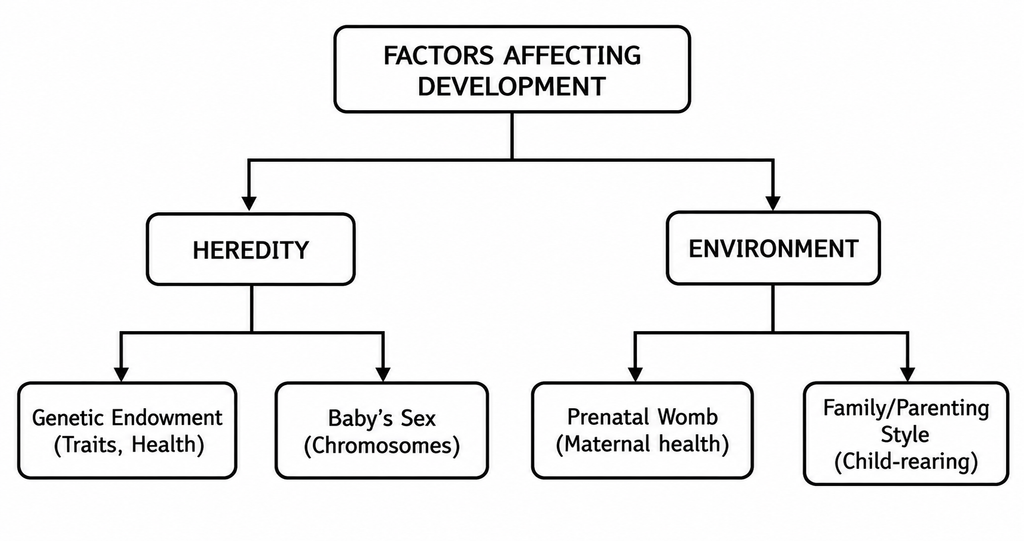
Two Hereditary Factors:
(i) Genetic Endowment: At conception, we inherit 23 chromosomes from each parent containing genes. This genetic makeup influences our basic physical traits (height, weight, color of skin/hair) and our genetic predisposition/susceptibility to certain medical conditions like asthma or heart ailments.
(ii) Sex Determination: The chromosomes passed from parents determine the biological sex of the baby. This genetic determination influences physical trajectories; for instance, girls generally begin to undergo pubertal changes earlier than boys, whereas boys continue to gain weight and muscle mass later than girls.
Two Environmental Factors:
(i) Pre-natal Environment: Even before birth, the child is affected by the environment within the mother’s womb. Unfavorable conditions like maternal stress, poor maternal nutrition, or exposure to environmental pollution can directly restrict optimal prenatal growth.
(ii) Child-rearing/Parenting Practices: The way parents interact with a child shapes their self-esteem and confidence. For instance, democratic/warm parenting that guides children while offering decision-making autonomy fosters confidence, whereas cold, overly strict, or neglectful environments can stunt emotional and social competencies.
5. Explain lifespan development taking examples from your own life changes.
Ans: The lifespan developmental perspective (formulated by Paul Baltes) defines development through key principles that we can relate to our own lives:
Development is Lifelong: It does not stop at adolescence; we must adapt to new situations daily.
Personal Example: Moving to a new city, starting higher studies, or taking up job responsibilities are developmental transitions that require continuous cognitive and socio-emotional adaptation.
Development is Multidirectional (Gain and Loss): We gain in some dimensions while losing in others.
Personal Example: As we grow older, our vocabulary and general knowledge (crystallized intelligence) continue to expand, but our raw speed of processing new, unfamiliar problems (fluid intelligence) might slow down compared to our teenage years.
Development Shows Plasticity: Plasticity represents our ability to learn, modify skills, and change throughout life.
Personal Example: Recovering from physical injury through exercise, or learning a brand new language or computer program as an adult, displays the brain’s internal plasticity.
Shifting Biological and Cultural Influences: As physical biology naturally declines in older age, cultural tools (relationships, technology, social support) step in to compensate.
6. What are some of the changes that take place in child’s physical development and growth, and how can they be measured?
Ans: Changes in Growth: This involves increase in physical size, such as height and weight. It also includes changes in body proportions (e.g., a newborn’s head is very large, accounting for 1/4th of their body length by age 3, but changes proportionally as limbs grow).
Changes in Physical Development: This includes milestones like skeletal hardening, muscle tone improvement, and the acquisition of gross motor skills (crawling, standing, walking, bicycling) and fine motor skills (grasping toys, tying shoe laces, writing).
How They are Measured:
Growth is measured quantitatively using standardized indicators (height/weight metrics, head circumference) and plotting them on Height and Weight Charts to track normal growth patterns.
Physical development is measured qualitatively by observing the predictable sequential achievement of motor milestones (checking if the child can sit independently, track objects, button their shirt, or write letters clearly at expected ages).
7. What is the difference between growth and development, and how is development measured?
Ans: The difference between growth and Development:
| Growth | Development |
| Growth refers to quantitative changes in the body. | Development refers to qualitative changes in the body, behaviour, and abilities. |
| It mainly involves physical changes. | It involves physical, mental, social, emotional, and cognitive changes. |
| Examples include increase in height, weight, and body size. | Examples include changes in reasoning, behaviour, emotions, and relationships. |
| It can be easily measured. | It is difficult to measure quantitatively and is mainly assessed qualitatively. |
| Growth may stop after a certain stage of life. | Development is a continuous process throughout the |
Development cannot be measured simply by weighing scale or measuring tapes. Instead, it is evaluated qualitatively through:
(i) Cognitive Assessments: Evaluating how children reason, transition from concrete to abstract concepts, and solve problems.
(ii) Socio-emotional Milestones: Assessing mirror self-recognition (signifying self-awareness), quality of peer interaction, control over emotional reactions, and social group adaptation.
(iii) Language Competencies: Observing changes in complexity from babbling and single words to syntactic mastery and complete sentences.
Subject Ka Complete Video Solution Dekhein
Step-by-step easy concept explanation aur full questions Answer ke liye watch karein ya app download karein:


 Buy Now