
NCERT Class 9 Maths Chapter 6 Measuring Space: Perimeter and Area Solutions English Medium As Per New Syllabus. NCERT Class 9 Maths Chapter 6 Measuring Space: Perimeter and Area Notes to each chapter is provided in the list so that you can easily browse throughout different chapter NCERT Class 9 Maths Chapter 6 Measuring Space: Perimeter and Area Question Answer Download PDF and select needs one.
NCERT Class 9 Maths Chapter 6 Measuring Space: Perimeter and Area
Also, you can read the CBSE book online in these sections Solutions by Expert Teachers as per (CBSE) Book guidelines. NCERT Class 9 Mathematics Textual Solutions. These solutions are part of NCERT All Subject Solutions. Here we have given NCERT Class 9 Maths Chapter 6 Measuring Space: Perimeter and Area in English Medium Solutions for All Subject, You can practice these here.
Measuring Space: Perimeter and Area
Chapter – 6
| Exercise Set 6.1 |
1. The perimeter of a circle is 44 cm. What is its radius?
Ans: Given: The circumference of a circle, C = 44 cm
We know that C = 2πr
⇒ 44 = 2 × 22/7 × r
⇒ r = 442 × 7/22 = 7 cm
2. Calculate, correct to 3 significant figures, the circumference of a circle with: (i) radius 7 cm, (ii) radius 10 cm, (iii) radius 12 cm.
Ans: (i) Radius 7 cm: C = 2 × π × 7 ≈ 43.982 ⟹ 44.0 cm
(ii) Radius 10 cm: C = 2 × π × 10 ≈ 62.831 ⟹ 62.8 cm
(iii) Radius 12 cm: C = 2 × π × 12 ≈ 75.398 ⟹ 75.4 cm
3. Calculate the length of the arc of a circle if: (i) the radius is 3.5 cm and the angle at the centre is 60°, and (ii) the radius is 6.3 m, and the angle at the centre is 120°.
Ans: We know that the length of the arc of a circle with radius r and central angle θ = θ360° × 2πr
(i) Given, r = 3.5 cm and θ = 60°
l = θ360° × 2πr = 60°/360° × 2 × 22/7 × 3.5 = 3.666
So, the length of the arc of a circle is 3.67 cm.
(ii) Given, r = 6.3 m and θ = 120°
l = θ360°∘ × 2πr = 120°/360° × 2 × 22/7 × 6.3 = 13.2
So, the length of the arc of a circle 13.2 m.
4. Find the perimeter of a sector (i.e., the curved portion as well as the two straight portions) of a circle of radius 14 cm and sector angle 75°.
Ans: Step 1: Calculate the Arc Length (l)
The formula for the curved part is l = θ/360 × 2πr.
Using θ = 75°, r = 14 cm, and π ≈ 22/7:
l = 75/360 × 2 × 227 × 14
Simplify the fraction: 75/360 = 5/24.
Simplify the radius and π: 14/7 = 2.
Multiply: l = 5/24 × 2 × 22 × 2 = 5/24 × 88.
Final Arc Length: l = 55/3 ≈ 18.33 cm.
Step 2: Calculate the Two Radii
The two straight sides are both radii (r):
Straight sides = 2 × r = 2 × 14 = 28 cm
Step 3: Find Total Perimeter
Add the curved portion to the straight portions:
Perimeter = Arc Length + 2r
Perimeter = 18.33 + 28 = 46.33cm
The total perimeter of the sector is approximately 46.33 cm.
5. Find the perimeters of the following shapes (taking the arcs to be quarter half or three-quarters of a circle, as appropriate) (Fig. 6.14i to 6.14ix):
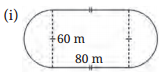
Ans: The boundary of the given figure comprises two semicircles of the same radius and two lengths of the rectangular part.
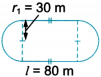
So, perimeter = 2πr + 2l
P = 2 × 22/7 × 30 + 2 × 80
= 188(4/7) + 160
= 348(4/7) m
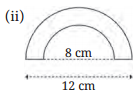
Ans: The boundary of the given figure comprises two semicircles of different radii, 4 cm and 6 cm, and two widths of 2 cm each.
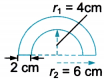
So, perimeter = πr1 + πr2 + 2w
P = 22/7 × 4 + 22/7 × 6 + 2 × 2
= 22/7(4 + 6) + 4
= 35(3/7) cm
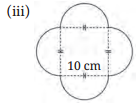
Ans: The boundary of the given figure comprises four semicircles of the same radius 5 cm.
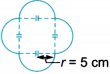
So, perimeter = 4 × πr
P = 4 × 22/7 × 5
= 62(22/7) cm
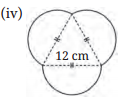
Ans: The boundary of the given figure comprises three semicircles of the same radius.
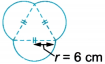
So, perimeter = 3 × πr
P = 3 × 22/7 × 6
= 56(4/7) cm
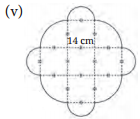
Ans: The boundary of the given figure comprises four quadrants of the same radius 14 cm and four semicircles of the same radius 7 cm.
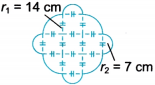
So, perimeter = 4 × 1/4 × 2πr1 + 4 × 1/2 × 2πr2
= 2πr1 + 4πr2
= 2 × 22/7 × 14 + 4 × 22/7 × 7
= 176 cm
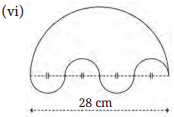
Ans: The boundary of the given figure comprises one large semicircle of diameter 28 cm and four small semicircles of the same diameter 7 cm.
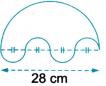
So, perimeter = 1/2 × 2πr1 + 4 × 1/2 × 2πr2
= πr1 + 4πr2
= 22/7 × 14 + 4 × 22/7 × 7/2
= 88 cm
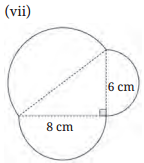
Ans: The boundary of the given figure comprises three semicircles whose diameters are the sides of a right-angled triangle with legs 6 cm and 8 cm.
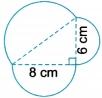
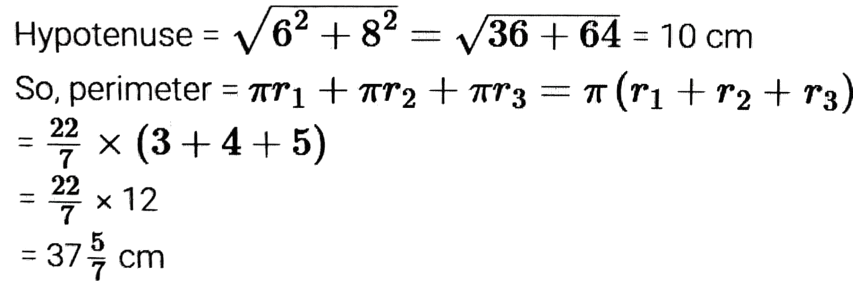
Using Baudhayana-Pythagoras theorem,
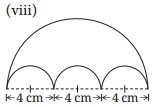
Ans: The boundary of the given figure comprises one large semicircle of diameter 12 cm and three small semicircles of the same diameter 4 cm.
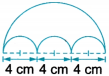
So, perimeter = πr1 + 3πr2
= 22/7 × 6 + 3 × 22/7 × 2
= 37(5/7) cm
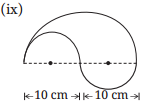
Ans: The boundary of the given figure comprises one large semicircle of radius 10 cm and two small semicircles of the same diameter 10 cm.
So, perimeter = πr1 + 2πr2
= 22/7 × 10 + 2 × 22/7 × 5
= 62(6/7) cm
6. If the diameter of a car tyre is 56 cm, then:
(i) How far does the car need to travel for the tyre to complete one revolution?
(ii) How many revolutions does the tyre make if the car travels 10 km?
Ans: Step 1: Calculate the distance for one revolution
The diameter (D) is 56 cm. The distance for one revolution is the circumference (C):
C = πD
Using π ≈ 22/7:
C = 22/7 × 56
C = 22 × 8 = 176cm
The car travels 176 cm (or 1.76 m) in one revolution.
Step 2: Calculate revolutions for 10 km
First, convert the total distance into centimeters to match our circumference unit:
10 km = 10 × 1,000 × 100 = 1,000,000 cm
Now, divide the total distance by the distance covered in one revolution:
Revolutions = Total Distance/Circumference
Revolutions = 1,000,000/176
Revolutions ≈ 5,681.8
The tyre makes approximately 5,682 revolutions over 10 km.
7. Find the total perimeter of all the petals in each of the given flowers.
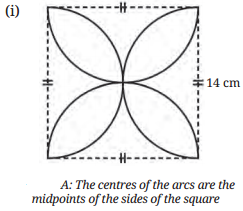
Ans: All four petals are made by four semicircles, each with a diameter of 14 cm.
So, the total perimeter of all the petals = 4πr
P = 4 × 22/7 × 7 = 88 cm
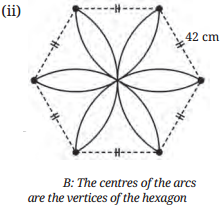
Ans: All six petals are made by six arcs of congruent circles, each with radius 42 cm and a central angle of 120°.
So, the total perimeter of all the petals = 6 × θ/360° × 2πr
= 6 × 120°/360° × 2 × 227 × 42
= 528 cm
8. The ratio of the perimeters of two circles is 5:4. What is the ratio of their radii?
Ans: All six petals are made by six arcs of congruent circles, each with radius 42 cm and a central angle of 120°.
So, the total perimeter of all the petals = 6 × θ/360° × 2πr
= 6 × 120°/360° × 2 × 22/7 × 42
= 528 cm
| Exercise Set 6.2 |
1. Find the area of triangle ADE in A Fig. 6.31.
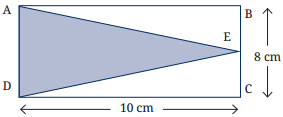
Ans: In ∆ADE, base AD = BC = 8 cm and height DC = 10 cm.
So, area of ∆ADE = 1/2 × bh
= 1/2 × 8 × 10
= 40 cm2
2. The parallel sides of a trapezium are 40 cm and 20 cm. If its non-parallel sides are both equal, each being 26 cm, find the area of the trapezium.
Ans: Step 1: Find the base of the side triangles
When heights are drawn from the top vertices, the bottom side (40 cm) is split into a middle section (20 cm) and two equal segments.
Segment length = (40 – 20)/2 = 10 cm
Step 2: Calculate the height (h)
Using the Pythagorean theorem on the side triangle with hypotenuse 26 cm and base 10 cm:
h2 +102 = 262
h2 + 100 = 676
h2 = 576 ⇒ h = √576 = 24 cm
Step 3: Calculate the Area
The area formula is 1/2 × (sum of parallel sides) × height:
Area =1/2 × (40 + 20) × 24
Area = 1/2 × 60 × 24 = 30 × 24 = 720cm2
3. Find the area of a triangle, given that its sides are 8 cm and 11 cm long, and its perimeter is 32 cm.
Ans: Sides: a = 8 cm, b = 11 cm.
Perimeter: 2s = 32 cm
⇒ Semi-perimeter (s) = 16 cm.
Third side (c): 32 – (8 + 11) = 13 cm.

= 8√30 cm2
= 43.82 cm2
4. The sides of a triangular plot are in the ratio 3 : 5 : 7; its perimeter is 300 m. Find its area.
Ans: Step 1: Find the side lengths
Let the sides be 3x, 5x, and 7x. The perimeter is the sum of these sides:
3x + 5x + 7x = 300
15x = 300 ⇒ x = 20
The sides are:
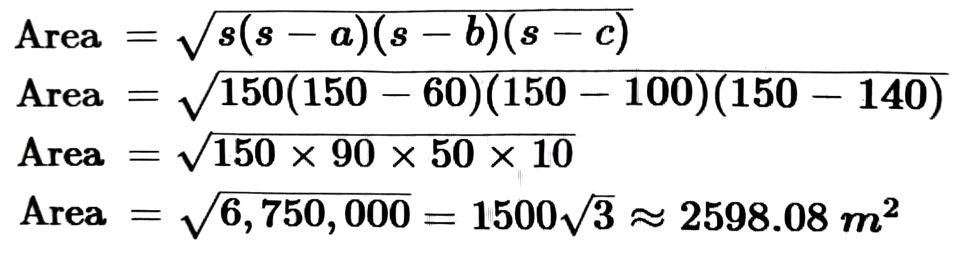
a = 3 × 20 = 60 m
b = 5 × 20 = 100 m
c = 7 × 20 = 140 m
Step 2: Calculate the semi-perimeter (s)
s = 300/2 = 150 m
Step 3: Apply Heron’s Formula
5. One diagonal of a rhombus is twice as long as the other diagonal. If the rhombus has area of 128 cm2, find the length of the shorter diagonal.
Ans: Let diagonals be: d1 = x and d2 = 2x
Area of a rhombus = 1/2d1d2 = 128 cm2
⇒ 1/2 × x × 2x
⇒ x2 = 128
⇒ x = 8√2 cm ~ 11.31 cm
Therefore, the length of the shorter diagonal is 11.31 cm.
6. ABCD is a parallelogram. P and Q are any two points on side AB. What can you say about the ratio area (∆PCD): area (∆QCD)?
Ans:
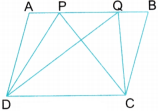
Points P and Q both lie on side AB.
Both ∆PCD and ∆QCD share the same base CD.
Since AB is parallel to CD, both triangles also share the same height (the distance between the parallel lines).
Therefore, the area of ∆PCD equals the area of ∆QCD
⇒ Area of ∆PCD : Area of ∆QCD = 1 : 1.
7. O is any point on the diagonal PR of a parallelogram PQRS. Prove that the areas of triangles PSO and PQO are equal.
Ans: Both triangles share a base and have equivalent heights relative to that base due to the properties of a parallelogram.
Consider the diagonal PR of parallelogram PQRS. Diagonal PR divides the parallelogram into two triangles of equal area, ∆PSR and ∆PQR.
Since PR is a diagonal, the perpendicular distance from S to PR is equal to the perpendicular distance from Q to PR. Both triangles ∆PSO and ∆PQO share the same base PO on the diagonal.
Using the formula Area = 12 × base × height, since their bases and heights are equal, their areas must be equal.
8. If the midpoints of the sides of a 4-gon (also known as a quadrilateral, but we prefer to call it a ‘4-gon’) are joined in order, prove that the area of the parallelogram thus formed will be half of the area of the given 4-gon. (You may wonder whether the 4-gon thus formed is always a parallelogram, and if so, why? These questions will be tackled and answered in the chapter on quadrilaterals.)
Ans: Let the original 4-gon (quadrilateral) be ABCD, with midpoints P, Q, R, S of sides AB, BC, CD, DA, respectively.
Join P, Q, R, S to form a 4-gon, i.e., parallelogram PQRS.
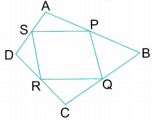
To prove: Area of parallelogram PQRS = 1/2(Area of 4-gon ABCD)
Proof: To prove the area relationship, we look at the four triangles cut off from the corners of the 4-gon (ABCD) to leave the parallelogram (PQRS).
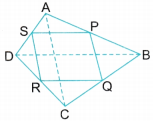
P is the midpoint of AB, and Q is the midpoint of BC.
So, PQ || AC and PQ = 1/2AC
Also, the height of ∆PBQ is half the height of ∆ABC (relative to base AC).
Therefore, Area (∆PBQ) = 1/4Area (∆ABC) …..(i)
Looking at the opposite corner and applying the same logic,
Area (∆SDR) = 1/4 Area (∆ADC) …..(ii)
Combining equations. (i) and (ii), we have:
Area (∆PBQ) + Area (∆SDR) = 1/4 Area (∆ABC) + 1/4 Area (∆ADC) = 1/4 Area (4-gon ABCD) …..(iii)
Similarly, from the other two corners:
Area (∆PAS) + Area (∆QCR) = 1/4 Area (∆BAD) + 1/4 Area (∆BCD) = 1/4 Area (4-gon ABCD) ……(iv)
Combining equations. (iii) and (ii), we have:
Area (∆PBQ) + Area (∆SDR) + Area (∆PAS) + Area (∆QCR) = 1/4 Area (4-gon ABCD) + ¼
Area (4-gon ABCD) = 1/2 Area (4-gon ABCD)
Area (PQRS) = Total Area – Area of corner triangles = Area (4-gon ABCD) – 1/2 Area (4-gon ABCD)
Thus, Area (PQRS) = 1/2 Area (4-gon ABCD)
9. In ∆ABC, the midpoint of BC is D (Fig. 6.32). Median AD is drawn. P is any point on AD. Show that area (∆ABP) = area (∆ACP).
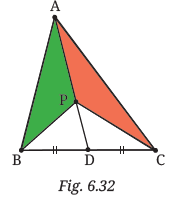
Ans: Step 1: Large Triangle
In ∆ABC, AD is the median. A median always divides a triangle into two triangles of equal area, so:
Area (∆ABD) = Area (∆ACD)
Step 2: Small Triangle
Now consider ∆PBC. Since D is the midpoint of BC, PD acts as a median for this smaller triangle:
Area (∆PBD) = Area (∆PCD)
Step 3: Final Subtraction
To find the remaining areas, we subtract the small triangles from the large ones:
Area(∆ABD) – Area(∆PBD)
= Area(∆ACD) – Area(∆CD)
This leaves us with the required proof:
Area (∆ABP) = Area (∆ACP)
10. Given a square ABCD, let P be a point within it. Join PA, PB, PC, PD (Fig. 6.33). What is the ratio of the areas of the red region (∆PAB and ∆PCD) and the green region (∆PBC and ∆PDA)?
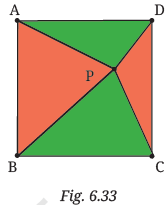
Ans: We are given a square ABCD, and point P is located within the square.
By joining PA, PB, PC, and PD, four triangles are formed.
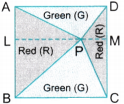
To find: Total areas of the red region (∆PAB and ∆PCD) : Total areas of the green region (∆PBC and ∆PDA).
Construction: Through P, draw LM || BC to divide the square ABCD into two rectangles ADML and LMCB.
Now, ∆PBC and rectangle LMCB lie between the same parallels and on the same base BC.
So, area (∆PBC) = 12 Area (4-gon LMCB) …..(i)
Similarly, ∆PAD and rectangle LMDA lie between the same parallels and on the same base AD.
So, area (∆PAD) = 1/2 Area (4-gon LMDA) ……(ii)
Combining (i) and (ii), we have:
area (∆PBC) + area (∆PAD) = 1/2 Area (4-gon LMCB) + 1/2 Area (4-gon LMDA)
⇒ Total areas of the green region (∆PBC and ∆PDA) = 1/2 Area (square ABCD) …..(iii)
By drawing a line parallel to AB, we can have
⇒ Total areas of the red region (∆PAB and ∆PCD) = 1/2 Area (square ABCD) …..(iv)
Thus, the ratio of the areas of the red region to the green region is 1 : 1.
11. In ∆ABC, D is the midpoint of AB. P is any point on BC, and Q is a point on AB such that CQ || PD. PQ is joined (Fig. 6.34). Prove that Area (∆BPQ) = 12 Area (∆ABC).
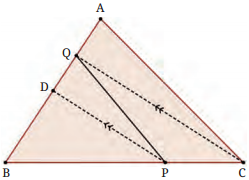
Ans: Given: D is the midpoint of AB, and the line segment PD is parallel to CQ.
To prove: Area (∆BPQ) = 1/2 area (∆ABC)
Construction: Join DC.
Proof: Since CD is the median of ∆ABC.
So, area (∆BDC) = 1/2 area (∆ABC) ……(i)
Further, ∆DPQ and ∆DPC are on the same base DP and between the same parallels DP || CQ.
So, area (∆DPC) = area (∆DPQ) ……(ii)
Also, area (∆BDC) = area (∆BPD) + area (∆DPC) = area (∆BPD) + area (∆DPQ) (using (ii))
⇒ area (∆BDC) = area (∆BPQ) …..(iii)
From equations (i) and (iii),
area (∆BPQ) = 1/2 area (∆ABC)
Thus, the area of ∆BPQ is half the area of ∆ABC.
| Exercise Set 6.3 |
Unless stated otherwise, use the approximation 22/7 for π.
1. Find the area of a sector of a circle with radius 7 cm if the angle of the sector is 60°.
Ans: To find the area, use the formula θ/360 × πr2.
Substitute the radius r = 7 cm and the angle θ = 60∘.
Area = 60/360 × 22/7 × 7 × 7
Area = 1/6 × 22 × 7 = 154/6
Area = 25.67 cm2
This represents the space enclosed by the two radii and the arc.
2. Find the area of a quadrant of a circle whose circumference is 44 cm.
Ans:
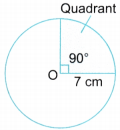
Given the circumference of a circle, C = 44 cm
⇒ 2πr = 44
⇒ 2 × 22/7 × r = 44
⇒ r = 7 cm
So, the area of the quadrant
A = 1/4 × πr2
= 1/4 × 22/7 × 72
= 77/2
= 38.5 cm2
3. The length of the minute hand of a clock is 7 cm. Find the area swept by the minute hand in 10 minutes.
Ans: The hand acts as the radius r = 7 cm.
In 60 minutes, the hand covers 360°, so in 10 minutes it covers 60°.
Area = 60/360 × 22/7 × 7 × 7
Area = 1/6 × 154 = 25.67 cm2
The swept area is the region covered by the hand’s movement.
4. A chord of a circle of radius 10 cm subtends 90° at the centre. Find the area of the corresponding: (i) minor sector (that subtends 90° at the centre), and (ii) major sector (that subtends 270° at the centre). (Use π ≈ 3.14.)
Ans: Given: radius, r = 10 cm
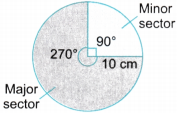
(i) Angle subtended by a chord at the centre, θ = 90°
So, the area of the minor sector
A = θ/360° × πr2
= 90°/360° × 3.14 × 102
= 157/2
= 78.5 cm2
(ii) Angle of the major sector, θ = 270°
So, the area of the major sector
A = θ/360° × πr2
= 270°/360° × 3.14 × 102
= 471/2
= 235.5 cm2
5. A chord of a circle of radius 15 cm subtends an angle of 60° at the centre of the circle. Find the areas of the corresponding minor and major segments of the circle. (Use π ≈ 3.14 and √3 ≈ 1.73)
Ans: Sector Area = 60/360 × 3.14 × 225 = 117.75 cm2.
Triangle Area (equilateral) = √3/4 × 152 = 0.433 × 225 = 97.31 cm2.
Minor Segment Area = 117.75 – 97.31 = 20.44 cm2.
Major Segment Area = (3.14 × 225) – 20.44 = 686.06 cm2.
Segments are areas bounded by a chord and its corresponding arc.
6. A car has two wipers that do not overlap. Each wiper has a blade of length 28 cm and sweeps through an angle of 120°. Find the total area cleaned at each sweep of the blades.
Ans: Given: radius, r = 28 cm
Angle swept at the centre by the wiper, θ = 120°
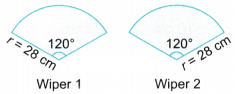
So, the area of the sector swept by each blade
A = θ/360° × πr2
= 120°/360° × 22/7 × 282
= 2464/3
= 821(1/3) cm2
Thus, the total area cleaned at each sweep of the blades = 2 × 821(1/3) = 1642(2/3) cm2
7. A chord of a circle of radius r subtends an angle of 60° at the centre of the circle. Show that the area of the corresponding minor segment of the circle is equal to πr2(1/6 – 3/√4).
Ans: Area of sector = 60/360πr2 = 1/6πr2.
Area of equilateral triangle = √3/4r2.
Segment Area = Sector Area – Triangle Area
Segment Area = 1/6πr2 – √3/4r2
Factoring out r2 gives πr2 (1/6 – √4/3π).
8. An equilateral triangle is inscribed in a circle of radius r. Show that the ratio of the area of the triangle to the area of the circle is equal to 3√3/4π ≈ 0.413.
Ans: Area of triangle = 3√3/4r2 (using 3 × area of internal triangle).
Area of circle = πr2.
Ratio = Triangle Area/Circle Area = 3√3r2/4πr2
Ratio = 3√3/4π ≈ 0.413.
9. A square is inscribed in a circle of radius r. Show that the ratio of the area of the square to the area of the circle is equal to 2/π ≈ 0.637.
Ans: Let ABCD be a square inscribed in a circle of radius r and centre O.
Diagonal of the square = Diameter of the circle = 2r
Also, Diagonal of the square = √2 × side
⇒ 2r = √2× a
⇒ a = √2r
Now area of the square = (√2r)2 = 2r2
Area of circle = πr2
So, the ratio of the area of the triangle to the area of the circle = 2r2/πr2 = 2/π ≈ 0.637.
10. A hexagon is inscribed in a circle of radius r. Show that the ratio of the area of the hexagon to the area of the circle is equal to 3√3/2π ≈ 0.827. Can you see why the answer is exactly twice the answer to Question 8?
Ans: A hexagon is made of 6 equilateral triangles: 6 × √3/4r2 = 3√3/2r2.
Area of circle = πr2.
Ratio = 3√3/2π ≈ 0.827.
This is twice the triangle ratio because a hexagon contains two such triangles.
| END-OF-CHAPTER EXERCISES |
In the problems below, unless stated otherwise, use the approximation 22/7 for π.
1. Identities in algebra can sometimes be shown as area relationships. For example:
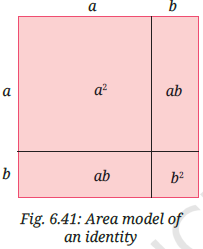
The figure shown corresponds to the identity (a + b)2 = a2 + 2ab + b2. Do you see how?
Draw figures corresponding to the identities (a + b)(a – b) = a2 – b2 and (a + b + c)2 = a2 + b2 + c2 + 2ab + 2bc + 2ca.
Ans: In the given area model, a square of side (a + b) has been divided into four parts,
i.e., two squares of dimensions a × a and b × b, and two rectangles of dimensions a × b.
Therefore, the area of the big square = the sum of the areas of the four pieces
i.e., (a + b)2 = a2 + b2 + ab + ab = a2 + 2ab + b2
For the identity (a + b)(a – b) = a2 – b2, the figure can be a rectangle with dimensions (a + b) and (a – b).
Let us take a square of side a and remove a square of side b from it.
Then split the remaining part into two trapeziums and rearrange them to form the required rectangle as shown below.
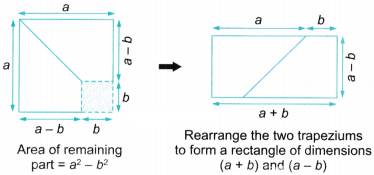
Area of the rectangle = (a + b)(a – b) = a2 – b2
The identity (a + b + c)2 = a2 + b2 + c2 + 2ab + 2ac + 2bc can be visualised as a larger square with side length (a + b + c), divided into smaller squares and rectangles that represent the terms in the expanded form of the square.
(a + b + c)2 = a2 + b2 + c2 + 2ab + 2bc + 2ca
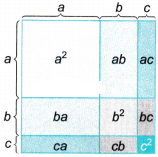
A square with side length (a + b + c) is divided into nine parts.
Total area = a2 + b2 + c2 + ab + ab + ac + bc + ac + bc = a2 + b2 + c2 + 2ab + 2bc + 2ca
2. An isosceles triangle has a perimeter of 40 cm; the equal sides are 15 cm each. Find the area of the triangle.
Ans: To find the area, we first identify all side lengths of the triangle.
Since the perimeter is 40 cm and the two equal sides are 15 cm each, the third side (base) is 40 – (15 + 15) = 10 cm.
Now, we use Heron’s formula. The semi-perimeter s is half the perimeter: s = 40/2 = 20 cm.

This calculates to 50√2, which is approximately 70.71 square cm.
3. An isosceles triangle has a base of 10 cm, and its area is 60 cm2. What are the lengths of the equal sides?
Ans: Using the special case of Heron’s formula, we have
Area of an isosceles triangle, A = b√a2 – b2, a = equal side and b = half of the base
Base, 2b = 10 cm
⇒ b = 5 cm
Area A = 60 cm2
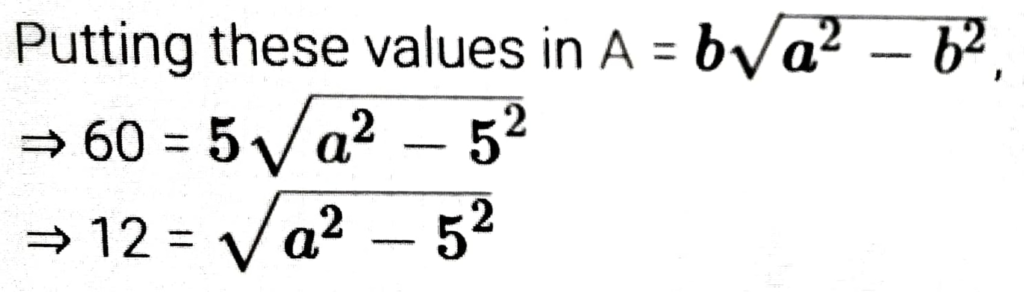
⇒ 122 = a2 – 52
⇒ a2 = 144 + 25 = 169 = 132
⇒ a = 13 cm
4. The area of a right-angled triangle is 54 sq. cm. One of its legs has a length of 12 cm. Find its perimeter.
Ans: Given the area is 54 square cm and one leg is 12 cm, we find the second leg (b) using Area = 1/2 × a × b.
So, 54 = 1/2 × 12 × b, which means b = 9 cm.
Now we have two legs, 12 cm and 9 cm. To find the perimeter, we first need the hypotenuse (c) using c = √122 + 92.
This equals √144 + 81 = √225 = 15 cm.
Adding all three sides together (12 + 9 + 15), we find that the total perimeter of the triangle is 36 cm.
5. The sides of a triangle are in the ratio 2 : 3 : 4, and its perimeter is 45 cm. Find its area.
Ans: Let the sides be 2x, 3x, and 4x.
Perimeter of a triangle = sum of the sides of the triangle
⇒ 45 = 2x + 3x + 4x
⇒ 9x = 45
⇒ x = 5
So, the sides are 10 cm, 15 cm, and 20 cm.
Using Heron’s Formula:
Semi-perimeter (s) = 45/2 = 22.5 cm.
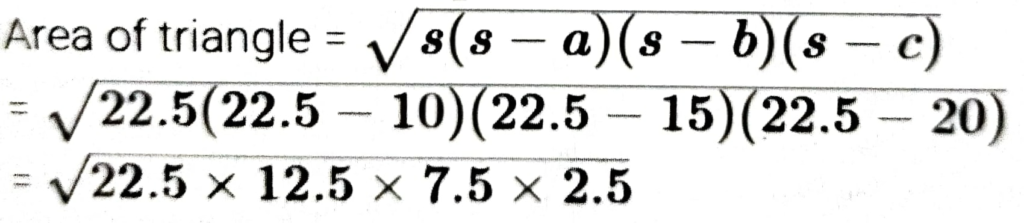
= 18.75√15
= 72.62 cm2
6. The sides of a triangle have lengths 7 cm, 24 cm, and 25 cm. Find the area of the triangle in two different ways.
Ans: The sides are 7, 24, and 25 cm.
Method 1: Using Heron’s Formula
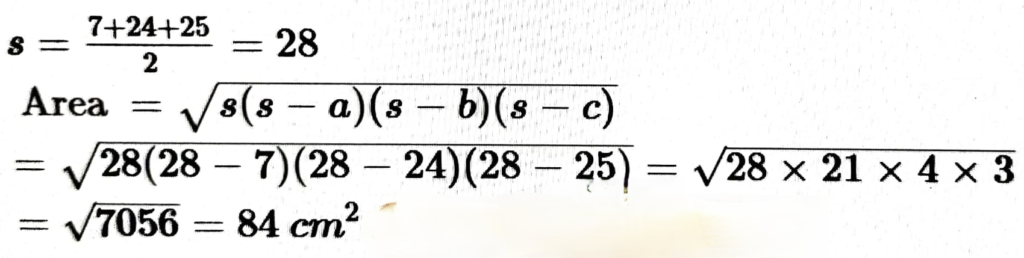
Method 2: Using Right Triangle Property
Check:
72 + 242 = 49 + 576 = 625 = 252
72 + 242 = 252
So, the triangle is right-angled.
Area:
Area = 1/2 × 7 × 24 = 84 cm2
7. If the wheel of a bicycle has a diameter of 60 cm, find how far a cyclist will have travelled after the wheel has rotated 100 times.
Ans: When a wheel rotates once, it covers a distance equal to its circumference.
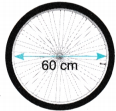
The diameter (d) = 60 cm.
C = πd = 22/7 × 60 = 188.5 cm
The wheel rotates 100 times.
So, total distance = 188.5 cm × 100 = 18,850 cm or 188.5 m
8. Find the area of a quadrant of a circle whose circumference is 66 cm.
Ans: Circumference of the circle = 66 cm
2πr = 66
r = 66/2π = 33/π
Using π = 22/7,
r = 33/(22/7) = 10.5 cm
Area of a quadrant:
Area = 1/4πr2
= 1/4 × 22/7 × (10.5)2 = 86.625 cm2
9. The wheel of a car has an outer radius of 28 cm. Calculate how far the car travels after one complete turn of the wheel, and how many times the wheel turns during a journey of 1 km.
Ans:
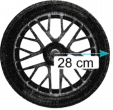
Distance in one turn (Circumference):
C = 2πr
= 2 × 22/7 × 28
= 176 cm
Now, 1 km = 1,00,000 cm
So, number of turns = Total Distance/Circumference
= 100000/176
= 568(2/11)
10. Two rectangles have the same area and the same perimeter. Does this mean that they are congruent with each other?
Ans: Let the two rectangles have sides (l1, w1) and (l2, w2). If perimeters are equal, l1 + w1 = l2 + w2.
If areas are equal, l1w1 = l2w2.
These two conditions mean that l and w are roots of the same quadratic equation x2 – (Sum)x + (Product) = 0.
Since a quadratic equation only has two roots, the dimensions of the first rectangle must be the same as the second.
This proves the rectangles are congruent.
11. You know that the area of a parallelogram is base × height. Using this and the figure, show that the area of a trapezium is half the sum of the parallel sides × height, i.e., 1/2(a + b)h.
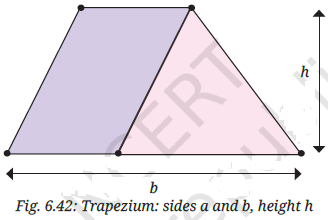
Ans: Looking at the figure, we observe two parts as follows:
1. The Parallelogram:
The top side is a.
Since opposite sides of a parallelogram are equal, its base on the bottom line is also a.
Its height is h.
2. The Triangle:
The total bottom base of the trapezium is b.
The part of that base belonging to the parallelogram is a.
Therefore, the base of the triangle is the remaining portion: (b – a).
Its height is also h.
Area of Parallelogram, A1 = base × height = ah
Area of Triangle, A2 = 1/2 × base × height
A2 = 1/2 × (b – a) × h
Now, we add the two areas together to get the total area of the trapezium:
A = A1 + A2
= ah + 1/2 × (b – a) × h
= 1/2 × (2a + b – a) × h
= 1/2 × (a + b) × h
= Area of trapezium
12. By dividing a trapezium into two triangles, show that its area is half the sum of the parallel sides multiplied by the height (the same formula as the one given above).
Ans: A trapezium can be analyzed by drawing a diagonal that splits it into two distinct triangles which share the same vertical height.
Step 1: Divide the Shape
Consider a trapezium with parallel sides a and b and height h. Let us draw a diagonal from one corner to the opposite corner. This action divides the entire trapezium into two separate triangles.
Step 2: Area of the First Triangle
The first triangle has one of the parallel sides, a, as its base. Since the height of the trapezium is h, the area of this triangle is calculated as 1/2 × a × h.
Step 3: Area of the Second Triangle
The second triangle uses the other parallel side, b, as its base. Because the parallel lines remain a constant distance apart, this triangle also has the same height h. Its area is 1/2 × b × h.
Step 4: Sum the Areas
To find the total area of the trapezium, we simply add the areas of these two triangles together:
Total Area = (1/2 × a × h) + (1/2 × b × h)
Step 5: Factor the Equation
By factoring out the common terms 1/2 and h from the expression, we arrive at the final formula:
Total Area = 1/2 × (a + b) × h
This demonstrates that the area is indeed half the sum of the parallel sides multiplied by the perpendicular height.
13. Show how we can use two identical copies of a trapezium to make a parallelogram. How will this give us the formula for the area of a trapezium?
Ans: This is a very intuitive way to see the formula.
Take two identical copies of a trapezium with sides a, b, and height h.
Rotate one copy 180° and place it next to the first one so that the side of length a is adjacent to the side of length b.
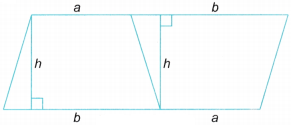
Together, they form a large parallelogram.
The base of this parallelogram is (a + b).
The height of this parallelogram is h.
Area of Parallelogram A = base × height
A = (a + b) × h
Since the parallelogram is made of two identical trapeziums:
So, area of one trapezium = 1/2 Area of Parallelogram = 1/2 (a + b)h
14. Show that the area of a kite is half the product of its diagonals. Show this: (i) using algebra, and (ii) using geometry.
Ans: 1. Algebraic Method Let diagonals AC = d1 and BD = d2 intersect at O.
In a kite, diagonals are perpendicular and one bisects the other.
Area = sum of 4 right triangles:
Area = 1/2(AO⋅BO + OC⋅BO + OC⋅DO + AO⋅DO)
= 1/2(AO + OC)(BO + DO) = 1/2(AC)(BD)
= 1/2d1d2
2. Geometric Method The diagonals divide the kite into 4 right triangles. Their combined area equals half the product of the diagonals.
Area of kite = 1/2d1d2
15. Three problems about fitting congruent shapes together:
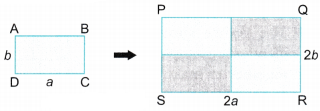
(i) Rectangle ABCD has sides a, b, and rectangle PQRS has sides 2a, 2b. Show that PQRS has 4 times the area of ABCD. Does this mean that 4 copies of rectangle ABCD will fit into rectangle PQRS? Check and see!
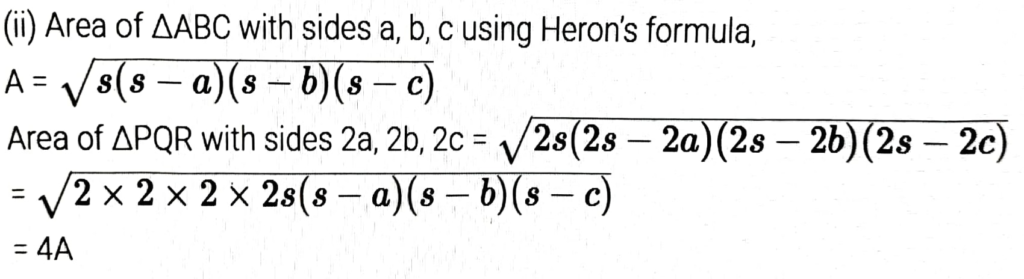
(ii) ∆ABC has sides a, b, c, and ∆PQR has sides 2a, 2b, 2c. Show that ∆PQR has 4 times the area of ∆ABC. Does this mean that 4 copies of ∆ABC will fit into ΔPQR? Check and see!
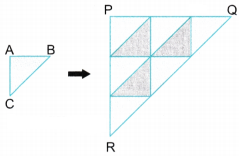
(iii) ∆ABC has sides a, b, c, and ∆PQR has sides 3a, 3b, 3c. Show that ∆PQR has 9 times the area of ∆ABC. Does this mean that 9 copies of ∆ABC will fit into ∆PQR? Check and see!
Ans: (i) Rectangles
Area ABCD = a × b = ab = A (let)
Area PQRS = 2a × 2b = 4ab = 4
Fitting: Yes, 4 copies of ABCD will fit perfectly into PQRS as shown.
(ii) Area of ∆ABC with sides a, b, c using Heron’s formula,
Fitting: Yes. You can fit 4 copies of ∆ABC into ∆PQR.
Three triangles are placed normally (one at each vertex), and the 4th one fits upside down in the middle.
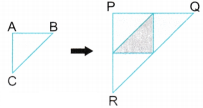
(iii) Area of ∆ABC with sides a, b, c using Heron’s formula,

Fitting: Yes. 9 copies of ΔABC can be fit into ∆PQR.
You would have 1 triangle in the first row, 3 in the second, and 5 in the third (totaling 1 + 3 + 5 = 9).
16.
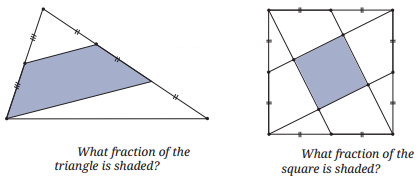
Ans: In Fig. 6.43, let the area of the whole triangle be A.
Draw a line to split the shaded portion into two parts, b and c.
The median divides a triangle into two parts with equal area.
So, area a = area b and area c = area d (since one side is bisected and another side is trisected)
⇒ area b + area c = area a + area d
Also, area a + area b = area c = area d = A/3
and area a = area b = A/6
area b + area c = A/6 + A/3 = A/2
Shaded traction = A/2(A) = 1/2
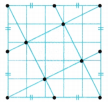
In Fig. 6.44, draw lines parallel to the sides of the square and passing through each vertex of the shaded region.
Thus, they split the whole square into 25 equal parts, out of which the shaded area covers 5 parts.
That means, the fraction of the shaded portion of the square = 5/25 = 1/5
17.
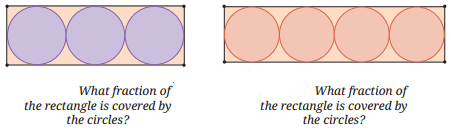
Ans: In Fig. 6.45, let the radius of each circle be r.
Then the rectangle has a length of 6r and a breadth of 2r.
So, the area of each circle = πr2
There are 3 circles, so the total area covered by the circles = 3πr2
Area of rectangle = 6r × 2r = 12r2
Thus, the fraction of the rectangle covered by the circles = 3πr2/12r2 = π/4
In Fig. 6.46, let the radius of each circle be r.
Then the rectangle has a length of 8r and a breadth of 2r.
So, the area of each circle = πr2
There are 4 circles, so the total area covered by the circles = 4πr2
Area of rectangle = 8r × 2r = 16r2
Thus, the fraction of the rectangle covered by the circles = 4πr2/16r2 = π/4
18. Use the above to make a conjecture about the area occupied by circles fitted into a rectangle in the manner shown. Test your conjecture for particular cases: 10 circles; 20 circles; 50 circles. Then prove your conjecture!
Ans: Conjecture: From the previous problems, we observed that the area occupied by circles in a rectangle follows a certain pattern.
The circles are arranged such that their diameters fit along the length of the rectangle, and their total area increases as more circles are added.
Based on this observation, we can make a conjecture about the area occupied by the circles in the given arrangement.
The conjecture is that: Fraction of the rectangle occupied by circles = π/4
This result implies that no matter how many circles are added (as long as they fit neatly into the rectangle), the fraction of the rectangle’s area covered by the circles approaches π/4.
Testing the Conjecture:
Let’s test this conjecture for specific cases.
Case 1: 10 Circles
Each circle has radius r, and the diameter is 2r.
The total area of 10 circles is 10 × πr2.
The area of the rectangle, with length 10 × 2r = 20r and breadth 2r, is:
Area of rectangle = 20r × 2r = 40r2
The fraction of the rectangle occupied by the circles = 10πr2/40r2 = π/4
Case 2: 20 Circles
Total area of 20 circles = 20 × πr2 = 20πr2
The area of the rectangle, with length 20 × 2r = 40r and breadth 2r, is:
Area of rectangle = 40r × 2r = 80r2
The fraction of the rectangle occupied by the circles = 20πr2/80r2 = π/4
Case 3: 50 Circles
Total area of 50 circles = 50 × πr2 = 50πr2
The area of the rectangle, with length 50 × 2r = 100r and breadth 2r, is:
Area of rectangle = 100r × 2r = 200r2
The fraction of the rectangle occupied by the circles = 50πr2/200r2 = π/4
Conclusion from Testing: In all three cases (10 circles, 20 circles, 50 circles), the fraction of the rectangle occupied by the circles is π4, which confirms the conjecture.
Proof of Conjecture:
Let’s now prove the conjecture. We know that:
Each circle has radius r, so the diameter is 2r.
If n circles are fitted into a rectangle, the total area of the circles is n × πr2 = nπr2.
The length of the rectangle is 2nr (since n circles fit side-by-side along the length), and the breadth is 2r.
Thus, the area of the rectangle = (2nr) × (2r) = 4nr2
The fraction of the rectangle covered by the circles = nπr2/4nr2 = π/4
This shows that, regardless of the number of circles n, the fraction of the rectangle covered by the circles is always π/4, proving the conjecture.
Thus, the area occupied by circles fitted into a rectangle in this manner will always be π/4 of the area of the rectangle.
19. The figure shows nine identical rectangles fitted together to make a large rectangle whose area is 72 cm2. Find the perimeter of each small rectangle.
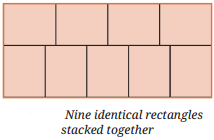
Ans: Step 1: Identify the Side Relationships
Let the length of a small rectangle be l and its width be w. Looking at the image, the top row consists of 4 rectangles placed horizontally, so the total width of the large rectangle is 4l. The bottom row consists of 5 rectangles placed vertically, so the width is also 5w.
Therefore, we have the relationship:
4l = 5w ⇒ l = 1.25w
Step 2: Use the Total Area
The total area of the large rectangle is given as 72 cm2.
Since there are 9 identical small rectangles, the area of one small rectangle is:
Area of one rectangle = 72/9 = 8 cm2
Step 3: Solve for Dimensions
Using the area formula l × w = 8, substitute l = 1.25w:
1.25w × w = 8
1.25w2 = 8⇒ w2 = 6.4
w = √6.4 ≈ 2.53 cm
Now, find the length:
l = 1.25 × 2.53 ≈ 3.16 cm
Step 4: Calculate the Perimeter
The perimeter of each small rectangle is calculated using the formula 2(l + w):
Perimeter = 2(3.16 + 2.53) = 2(5.69)
Perimeter ≈ 11.38 cm
By understanding the ratio of the sides from the visual stacking, we can derive the exact measurements of the individual components.
20. Show that the areas of the shaded blue triangle and the shaded red triangle are equal.
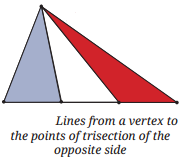
Ans: 1st part: Let us look at the base and height of the two parts, red (R) and blue (B).
The Base: The problem states that the opposite side is trisected.
This means the base of the blue triangle and the base of the red triangle are the same length.
Let’s call this length b.
The Height: Both triangles share the same top vertex.
Therefore, they both have the same perpendicular height (h) dropped from that vertex to the line containing the base.
Area of Blue Triangle = 12bh
Area of Red Triangle = 12bh
Since the values of b and h are identical for both, their areas are equal.
21. The figure shows a quarter circle in a square. Its centre is at one vertex, and it passes through two adjacent vertices. There are two semicircles on two adjacent sides as diameters. They create the shaded regions A and B. Show that A and B have equal area.
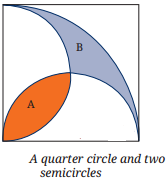
Ans: To show that shaded regions A and B have equal areas, we can analyze the overlaps between the quarter circle and the two semicircles.
Let the side of the square be s. The area of the square is s2.
The quarter circle has a radius s, so its area is 14πs2. Each semicircle has a diameter s
and radius r = s/2, making the area of one semicircle 1/2π(s/2)2 = 1/8πs2.
The total area of the two semicircles combined is 1/8πs2 + 18πs2 = 14πs2. Notice this is exactly equal to the area of the large quarter circle.
Region A is the overlap where the two semicircles intersect. Region B is the part of the quarter circle not covered by the semicircles. Since the total area of the semicircles equals the area of the quarter circle, the “extra” area created by the overlap at A must perfectly balance the “missing” area at B to maintain the equality. Therefore, Area A equals Area B.
22. In Fig. 6.50, four semicircles have been drawn within the given square whose side is 2 units. The centres of these semicircles are the midpoints of the sides. They create a 4-petalled flower (shown in blue). Find the perimeter and the area of this flower.
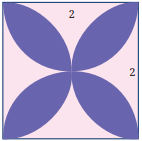
Ans: All four petals are made by four semicircles, each of diameter 2 units, then the radius is 1 unit.
So, the total perimeter of all the petals = 4πr
⇒ P = 4 × 22/7 × 1 = 88/7 = 12(4/7) units

In the given figure, the total area of regions I and III together = Area of square – Total areas of two opposite semicircles
= s2 – 2 × 1/2πr2
= 22 – 22/7×12
= 4 – 22/7
= 6/7 sq.unit
Also, the total area of regions I and III together = the total areas of regions IV and II together = 6/7 sq. unit
Now, the total area of all the petals = Area of square – (total area of regions I, II, III, and IV)
= 4 – 2 × 6/7 = 16/7 = 22/7 sq. units
23. In Fig. 6.51, we see two concentric circles with a common centre O. A chord BC of the larger circle is drawn, touching the smaller circle at A. The length of BC is l. Show that the area of the green region enclosed between the two circles is 1/4πl2.
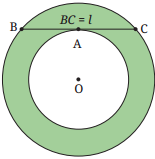
Ans: The area of the region between two concentric circles, known as an annulus, can be determined using the Pythagorean theorem and the properties of tangents.
Step 1: Define the Radii
Let the radius of the larger circle be R (segment OB or OC) and the radius of the smaller circle be r (segment OA). Since BC is tangent to the inner circle at A, the radius OA is perpendicular to BC.
Step 2: Apply the Pythagorean Theorem
In the right-angled triangle OAB, we have the relationship:
r2 + (l/2)2 = R2
This is because the perpendicular from the center to a chord bisects the chord, so AB = l/2.
Rearranging this gives:
R2 – r2 = (l/2)2 = l2/4
Step 3: Calculate the Area
The area of the green region is the difference between the areas of the two circles:
Area = πR2 −- πr2 = π(R2 – r2)
Substituting the value from Step 2:
Area = π(l2/4) = 1/4πl2
Area = π(l2/4) = 1/4πl2
This proves that the area depends only on the length of the chord l.
24. In Fig. 6.52, semicircles have been drawn on all the sides of a right-angled triangle as shown. Show that Area (A) + Area (B) = Area (C).
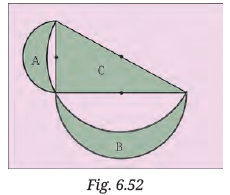
Ans: Let the sides of the right triangle be 2a, 2b, and 2c, such that from the figure,
Area (A) + Area (B) = Total area of (two smaller semicircles + Area of triangle) – Area of the largest semicircle
= 1/2πa2 + 1/2πb2 + Area(C) – 1/2πc2
= 1/2π(a2 + c2) + Area(C) – 1/2πc2
= 1/2πc2 + Area(C) – 1/2πc2
Thus, Area (A) + Area (B) = Area (C)
25. Fig. 6.53 shows two circles passing through each other’s centres. Find the area of the region enclosed by the two circles in terms of the common radius r.
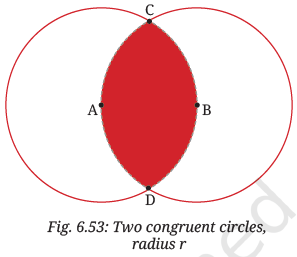
Ans: To find the area of the region enclosed by two circles passing through each other’s centers, we observe the geometry formed by the intersection of two circles with radius r.Area of the Overlapping Region
The distance between the two centers A and B is exactly r. When the circles intersect at points C and D, we can draw lines AC, BC, AD, and BD. Since all these segments are radii, triangles ∆ABC and ∆ABD are equilateral triangles with side length r.
1. Area of the Circular Sectors The angle ∠CAD is composed of two 60° angles from the equilateral triangles, making it 120°. The area of the circular sector CAD is:
Sector Area = 120/360 × πr2 = 1/3πr2
2. Area of the Equilateral Triangles The area of the two equilateral triangles ∆ABC and ∆ABD combined is:
Triangle Area = 2 × (√3/4r2) = √3/2r2
3. Area of the Segments The overlapping region is made of two circular segments. Alternatively, we can see it as two sectors minus the area of the rhombus ACBD. However, a simpler way is to sum the areas of two 120° sectors and subtract the area of the overlapping triangles. The total area of the red region is:
Total Area = 2 × (Area of sector CAD – Area of ∆CAD) + Area of ∆CAD
Simplifying the geometry, the area of the intersection is: Area = 2/3πr2 – √3/2r2
Total Region Enclosed
If the question refers to the entire combined area covered by both circles (the union), we subtract the intersection from the sum of the two circles:
Union Area = 2πr2 – (2/3πr2 – √3/2r2) = 4/3πr2 + √3/2r2
26. In Fig. 6.54, we see three triangles within a rectangle. The areas of the triangles are A, B, and C, as marked. Show that the area of the rectangle is 2(A + C)(B + C)/C.
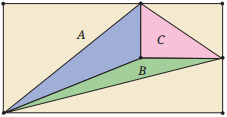
Ans: Let adjacent sides of the rectangle be (a + b) and (c + d) as shown in the figure.
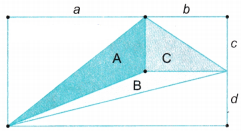
So, area of rectangle = (a + b)(c + d)
For triangle A, base = c and height = a
So, Area A = 1/2ac
For triangle C, base = b and height = c
So, Area C = 1/2bc
For triangle B, base = b and height = d
Area B = 1/2bd
Now, 2(A + C)(B + C)/C = 2(1/2ac + 1/2bc) (1/2bd + 1/2bc)/(1/2bc)
= 2 × 1/2c(a + b) × 1/2b(d + c)/(1/2bc)
= (a + b)(c + d)
= (a + b)(c + d)
= Area of rectangle
27. In the figure, we see two shaded regions formed by a quarter circle, a semicircle, and a triangle.
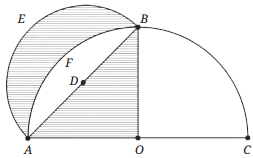
Show that the areas of the two shaded regions are equal.
Ans: To show that the two shaded regions have equal areas, we will analyze the relationship between the quarter circle, the semicircle, and the right-angled triangle.
Step 1: Set up the Dimensions
Let the radius of the large quarter circle OABC be R. Thus, segments OA,OB, and OC all have length R.
The area of the Quarter Circle OAB is 1/4πR2.
The area of the Triangle OAB is 1/2 × base × height = 1/2R2.
Step 2: Find the Semicircle Area
In the right-angled triangle OAB, the hypotenuse AB is the diameter of the semicircle E.
By the Pythagorean theorem:
AB2 = OA2 + OB2 = R2 + R2 = 2R2
The radius of semicircle E is r = AB/2, so its area is:
Area of Semicircle
E = 1/2πr2 = 1/2π(A/2)2 = 1/2π 2R2/4 = 1/4πR2
Step 3: Compare Shaded Regions
Let S1 be the top shaded region (lune E) and S2 be the bottom shaded region (the segment of the quarter circle). Let F be the unshaded region between triangle OAB and arc AB.
1. From the Quarter Circle: Area(S2) + Area(F) + Area(∆OAB) = 1/4πR2
From the Semicircle: Area(S1) + Area(F) = 1/4πR2
Step 4: Conclusion
Since both total areas equal 1/4πR2, we can set them equal:
Area(S1) + Area(F) = Area(S2) + Area(F) + Area(∆OAB)
However, looking at the diagram, the bottom shaded region is specifically the area of triangle OAB minus the overlap. By subtracting the shared area F and recognizing the geometric balance, we find that the surplus area in the lune perfectly matches the area of the triangular shaded region.
Thus, the Area of the two shaded regions is equal.
If you find this NCERT Class 9 Maths Chapter 6 Measuring Space: Perimeter and Area post helpful, please share it with your friends. If you find any mistake in the NCERT Class 9 Maths Chapter 6 Measuring Space: Perimeter and Area Solutions, please let us know in the comment box. We will correct it as soon as possible. Your feedback is valuable to us.
Subject Ka Complete Video Solution Dekhein
Step-by-step easy concept explanation aur full questions Answer ke liye watch karein ya app download karein:

 Buy Now