
Grok 4.6: How xAI Is Turning AI Into a More Capable Digital Worker
Grok 4.6 is xAI’s latest AI model, designed to handle more complex tasks instead of simply answering questions. The model focuses on coding, long-running AI agents, research, and other types of knowledge work.
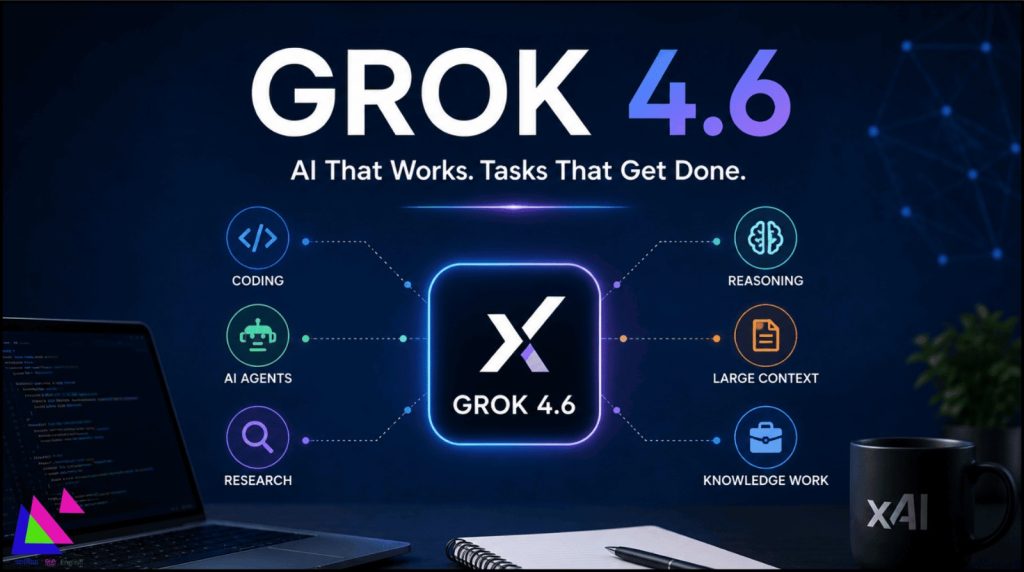
The bigger idea behind the launch is simple: AI is moving from tools that give answers to systems that can work through tasks.
What Is Grok 4.6?
The model builds on xAI’s previous work and is designed for tasks that require multiple steps.
Key areas include:
- Coding and software development.
- AI agent workflows.
- Complex reasoning.
- Research.
- Knowledge work.
- Tool use.
- Large documents and codebases.
xAI’s developer documentation also lists a 500,000-token context window, which can help developers work with large amounts of information in a single task.
How Are AI Agents Different?
The main difference is that an AI agent can work toward a goal instead of only responding to individual questions.
For example, when working on a software problem, an agent could:
- Examine the code.
- Find a possible issue.
- Suggest a solution.
- Make changes.
- Run tests.
- Review the results.
- Make corrections if necessary.
This can make AI more useful for longer and more complicated workflows.
Grok 4.6 for Developers
Grok 4.6 is particularly relevant for software developers because coding is one of its major areas of focus.
Developers can use AI systems for:
- Writing code.
- Understanding existing code.
- Finding bugs.
- Reviewing code.
- Testing software.
- Working with large projects.
Instead of manually handling every small coding task, developers could give the AI a broader goal and then review the work it produces.
This could reduce repetitive work and give developers more time for architecture, testing, and product decisions.
Large Context Window
The 500,000-token context window is another useful feature. In simple terms, it allows the model to work with a large amount of information at once.
This can be useful for:
- Large codebases.
- Long reports.
- Research documents.
- Business files.
- Multiple related documents.
For developers, this could make it easier to work on projects where understanding the surrounding code is important.
Where Can It Be Used?
Software Development
- Coding.
- Debugging.
- Testing.
- Code review.
Research
- Finding information.
- Comparing documents.
- Summarizing research.
- Exploring unfamiliar topics.
Business
- Preparing reports.
- Organizing information.
- Analyzing documents.
- Automating repetitive tasks.
Read Also: AI Infrastructure Debt Is Rising: Why the AI Boom Is Getting More Expensive
Knowledge Work
Professionals working with documents, research, planning, and analysis could use AI agents to handle parts of their daily workflows.
Benefits of xAI
1. Handles Longer Tasks: Designed for workflows that require several steps.
2. Coding Support: Can assist with development beyond basic code suggestions.
3. Large Context: Useful when working with large projects and documents.
4. Agent Workflows: Can support systems that take multiple actions.
5. More Efficient Work: Could reduce repetitive tasks for developers and professionals.
Limitations of xAI
Despite the improvements, Grok 4.6 is still an AI system and can make mistakes.
Some challenges include:
- Incorrect information.
- Faulty code.
- Misunderstanding instructions.
- Incorrect tool use.
- Poor decisions during automated tasks.
- Need for human review.
This is particularly important when AI has permission to modify software or perform actions automatically.
What Does This Mean for Developers?
AI agents could change the developer’s role.
Instead of writing everything manually, developers may increasingly:
- Explain the goal.
- Let AI handle routine tasks.
- Review the generated work.
- Test the results.
- Solve difficult problems.
- Make important technical decisions.
This does not mean programmers will disappear. Their work may simply shift toward planning, reviewing, testing, and guiding AI systems.
The Future of AI Agents
Grok 4.6 is part of a wider move toward AI systems that can work more independently.
Future AI agents could become better at:
- Planning tasks.
- Using different tools.
- Working across applications.
- Handling longer projects.
- Checking their own work.
- Completing multi-step workflows.
The goal is to make AI less like a chatbot that waits for every instruction and more like a system that can help complete an entire task.
Conclusion
Grok 4.6 shows how AI is moving beyond traditional chatbot features. Its focus on coding, long-running tasks, large context, and AI agents reflects a broader change in how people may use AI at work.
The technology still needs human supervision, especially for important technical and business decisions. But as AI becomes better at handling multiple steps, developers and professionals may increasingly use it as a working partner rather than simply a tool for answering questions.
FAQs
1. What is Grok 4.6?
Ans: It is xAI’s AI model focused on coding, reasoning, AI agents, and complex knowledge work.
2. What are AI agents?
Ans: AI agents are systems that can understand a goal, break it into steps, use tools, and work toward completing a task.
3. Is it useful for coding?
Ans: Yes. Coding and software development are among its key use cases.
4. What is its context window?
Ans: xAI’s developer documentation lists a 500,000-token context window.
5. Can AI agents work without humans?
Ans: They can handle multiple steps in supported workflows, but human supervision remains important for accuracy, security, and important decisions.







 Buy Now