
NIOS Class 12 Accountancy Chapter 22 Partnership: An Introduction Solutions English Medium As Per New Syllabus. to each chapter is provided in the list so that you can easily browse throughout different chapters NIOS Class 12 Accountancy Chapter 22 Partnership: An Introduction Notes and select need one. NIOS Class 12 Accountancy Chapter 22 Partnership: An Introduction Question Answers Download PDF. NIOS Study Material of Class 12 Accountancy Paper Code: 320.
NIOS Class 12 Accountancy Chapter 22 Partnership: An Introduction
Also, you can read the NIOS book online in these sections Solutions by Expert Teachers as per National Institute of Open Schooling (NIOS) Book guidelines. These solutions are part of NIOS All Subject Solutions. Here we have given NIOS Class 12 Accountancy Solutions English Medium, NIOS Senior Secondary Course Accountancy Notes in English Medium for All Chapter, You can practice these here.
Partnership: An Introduction
Chapter: 22
| Module – 4: Partnership Account |
INTEXT QUESTIONS 22.1
I. Fill in the blanks with appropriate word/words :
(i) There must be at least ________ persons to form a partnership.
Ans: Two.
(ii) A partnership is formed by _________.
Ans: Agreement.
(iii) Agreement of partnership can be __________ or __________.
Ans: Written or oral.
(iv) The written form of agreement of a partnership is called __________.
Ans: Partnership deed.
(v) The liability of each partner is __________.
Ans: Unlimited.
II. Asha and Rahul are partners in a firm . If there is no partnership deed, how will you deal with the following? Give your answer in yes or no.
(i) Asha wants a salary of Rs.3000 per month to be paid to her. Can she claim the salary?
Ans: No.
(ii) Rahul has advanced a loan to the firm. He claims interest @ 6% p.a. is it permissible?
Ans: Yes.
(iii) Asha and Rahul contribute Rs. 50,000 each as capital. Rahul wants more
profit than Asha. Is it permissible?
Ans: No.
(iv) Asha gets contracts for the firm. She wants 2% commission on the amount of contract. Is she entitled to such commission?
Ans: No.
(v) Rahul withdraws Rs. 500 p.m. for personal use. Asha wants interest to be charged on Rahul’s drawings. Can it be charged?
Ans: No.
INTEXT QUESTIONS 22.2
Fill in the blanks with suitable word/words :
(i) Fixed Capital account always show _________ balance only.
Ans: Credit.
(ii) A ________ capital account may show a debit or a credit balance.
Ans: Fluctuating.
(iii) Two separate accounts are kept for each partner, if capital is _________.
Ans: Fixed.
(iv) Interest on capital is shown on the _________ side of the current account.
Ans: Credit.
(v) Interest on drawings is shown on the ________ side of the current account.
Ans: Debit.
INTEXT QUESTIONS 22.3
I. Fill in the blanks with appropriate word/words :
(i) Interest on capital is ________ in partner’s capital account.
Ans: Credited.
(ii) Interest on drawings is ________ in partner’s capital account.
Ans: Debited.
(iii) Interest is charged on the _________ of the partner’s capital account.
Ans: Opening balance.
(iv) When money is withdrawn in the begining of the each month, the average period is ________ for charging interest.
Ans: 6½ months.
II. Reema and Anish are partners with a capital of Rs. 50,000 and Rs. 80,000 on April 2013, respectively. Reema introduced additional capital of Rs.50,000 on 1st Jan 2014. Calculate interest on capital @10 p.a. on March 31, 2014.
Ans: Interest on capital Reema ₹6,250 and Anish ₹8,000.
III. Ashu withdrew Rs. 2000 p.m. from business for personal use at the end of every month during the year. Calculate interest on Drawing @10 p.a.
Ans: Interest on drawings ₹1,100.
INTEXT QUESTIONS 22.4
(i) List the items which usually appear on the debit side of Profit and loss Appropriation Account.
Ans: Partner’s salary, partner’s commission, interest on capital, interest on partner’s loan.
(ii) If, balance of Profit and Loss Account is debit, what entry will be recorded for transferring the amount to Profit and Loss Appropriation account?
Ans: Profit and Loss Appropriation A/c Dr.
To Profit and Loss A/c.
(iii) When interest on drawings is to be transferred to Profit and Loss Appropriation account, what journal entry is to be recorded in the books?
Ans: Interest on Drawings A/c Dr.
To Profit and Loss Appropriation A/c.
| TERMINAL EXERCISE |
1. Explain the characteristics of a partnership.
Ans: The main characteristics of a partnership are as follows:
(i) Agreement: A partnership is formed by an agreement between two or more persons. It may be oral or written. The written agreement is called a Partnership Deed.
(ii) Number of Persons: There must be at least two persons to form a partnership. The maximum number of partners is 50 as per the Companies Act 2013.
(iii) Business: The partnership is formed to carry on a lawful business with the objective of earning profits.
(iv) Sharing of Profits and Losses: Partners agree to share profits in a fixed ratio. Losses are also shared in the same ratio.
(v) Mutual Agency: Every partner is both a principal and an agent. One partner’s act can bind the firm and other partners.
(vi) Unlimited Liability: Each partner has unlimited liability. If business assets are insufficient, personal assets can be used to pay debts.
(vii) Management: All partners have the right to participate in the management of the business, unless agreed otherwise.
(viii) Transferability of Share: A partner cannot transfer his/her share to anyone without the consent of all other partners.
2. In the absence of any partnership deed, what are the provisions that become applicable?
Ans: The partnership deed lays down the terms and conditions of partnership in regard to rights, duties and obligations of the partners. In the absence of partnership deed, there may arise a controversy on certain issues like profit sharing ratio, interest on capital, interest on drawings, interest on loan and salary of the partners. In such cases, the provisions of the Indian Partnership Act becomes applicable:
Some of the Issues are:
(i) Distribution of Profit: Partners are entitled to share profits equally.
(ii) Interest on Capital: Interest on capital is not allowed.
(iii) Interest on Drawings: No interest on drawing of the partners is to be charged.
(iv) Interest on Partner’s Loan: A Partner is allowed interest @ 6% per annum on the amount of loan given to the firm by him/her.
(v) Salary and Commission to Partner: A partner is not entitled to any salary or commission or any other remuneration for managing the business.
3. Distinguish between fixed and fluctuating capital accounts.
Ans:
| Basis of Distinction | Fixed Capital Account | Fluctuating Capital Account |
| Number of accounts | Two separate accounts are prepared for each partner i.e. ‘capital account’ and ‘current account’. | Only one account for each partner is prepared i.e. capital account. |
| Adjustments | All adjustments are recorded in the current account and not in the capital account. | Adjustments are recorded directly in the capital accounts, as no current account is opened. |
| Fixed balance | The capital account balance normally remains unchanged except under special circumstances. | The balance of the capital account fluctuates from period to period. |
| Balance | Capital accounts always show a credit balance only. | The capital account can show a debit balance or a credit balance at the end of the period. |
4. Why the Profit and Loss Appropriation Account is prepared?
Ans: The Profit and Loss Appropriation Account is prepared to show how the net profit or loss of a partnership firm is distributed among the partners. After calculating the profit in the Profit and Loss Account, this account is used to make necessary adjustments such as partner’s salary, commission, interest on capital, and interest on drawings. These adjustments are made before distributing the remaining profit among the partners in their agreed profit-sharing ratio. Thus, it ensures a fair and proper allocation of profit according to the partnership agreement.
5. A and B are partners in a firm. On January 1, 2013 their capital is Rs. 3,00,000 and Rs.2,00,000 respectively. Their drawings during the year were Rs. 3,000 per month each. They allowed 6% interest on capital. The profit for the year Rs. 4,00,000.Calculate interest on capital for the year 2013 when capitals are fixed.
Ans: Given:
A ka Capital = ₹3,00,000
B ka Capital = ₹2,00,000
Interest rate = 6% per annum Capitals are fixed (drawings ka effect nahi padega interest par)
Interest on Capital Formula:
Interest=Capital×Rate/100
A’s Interest:
300000 × 6/100 = rs. 18,000
B’s Interest
200000 × 6/100 = Rs. 12000
Total Interest on Capital = ₹30,000
Ye amount profit se deduct hoga before profit sharing.
6. X and Y are equal partners. They withdrew Rs. 4,000 each per month. Calculate interest 4% p.a. on drawing in the following cases:
(i) if they withdrew in the beginning of each month:
(ii) if they withdrew at the end of each month:
(iii) if they withdrew in the middle of each month:
Ans: Given:
Monthly drawings = ₹4,000
Total months = 12
Total drawings = ₹4,000 × 12 = ₹48,000
Rate = 4% p.a.
Formula:
Interest on Drawings=Total Drawings× Rate/ 100× Average Period / 12
(i) Beginning of each month
Average period = 6.5 months

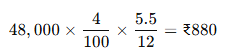
(ii) End of each month
Average period = 5.5 months
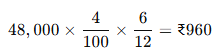
(iii) Middle of each month
Average period = 6 months
7. Naman and Asmeta started business with capital of Rs. 1,00,000 each on January 1,2013. their drawings during the year were Rs. 1,000 and Rs. 500 per month respectively. The interest on drawing was Rs. 200 and Rs. 100 respectively. They are allowed interest on capital at 8% p.a. Naman is allowed a salary of Rs. 2,000 per month. They earned a profit of Rs. 94,000 before interest and salary. They share profit is the ratio of 2.1.
Prepare Profit and Loss Appropriation Account for the year ended March 31, 2013 and Capital accounts of partners.
Ans: Working Notes
(i) Interest on Capital (8% p.a.)
- Naman = 1,00,000 × 8% = ₹8,000
- Asmeta = 1,00,000 × 8% = ₹8,000
(ii) Salary to Naman
- ₹2,000 × 12 = ₹24,000
(iii) Profit available for distribution Profit before appropriation = ₹94,000
Less:
- Interest on Capital = ₹16,000
- Salary to Naman = ₹24,000
Remaining Profit = ₹54,000
(iv) Profit Sharing Ratio (2 : 1)
- Naman = 54,000 × 2/3 = ₹36,000
- Asmeta = 54,000 × 1/3 = ₹18,000
Profit & Loss Appropriation Account
| Particulars | Amount (₹) | Particulars | Amount (₹) |
| To Interest on Capital: | By Net Profit | 94,000 | |
| Naman | 8,000 | ||
| Asmeta | 8,000 | ||
| To Salary (Naman) | 24,000 | ||
| To Profit transferred to: | |||
| Naman (2/3) | 36,000 | ||
| Asmeta (1/3) | 18,000 | ||
| Total | 94,000 | Total | 94,000 |
Capital Accounts
Naman’s Capital Account
| Particulars | Amount (₹) | Particulars | Amount (₹) |
| To Drawings (1,000×12) | 12,000 | By Balance b/d | 1,00,000 |
| To Interest on Drawings | 200 | By Interest on Capital | 8,000 |
| By Salary | 24,000 | ||
| By Share of Profit | 36,000 | ||
| Total | 12,200 | Total | 1,68,000 |
Closing Capital = ₹1,55,800
Asmeta’s Capital Account
| Particulars | Amount (₹) | Particulars | Amount (₹) |
| To Drawings (500×12) | 6,000 | By Balance b/d | 1,00,000 |
| To Interest on Drawings | 100 | By Interest on Capital | 8,000 |
| By Share of Profit | 18,000 | ||
| Total | 6,100 | Total | 1,26,000 |
Closing Capital = ₹1,19,900


 Buy Now