
NCERT Class 9 Maths Chapter 4 Exploring Algebraic Identities Solutions English Medium As Per New Syllabus. NCERT Class 9 Maths Chapter 4 Exploring Algebraic Identities Notes to each chapter is provided in the list so that you can easily browse throughout different chapter NCERT Class 9 Maths Chapter 4 Exploring Algebraic Identities Question Answer Download PDF and select needs one.
NCERT Class 9 Maths Chapter 4 Exploring Algebraic Identities
Also, you can read the CBSE book online in these sections Solutions by Expert Teachers as per (CBSE) Book guidelines. NCERT Class 9 Mathematics Textual Solutions. These solutions are part of NCERT All Subject Solutions. Here we have given NCERT Class 9 Maths Chapter 4 Exploring Algebraic Identities in English Medium Solutions for All Subject, You can practice these here.
Exploring Algebraic Identities
Chapter – 4
| Exercise Set 4.1 |
1. Using the identity (a + b)2 = a2 + 2ab + b2, expand the following:
(i) (7x + 4y)2
Ans: (7x + 4y)2 = (7x)2 + 2 × 7x × 4y + (4y)2
[∵ (a + b)2 = a2 + 2ab + b2] = 49x2 + 56xy + 16y2
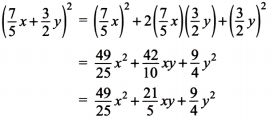
(ii) (7/5x + 3/2y)2
Ans:
(iii) (2.5p + 1.5q)2
Ans: Using the identity
(a + b)2 = a2 + 2ab + b2
we expand (2.5p + 1.5q)2
= (2.5p)2 + 2(2.5p) (1.5q) + (1.5q)2
= 6.25p2 + 7.5pq + 2.25q2
(iv) (3/4s + 8t)2
Ans: (3/4s + 8t)2
= (3/4s)2 + 2(3/4s)(8t) + (8t)2
= 9/16s2 + 12st + 64t2
(v) (x + 1/2y)2
Ans: Using the identity
(a + b)2 = a2 + 2ab + b2
we expand
(x + 1/2y)2 = x2 + 2(x⋅1/2y) + (1/2y)2
= x2 + x/y + 1/4y2
(vi) (1/x + 1/y)2
Ans: (1/x + 1/y)2
= (1x)2 + 2(1x) (1y) + (1y)2
= 1/x2 + 2/xy + 1/y2
2. Using the same identity, find the values of the following:
(i) (64)2
Ans: Using the identity
(a + b)2 = a2 + 2ab + b2
Write 64 = 60 + 4
(60 + 4)2 = 602 + 2(60) (4) + 42
= 3600 + 480 + 16 = 4096
(ii) (105)2
Ans: (105)2
Using the identity: (a + b)2 = a2 + 2ab + b2
1052 = (100 + 5)2
= 1002 + 2 × 100 × 5 + 52
= 10000 + 1000 + 25
= 11025
(iii) (205)2
Ans: Using the identity
(a + b)2 = a2 + 2ab + b2
Write 205 = 200 + 5
(200 + 5)2 = 2002 + 2(200) (5) + 52
= 40000 + 2000 + 25 = 42025
| Exercise Set 4.2 |
1. Factor completely:
(i) 9x2 + 14xy + 16y2
Ans: 9x2 + 14xy + 16y2
= (3x)2 + 2 × (3x) × (4y) + (4y)2
= (3x + 4y)2 [∵ (a + b)2 = a2 + 2ab + b2]
(ii) 4s2 + 20st + 25t2
Ans: We use the identity
a2 + 2ab + b2 = (a + b)2
49x2 + 28xy + 4y2
= (7x)2 + 2(7x) (2y) + (2y)2 = (7x+2y)2
(iii) 49x2 + 28xy + 4y2
Ans: 49x2 + 28xy + 4y2
= (7x)2 + 2 × (7x) × (2y) + (2y)2
= (7x + 2y)2 [∵ (a + b)2 = a2 + 2ab + b2]
(iv) 64p2 + 32/3pq + 4/9q2
Ans: We use the identity
a2 + 2ab + b2 = (a + b)2
64p2 + 32/3pq + 49q2
= (8p)2 + 2(8p) (23q)↓ + (23q)2 = (8p + 23q)2
(v) 3a2 + 4ab + 43b2
Ans: 3a2 + 4ab + 43b2
= (√3a)2 + 2 × (√3a) × (2/√3b) + (2/√3b)2
[∵ (√3) = √3 × √3 = √3 × 3 = 3]
= (√3a + 2/√3b)2 [∵ (a + b)2 = a2 + 2ab + b2]
(vi) 9/5s2 + 6sv + 5v2
Ans: = (3/√5s)2 + 2 × (3/√5s) × (√5v) + (√5v)2
(∵ 6 = 2 × 3/√5 × √5)
= (3/√5s + √5v)2
[∵ (a + b)2 = a2 + 2ab + b2]
2. Find the values of the following using the identity (a – b)2 = a2 – 2ab + b2.
(i) (79)2
Ans: Using the identity
(a – b)2 = a2 – 2ab + b2
Write 79 = 80 – 1
(80 – 1)2 = 802 – 2(80) (1) + 12
= 6400 – 160 + 1 = 6241
(ii) (193)2
Ans: (193)2 = (200 – 1)2 = 2002 – 2(200) (7) + 72
= 40000 – 2800 + 49
= 37249
(iii) (299)2
Ans: Using the identity
(a – b)2 = a2 – 2ab + b2
Write 299 = 300 – 1
(300 – 1)2 = 3002 – 2(300) (1) + 12
= 90000 – 600 + 1 = 89401
| Exercise Set 4.3 |
1. Find the following squares using one of the above identities. Determine which of these identities will make these calculations easier.
(i) 1172
Ans: 1172 = (100 + 10 + 7)2
= 1002 + 102 + 72 + 2(100)(10) + 2(10)(7) + 2(7)(100)
[∵ (a + b + c)2 = a2 + b2 + c2 + 2ab + 2bc + 2ca]
= 10000 +100 + 49 + 2000 + 140 + 1400 = 13689
(ii) 782
Ans: We use identity:
(a – b)2 = a2 – 2ab + b2
782 = (80 – 2)2
= 802 – 2(80) (2) + 22 = 6400 − 320 + 4 = 6084
(iii) 1982
Ans: 1982 = (200 – 2)2
= 2002 + 22 – 2 × 200 × 2
[∵(a – b)2 = a2 – 2ab + b2]
= 40000 – 800 + 4
= 39204
(iv) 2142
Ans: We use identity:
(a + b)2 = a2 + 2ab + b2
2142 = (200 + 14)2
= 2002 + 2(200) (14) + 142
= 40000 + 5600 + 196 = 45796
(v) 11042
Ans: 11042 = (1000+ 100 + 4)2
= 10002 + 1002 + 42 + 2(1000) (100) + 2(100)(4) + 2(4)(1000)
[∵ (a + b + c)2 = a2 + b2 + c2 + 2ab + 2bc + 2ca]
= 1000000 + 10000 + 16 + 200000 + 800 + 8000
= 1218816
(vi) 11202
Ans: We use identity:
(a + b)2 = a2 + 2ab + b2
11202 = (1100 + 20)2
= 11002 + 2(1100) (20) + 202 = 1210000 + 44000 + 400 = 1254400
2. Factor using suitable identities:
(i) 16y2 – 24y + 9
Ans: 16y2 – 24y + 9 = (4y)2 – 2 × (4y) × 3 + (3)2
= (4y – 3)2
[∵(a – b)2 = a2 – 2ab + b2]
(ii) 9/4s2 + 6st + 4t2
Ans: We use identity:
(a + b)2 = a2 + 2ab + b2
94s2 + 6st + 4t2
= (3/2s)2 + 2(3/2s) (2t) + (2t)2 = (3/2s + 2t)2
(iii) m2/9 + mk/3 + k2/4 + 3nk + 2mn + 9n2
Ans: = (m/3)2 + (k/2)2 + (3n)2 + 2 × (m/3) × (3n) + 2 × (k/2)×(m/3) + 2 × (k/2) × (3n)
= (m/3 + k/2 + 3n)2
[∵ (a + b + c)2 = a2 + b2 + c2 + 2ab + 2bc + 2ca]
(iv) p2/16 – 2 + 16/p2
Ans: We use identity:
(a – b)2 = a2 – 2ab + b2
p2/16 – 2 + 16/p2
= (p/4)2 – 2(p/4 ⋅ 4/p) + (4p)2 = (p4 – 4p)2
(v) 9a2 + 4b2 + c2 – 12ab + 6ac – 46c
Ans: 9a2 + 4b2 + c2 – 12ab + 6ac – 46c
= (3a)2 + (-2b)2 + (c)2 + 2(3a)(-2b) + 2(3a)(c) + 2(-2b)(c)
= [3a + (-2b) + c]2
= (3a – 2b + c)2
3. Expand the following using the identity
(a + b + c)2 = a2 + b2 + c2 + 2ab + 2bc + 2ca:
(i) (p + 3q + 7r)2
Ans: Using the identity
(a + b + c)2 = a2 + b2 + c2 + 2ab + 2bc + 2ca
(p + 3q + 7r)2
Here a = p,b = 3q, c = 7r
= p2 + (3q)2 + (7r)2 + 2(p)(3q) + 2(3q)(7r) + 2(7r)(p)
= p2 + 9q2 + 49r2 + 6pq + 42qr + 14pr
(ii) (3x – 2y + 4z)2
Ans: (3x – 2y + 4z)2
= (3x)2 + (-2y)2 + (4z)2 + 2(3x)(-2y) + 2(-2y) + 2(-2y)(4z) + 2(3x)(4z)
= 9x2 + 4y2 + 16x2 – 12xy – 16yz + 24xz
4. Is this an identity?
(a + b – c)2 + (a – b + c)2 + (a – b – c)2 = 2a2 + 2b2 + 2c2.
Ans: Let us verify by expanding the LHS.
(a + b – c)2 a2 + b2 + c2 + 2a2 + 2b2 + 2c2
(a – b + c)2 = a2 + b2 + c2 – 2ab + 2ac – 2bc
(a – b – c)2 = a2 + b2 + c2 – 2ab – 2ac + 2bc
Adding all three:
LHS = 3a2 + 3b2 + 3c2 + (2ab – 2ab – 2ab)
+(-2ac + 2ac – 2ac) + (-2bc – 2bc + 2bc)
= 3a2 + 3b2 + 3c2 – 2ab – 2ac – 2bc
But RHS is:
2a2 + 2b2 + 2c2
Since
LHS ≠ RHS
the given expression is not an identity.
| Exercise Set 4.4 |
1. Fill in the blanks to complete the following identities:
(i) s2 – 11s + 24 = (__________) (__________)
Ans: We factor expression using the method
x2 + (a + b)x + ab = (x + a) (x + b).
s2 – 11s + 24
We need two numbers whose sum = -11 and product = 24: -3, -8
= (s – 3) (s – 8)
(ii) (__________) (x + 1) = (3x2 – 4x – 7)
Ans: (__________) (x + 1) = (3x2 – 4x – 7)
We have, 3x2 – 4x – 7
Multiply the coefficient of x2 (which is 3) by the constant term (which is -7): 3 x (-7) = -21
Now, we need to find two numbers that multiply to -21 and add up to the coefficient of x (which is -4).
The two numbers that satisfy this condition are -7 and 3 because (-7) x 3 = -21, (-7) + 3 = -4
Therefore, (3x2 – 4x -7) = 3x2 – (7 – 3)x – 7
= 3x2 + 3x – 7x – 7
= 3x(x + 1) – 7(x + 1)
= (3x – 7) (x + 1)
Thus, (3x – 7) (x + 1) = (3x2 – 4x – 7)
(iii) 10x2 – 11x – 6 = (2x – __) (__ + 2)
Ans: We factor expression using the method
x2 + (a + b)x + ab = (x + a) (x + b).
10x2 – 11x – 6 = (2x – ________) (________ + 2)
Try factors of 10x2 and -6:
= (2x – 3) (5x + 2)
So blanks = 3 and 5x
(iv) 6x2 + 7x + 2 = (__________) (__________)
Ans: 6x2 + 7x + 2 = (__________) (__________)
Multiply the coefficient of x2 (which is 6) by the constant term (which is 2): 6 × 2 = 12.
Now, we need to find two numbers that multiply to 12 and add up to the coefficient of x (which is 7). The two numbers that satisfy this condition are 3 and 4 because 3 × 4 = 12 and 3 + 4 = 7.
Therefore, 6x2 + 7x + 2 = 6x2 + 3x + 4x + 2
= 3x(2x + 1) + 2(2x + 1)
= (3x + 2) (2x + 1).
Thus, 6x2 + 7x + 2 = (3x + 2) (2x + 1)
2. Select and use the identity that will help you to find the following products without multiplying directly:
(i) (41)2
Ans: We use identity (a + b)2
412 = (40 + 1)2
= 1600 + 80 + 1 = 1681
(ii) (27)2
Ans: (27)2 = (30 – 3)2 = 3022 × 30 × 3 + 32
= 900 – 180 + 9
= 729
[∵ (a – b)2 = a2 – 2ab + b2]
(iii) (23 × 17)
Ans: We use identity (a + b) (a – b)
23 × 17 = (20 + 3) (20 – 3)
= 202 – 32 = 400 – 9 = 391
(iv) (135)2
Ans: (135)2 = (140 – 5)2
= 1402 – 2 × 140 × 5 + 52
= 19600 – 1400 + 25
= 18225
[∵ (a – b)2 = a2 – 2ab + b2]
(v) (97)2
Ans: We use identity (a – b)2
972 = (100 – 3)2
= 10000 – 600 + 9 = 9409
(vi) (18 × 29)
Ans: (18 × 29) = (20 – 2) (20 + 9)
= 202 + (-2 + 9)20 + (-2) × 9
[∵ (x + a)(x + b) = x2 + (a + b)x + ab]
= 400 + 140 – 18
= 522
(vii) (34 × 43)
Ans: We use identity (a – b)2
34 × 43 = ((34 + 43)/2)2 – ((43 – 34)/2)2
= 77/2, 9/2 ⇒ =(77/2)2 – (92)2
= 5929 – 81/4 = 5848/4 = 1462
(viii) (205)2
Ans: (205)2 = (205 + 5) (205 – 5) + 52
= 210 × 200 + 25
= 42025
[∵ a2 = (a + b)(a – b) + b2]
3. Factor the following:
(i) 9a2 + b2 + 4c2 – 6ab + 12ac – 4bc
Ans: 9a2 + b2 + 4c2 – 6ab + 12ac – 4bc
= (3a)2 + (-b)2 + (2c)2 + 2(3a)(-b)
+2(3a)(2c) + 2(-b)(2c)
= (3a – b + 2c)2
(ii) 16s2 + 25t2 – 40st
Ans: 16s2 + 25t2 – 40st
= (4s)2 + (5t)2 – 2 × (4s)(5t)
= (4s – 5t)2
[∵ (a – b)2 = a2 + b2 – 2ab]
(iii) r2 – r – 42
Ans: r2 – r – 42
Find numbers: product = -42, sum = -1 → -7, 6
= (r – 7) (r + 6)
(iv) 49g2 + 14gb + h2
Ans: 49g2 + 14gb + h2
= (7g)2 + 2(7g)b + h2
= (7g + h)2 [∵ (a + b)2 = a2 + b2 + 2ab]
(v) 64u2 + 121v2 + 4W2 – 176uv – 32uw + 44vw
Ans: 64u2 + 121v2 + 4W2 – 176uv – 32uw + 44vw
= (8u)2 + (-11v)2 + (-2w)2 + 2(8u) (-11v)
+2(8u)(-2w) + 2(-11v)(-2w)
= (8u – 11v – 2w)2
| Exercise Set 4.5 |
1. Simplify the following rational expressions assuming that the expressions in the denominators are not equal to zero:
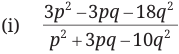
Ans:
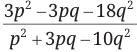
We have,
3p2 – 3pq – 18q2 = 3 (p2 – pq – 6q2)
= 3(p2 – 3pq + 2pq – 6q2)
(∵ -6 = -3 × 2 and -3 + 2 = -1)
= 3[p(p – 3q) + 2q(p – 3q)]
3p2 – 3pq – 18q2 = 3(p + 2q)(p – 3q) …(i)
Now, p2 + 3pq – 10q2 = p2 + 5pq – 2pq – 10q2
[∵ -10 = 5 × (-2) and 5 + (-2) = 3]
= p(p + 5q) – 2q(p + 5q)
Therefore, p2 + 3pq – 10q2 = (p – 2q)(p + 5q) …(ii)
From (i) and (ii), we get

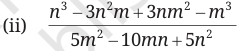
Ans:
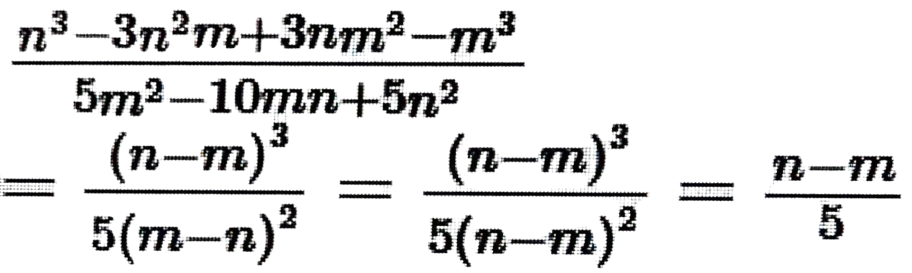

Ans:

We have, w3 – v3 + x3 + 3wvx
= (w – v + x)[w2 + (-v)2 + x2 – xv(-v) – (-v)x – wx]
= (w – v + x)(w2 + v2 + x2 + vw + vx – wx)
[∵ x3 + y3 + z3 – 3xyz = (x + y + z) (x2 + y2 + z2 – xy – xz – yz)]
Now, w2 + v2 + x2 – 2wv – 2vx + 2wx = (w – v + x)2
[∵ (a + b + c)2 = a2 + b2 + c2 + 2ab + 2bc + 2ca]
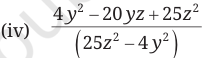
Ans:
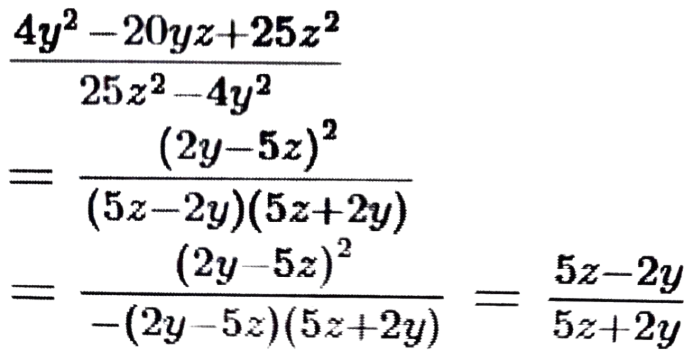
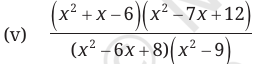
Ans:
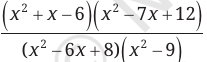
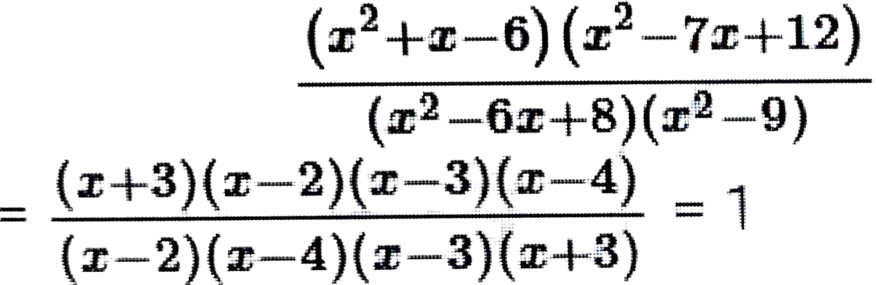
We have,
x2 + x – 6- (x + 3)(x – 2)
x2 – 7x + 12 = (x – 3)(x – 4)
x2 – 6x + 8 = (x – 2)(x – 4)
x2 – 9 = (x – 3)(x + 3)
Therefore,
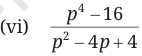
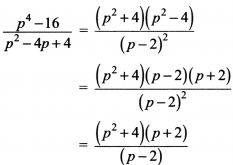
Ans:
| END-OF-CHAPTER EXERCISES |
1. Use suitable identities to find the following products:
(i) (-3x + 4)2
Ans: (-3x + 4)2
Using (a – b)2 = a2 – 2ab + b2
= (-3x)2 + 2(-3x)(4) + 42 = 9x2 – 24x + 16
(ii) (2s + 7) (2s – 7)
Ans: (2s + 7) (2s – 7)
We can use the identity
(a + b) (a – b) = a2 – b2
(25 + 7) (25 – 7) = (25)2 – (7)2
= 4s2 – 49
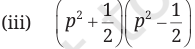
Ans: (p2 + 1/2) (p2 – 1/2)
= (p2)2 – (1/2)2 = p4 – 1/4
(iv) (2n + 7) (2n – 7)
Ans: (2n + 1) (2n – 1)
Using the identity: (a + b) (a – b) = a2 – b2
(2n + 7) (2n – 7) = (2n)2 – 72
= 4n2 – 49
(v) (s – 2t) (s2 + 2st + 4t2)
Ans: (s – 2t) (s2 + 2st + 4t2)
Using a3 – b3 = (a – b) (a2 + ab + b2)
= s3 – (2t)3 = s3 – 8t3
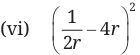
Ans: (1/2r – 4r)2
We simplify this by using the identity
(a – b)2 = a2 – 2ab + b2
(1/2r)2 – 2(1/2r)(4r) + (4r)2
= 1/4r2 – 4 + 16r2
(vii) (-3m + 4k – l)2
Ans: (-3m + 4k – l)2
Using (a + b + c)2
= 9m2 + 16k2 + l2 – 24mk + 6ml – 8kl
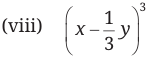
Ans: (x – 1/3y)3
Using (a – b)3 = a3 – 3a2b + 3ab2 – b3
= x3 – x2y + 1/3xy2 – 1/27y3
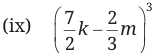
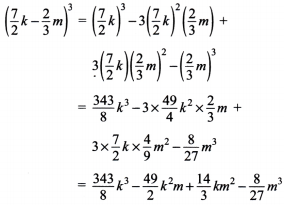
Ans: To expand this, we use the identity:
(a – b)3 = a3 – 3a2b + 3ab2 – b3
2. Find the values using suitable identities:
(i) 17 × 21
Ans: 17 × 21
Use (a – b) (a + b) = a2 – b2
= (19 – 2) (19 + 2) = 192 – 22 = 361 – 4 = 357
(ii) 104 × 96
Ans: 104 × 96
Here, 104 = 100 + 4 and 96 = 100 – 4,
So, 104 × 96 = (100 + 4) (100 – 4)
Using the identity (a + b) (a – b) = a2 – b2
= 1002 – 42
= 10000 – 16
= 9984
(iii) 24 × 16
Ans: 24 × 16
= (20 + 4) (20 – 4) = 202 – 42 = 400 – 16 = 384
(iv) 1473
Ans: 1473
We can use the identity for cubes:
(a – b)3 = a3 – 3a2b + 3 ab2 – b3
Here, 147 = 150 – 3,
So, 1473 = (150 – 3)3
= 1503 – 3 × 1502 × 3 + 3 × 150 × 32 – 33
Simplifying:
= 3375000 – 202500 + 4050 – 27
= 3176523
(v) 1993
Ans: 1993
= (200 – 1)3 = 2003 – 3(2002)(1) + 3(200)(1) – 1
= 8000000 – 120000 + 600 – 1 = 7880599
(vi) 1273
Ans: 1273
We can use the identity for cubes:
(a – b)3 = a3 – 3a2b + 3ab2 – b3
Here, 127 = 130 – 3,
So, 1273 = (130 – 3)3
= 1303 – 3 × 1302 × 3 + 3 × 130 × 32 – 33
= 2197000 – 152100 + 3510 – 27
= 2048383
(vii) (-107)3
Ans: (-107)3 = -(1073)
1073 = (100 + 7)3 = 1000000 + 210000 + 14700 + 343 = 1225043
⇒ (-107)3 = -1225043
(viii) (-299)3
Ans: (-299)3
We can use the identity for cubes:
(a + b)3 = a3 + 3a2b + 3 ab2 + b3
Here, -299 = -300 + 1,
So, (-299)3 = (-300 + 1)3
= (-300)3 + 3 × (-300)2 × 1 + 3 × (-300) × 12+ 13
= -27000000 + 270000 – 900 + 1
= 26730899
3. Factor the following algebraic expressions:
(i) 4y2 + 1 + 1/16y2
Ans: 4y2 + 1 + 1/16y2
= (2y)2 + 2 × (2y) × (1/4y) + (1/4y)2
= (2y + 12y)2
[∵ (a + b)2 = a2 + 2ab + b2]
(ii) 9m2 – 1/25n2
Ans: 9m2 – 1/25n2
= (3m)2 – (1/5n)2
= (3m + 1/5n)(3m – 1/5n)
[∵ a2 – b2 = (a + b)(a – b)]
(iii) 27b3 – 1/64b3
Ans: 27b3 – 1/64b3
= (3b)3 – (1/4b)3 = (3b – 1/4b) (9b2 + 34 + 1/16b2)
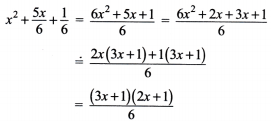
(iv) x2 + 5x/6 + 1/6
Ans:
(v) 27u3 – 1/125 – 27u2/5 + 9u/25
Ans: 27u3 – 1/125 – 27u2/5 + 9u/25
= (3u)3 – (1/5)3 – 3(3u)2 (1/5) + 3(3u) (1/5)2
= (3u – 15)3
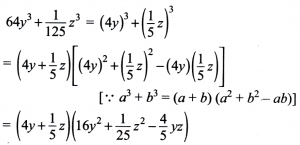
(vi) 64y3 – 1/125z3
Ans:
(vii) p3 + 27q3 + r3 – 9pqr
Ans: p3 + 27q3 + r3 – 9pqr
We have, x3 + y3 + z3 – 3xyz
= (x + y + z)(x3 + y3 + z3 – xy – xz – yz)
= (p + 3q + r)(p3 + 9q3 + r3 – 3pq – 3qr – pr)
(viii) 9m2 – 12m + 4
Ans: 9m2 – 12m + 4
= (3m)2 – 2(3m)(2) + 22 = (3m – 2)2
(ix) 9x3 – 8/3 y3 + z3/3 + 6xyz
Ans: 9x3 – 8/3 y3 + z3/3 + 6xyz
= 1/3(27x3 – 8y3 + z3 + 18xyz)
= 1/3[(3x)3 + (-2y)3 + (z)3 – 3(3x)(-2y)(z)]
= 1/3(3x – 2y +z)(9x3 + 4y3 + z3 + 6xy + 2yz – 3xz)
[∵ a3 + b3 + c3 – 3abc = (a + b + c)(a2 + b2 + c2 – ab – bc – ca)
(x) 4x2 + 9y2 + 36z2 + 12xz + 36yz + 24xy
Ans: 4x2 + 9y2 + 36z2 + 12xz + 36yz + 24xy
= (2x)2 + (3y)2 + (6z)2 + 2(2x)(3y) + 2(3y)(6z) + 2(2x)(6z)
= (2x + 3y + 6z)2
(xi) 27u3 – 1/216 – 9u2/2 + u/4
Ans: 27u3 – 1/216 – 9u2/2 + u/4
= (3u)3 – (1/6)3 – 3(3u)2 (1/6) + 3(3u) (1/6)2
= (3u – 1/6)3
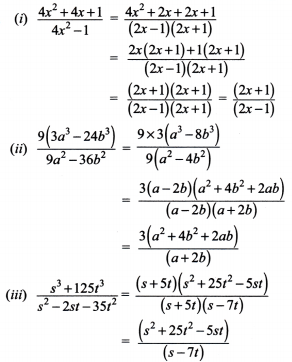
4. Simplify the following:
(i) 4x2 + 4x + 1/4x2 – 1
(ii) 9(3a3 – 24b3)/9a2 – 36b2
(iii) s3 + 125t3/s2 – 2st – 35t2
Note: Assume that the denominators are not equal to 0.
Ans:
5. Find possible expressions for the length and breadth of each of the following rectangles whose areas are given by the following expressions in square units.
(i) 25a2 – 30ab + 9b2
Ans: Recognise identity: (a – b)2 = a2 – 2ab + b2
= (5a)2 – 2(5a) (3b) + (3b)2 = (5a – 3b)2
So,
Length = 5a – 3b
Breadth = 5a – 3b
(ii) 36s2 – 49t2
Ans: 36s2 – 49t2
= (6s)2 – (7t)2
= (6s + 7t)(6s – 7t)
[∵ a2 – b2 = (a + b) (a – b)]
Area of a rectangle = length × breadth
Possible dimensions:
Length = (6s + 7t) units
Breadth = (6s – 7t) units.
6. Find possible expressions for the length, breadth, and heights of each of the following cuboids whose volumes are given by the following expressions in cubic units.
(i) 6a2 – 24b2
Ans: 6a2 – 24b2
Take common factor:
= 6 (a2 – 4b2)
Use identity a2 – b2 = (a – b)(a + b):
= 6(a – 2b)(a + 2b)
So possible dimensions are:
Length = 6
Breadth = a – 2b
Height = a + 2b
(ii) 3ps2 – 15ps +12p
Ans: 3ps2 – 15ps +12p
= 3p(s2 – 5s + 4)
= 3p(s2 – 4s – s + 4)
= 3p[s(s – 4) – 1(s – 4)]
= 3p(s – 1)(s – 4)
Volume of a cuboid = length × breadth × height
Possible dimensions:
Length = 3p units
Breadth = (s – 1) units
Height = (s – 4) units.
7. The village playground is shaped as a square of side 40 metres. A path of width s metres is created around the playground for people to walk. Find an expression for the area of the path in terms of s.
Ans: Side of square playground = 40 m
Path of width s is all around, so new outer square side:
= 40 + 2s
Area of outer square:
(40 + 2s)2
Area of playground:
402 = 1600
Area of path:
= (40 + 2s)2 – 1600
= (1600 + 160s + 4s2) – 1600
= 160s + 4s2
8. If a number plus its reciprocal equals 10/3, find the number.
Ans: Let the number be x. Then its reciprocal is 1x
According to question,
x + 1x = 103
⇒ x2 + 1x = 103
⇒ 3(x2 + 1) = 10x
⇒ 3x2 + 3 = 10x
⇒ 3x2 – 10x + 3 = 0
⇒ 3x2 – 9x – x + 3 = 0
⇒ 3x(x – 3) – 1(x – 3) = 0
⇒ (3x – 1)(x – 3) = 0
⇒ x = 1/3 or x = 3
9. A rectangular pool has area 2x2 + 7x + 3 square hastas. If its width is 2x + 1 hastas, find its length. Hasta was a unit used to measure length.
Ans: Area of rectangle = 2x2 + 7x + 3
Width = 2x + 1
We know:
Area = Length × Width
So,
Length = 2x2 + 7x + 3/2x + 1
Now factorise numerator:
2x2 + 7x + 3 = (2x + 1)(x + 3)
Cancel common factor:
Length = (2x + 1)(x + 3)/2x + 1 = x + 3
10. If both x – 2 and x – 1/2 are factors of px2 + 5x + r, show that p = r.
Ans: px2 + 5x + r
Factors = x – 2, x – 1/2
⇒ x = 2 or 1/2
For x = 2,
p(2)2 + 5(2) + r = 0
4p + 10 + r = 0 …(1)
For x = 1/2
p(1/2)2 + 5(1/2) + r = 0
p/4 + 5/2 + r = 0 …….(2)
Equating (1) and (2), we get
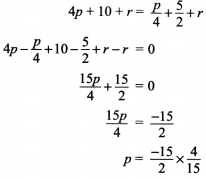
p = -2
Substituting p = -2 in equation (1), we get
4(-2) + 10 + r = 0
⇒ -8 + 10 + r = 0
⇒ 2 + r = 0
⇒ r = -2
∴ p = r = -2
Hence, p = r
11. If a + b + c = 5 and ab + bc + ca = 10, then prove that a3 + b3 + c3 – 3abc = -25.
Ans: Given:
a + b + c = 5, ab + bc + ca = 10
Use the identity:
a3 + b3 + c3 – 3abc = (a + b + c)(a2 + b2 + c2 – ab – bc – ca)
First find a2 + b2 + c2:
a2 + b2 + c2 = (a + b + c)2 – 2(ab + bc + ca)
= 52 – 2(10)
= 25 – 20 = 5
Now substitute:
a3 + b3 + c3 – 3abc = (a + b + c)(a2 + b2 + c2 – ab – bc – ca)
= 5(5 – 10)
= 5 × (-5)
= -25
Final Result:
a3 + b3 + c3 – 3abc = -25
12. By factoring the expression, check that n3 – n is always divisible by 6 for all natural numbers n. Give reasons.
Ans: n3 – n = n(n2 – 1)
Now using the identity a2 – b2 = (a + b)(a – b)
n3 – n = n(n – 1)(n + 1)
This is the product of three consecutive natural numbers.
We know that, among any three consecutive numbers:
One number is divisible by 3 (because every third number is a multiple of 3)
At least one number is even (divisible by 2)
So their product is divisible by 2 × 3 = 6
Therefore, n3 – n is always divisible by 6 for all natural numbers n.
Hence, proved.
13. Find the value of
(i) x3 + y3 – 12xy + 64, when x + y = -4
Ans: Given x + y = -4
Expression:
x3 + y3 – 12xy + 64
Use identity:
x3 + y3 = (x + y)3 – 3xy(x + y)
So,
x3 + y3 – 12xy + 64 = (x+y)3 – 3xy(x + y) – 12xy + 64
Substitute x + y = -4:
= (-4)3 – 3xy(-4) – 12xy + 64
=−64 + 12xy – 12xy + 64
= 0
(ii) x3 – 8y3 – 36xy – 216, when x = 2y + 6
Ans: We are given, x = 2y + 6
⇒ x – 2y = 6
Now, x3 – 8y3 – 36xy – 216
Using the identity: (a – b)3 = a3 – b3 – 3ab(a – b)
(x – 2y)3 = x3 – (2y)3 – 3x(2y)(x – 2y)
(6)3 = x3 – 8y3 – 6xy(6)
216 = x3 – 8y3 – 36xy
⇒ x3 – 8y3 – 36xy – 216 = 0
If you find this NCERT Class 9 Maths Chapter 4 Exploring Algebraic Identities post helpful, please share it with your friends. If you find any mistake in the NCERT Class 9 Maths Chapter 4 Exploring Algebraic Identities Solutions, please let us know in the comment box. We will correct it as soon as possible. Your feedback is valuable to us.
Subject Ka Complete Video Solution Dekhein
Step-by-step easy concept explanation aur full questions Answer ke liye watch karein ya app download karein:

 Buy Now