
NCERT Class 9 Maths Chapter 1 Orienting Yourself: The Use of Coordinates Solutions English Medium As Per New Syllabus. NCERT Class 9 Maths Chapter 1 Orienting Yourself: The Use of Coordinates Notes to each chapter is provided in the list so that you can easily browse throughout different chapter NCERT Class 9 Maths Chapter 1 Orienting Yourself: The Use of Coordinates Question Answer Download PDF and select needs one.
NCERT Class 9 Maths Chapter 1 Orienting Yourself: The Use of Coordinates
Also, you can read the CBSE book online in these sections Solutions by Expert Teachers as per (CBSE) Book guidelines. NCERT Class 9 Mathematics Textual Solutions. These solutions are part of NCERT All Subject Solutions. Here we have given NCERT Class 9 Maths Chapter 1 Orienting Yourself: The Use of Coordinates in English Medium Solutions for All Subject, You can practice these here.
Orienting Yourself: The Use of Coordinates
Chapter – 1
| Exercise Set 1.1 |
1. Fig 1.3 shows Reiaan’s room with points OABC marking its corners. The x- and y-axes are marked in the figure. Point O is the origin.
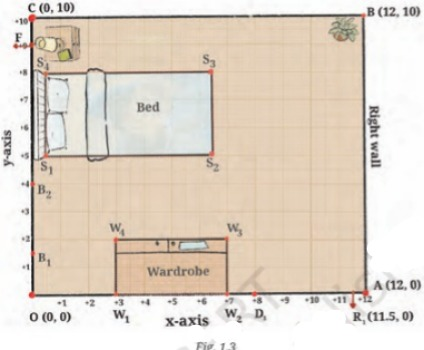
Referring to Fig. 1.3, answer the following questions:
(i) If D1 R1 represents the door to Reiaan’s room, how far is the door from the left wall (the y-axis) of the room? How far is the door from the x-axis?
Ans: From the figure, D1 is on the x-axis and 8 units to the right of O, its coordinates are (8, 0).
Since D1 = (8, 0) and R1 =(11.5, 0), the door is 8 units away from the left wall (y-axis).
The door lies on the x-axis, so its distance from the x-axis = 0 units.
(ii) What are the coordinates of D1?
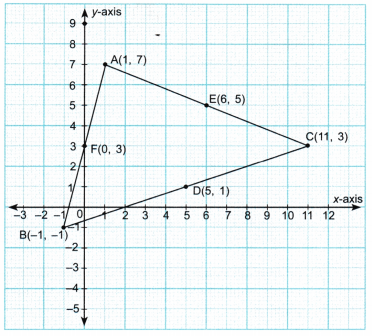
Ans: The coordinates of D1 are (8,0).
(iii) If R1 is the point (11.5,0), how wide is the door? Do you think this is a comfortable width for the room door? If a person in a wheelchair wants to enter the room, will he/she be able to do so easily?
Ans: D1 R1, represents the door, coordinates of D1 = (8, 0) and R1 = (11.5, 0).
So the width of the door = distance between x-coordinates of D1 and R1 points
= 11.5 – 8 = 3.5 units
Let 1 unit = 1 foot 3.5 units = 3.5 feet
Since an average door width is 2 to 3 feet, a door with a width of 3.5 feet is quite comfortable for a room door. A wheelchair is typically 2 to 2.25 feet wide, so, if a person in a wheelchair wants to enter the room, he/she will be able to do so easily.
(iv) If B1 (0, 1.5) and B2 (0, 4) represent the ends of the bathroom door, is the bathroom door narrower or wider than the room door?
Ans: Coordinates of B₁ = (0, 1.5) and B₂ = (0, 4).
So, the width of the bathroom door
= distance between B₁ and B₂
= 4 – 1.5 = 2.5 units
Since 2.5 < 3.5, the bathroom door is narrower than the room door.
| Exercise Set 1.2 |
On a graph sheet, mark the x-axis and y-axis and the origin O. Mark points from (-7, 0) to (13, 0) on the x-axis and from (0, -15) to (0, 12) on the y-axis. (Use the scale 1 cm = 1 unit.) Using Fig. 1.5, answer the given questions.
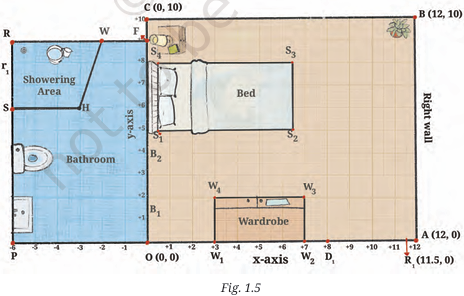
1. Place Reiaan’s rectangular study table with three of its feet at the points (8, 9), (11, 9) and (11,7).
(i) Where will the fourth foot of the table be?
Ans:
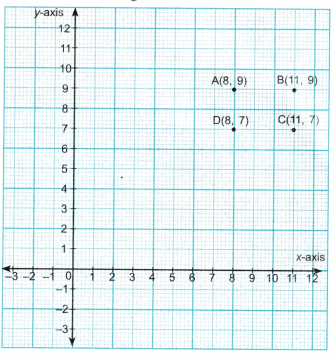
The given three points form three corners of a rectangular study table:
A = (8, 9)
B = (11, 9)
C = (11, 7)
To complete the rectangle, the fourth point must have:
- same x-coordinate as A – 8
- same y-coordinate as C – 7
Therefore, the fourth foot is at D = (8, 7).
(ii) Is this a good spot for the table?
Ans: Yes, this is a good spot because:
- The table is placed neatly inside the room.
- It does not block doors or pathways.
- It is positioned near the wall, which is practical for study.
(iii) What is the width of the table? The length? Can you make out the height of the table?
Ans: Length of the table = Distance between the x-coordinates of the points (8, 9) and (11, 9)
= 11 – 8
= 3 units
Width of the table = Distance between the y-coordinates of the points (11, 9) and (11, 7)
= 9 – 7
= 2 units
The height of the table cannot be determined because the figure shows only a top view (2D) and does not provide any information about its height.
2. If the bathroom door has a hinge at B1 and opens into the bedroom, will it hit the wardrobe? Are there any changes you would suggest if the door is made wider?
Ans: From Fig. 1.5:
– B₁ = (0, 1.5)
– B₂ = (0, 4)
So, the bathroom door has width:
= 4 – 1.5
= 2.5 units
If the door is hinged at B₁ and opens into the bedroom, it will sweep an arc of radius 2.5 units from B₁.
Now the wardrobe begins at:
W₁ = (3, 0)
W₄ = (3, 2)
The nearest point of the wardrobe from B₁(0, 1.5) is around x = 3, which is farther than the door width 2.5 units.
Therefore, the bathroom door will not hit the wardrobe.
Suggestion if the door is made wider:
- If the door becomes much wider, it may come close to or hit the wardrobe.
- In that case, the door could be made to open inward into the bathroom, or
- the wardrobe could be shifted slightly to the right or
- the door width could be kept limited for comfortable movement.
3. Look at Reiaan’s bathroom.
(i) What are the coordinates of the four comers O, F, R, and P of the bathroom?
Ans: The coordinates of the four corners O, F, R, and P of the bathroom are:
O = (0, 0)
F = (0, 9)
R = (-6, 9)
P = (-6, 0)
(ii) What is the shape of the showering area SHWR in Reiaan’s bathroom? Write the coordinates of the four comers.
Ans: From the figure:
S = (-6,5)
H = (-3,5)
W = (-2,9)
R = (-6,9)
Since one pair of opposite sides is parallel, SHWR is a trapezium.
Shape of SHWR = Trapezium
Coordinates of the corners: S = (-6,5)
H = (-3,5)
W = (-2,9)
R = (-6,9)
(iii) Mark off a 3 ft × 2 ft space for the washbasin and a 2 ft × 3 ft space for the toilet. Write the coordinates of the comers of these spaces.
Ans: The coordinates of the corners of the washbasin space are:
L = (-6, 2)
M = (-3, 2)
N = (-3, 0)
P = (-6, 0)
The coordinates of the comers of the toilet space are:
I = (-6, 5)
J = (-4, 5)
K = (-4, 2)
L = (-6, 2)
4. Other rooms in the house:
(i) Reiaan’s room door leads from the dining room which has the length 18 ft and width 15 ft. The length of the dining room extends from point P to point A. Sketch the dining room and mark the coordinates of its comers.
Ans: From Fig. 1.5:
Coordinates of P = (-6, 0)
Coordinates of A = (12, 0)
So, the length of PA = 12 – (-6) = 18 ft, which matches the given length.
If the dining room is 15 ft wide and lies below PA, then its upper side is PA and it extends downward 15 units.
Hence the coordinates of four corners are:
P = (-6, 0)
A = (12, 0)
Q = (12, -15)
S = (-6, -15)
The coordinates of the dining room corners are:
(-6, 0), (12, 0), (12, -15), (-6, -15)
(ii) Place a rectangular 5 ft × 3 ft dining table precisely in the centre of the dining room. Write down the coordinates of the feet of the table.
Ans: The dining room extends:
From x = -6 to x = 12
From y = 0 to y = -15
Centre of the dining room:
x-coordinate of centre = (-6 + 12)/2 = 3
y-coordinate of centre = (0 + (-15))/2 = -7.5
Now place a 5 ft × 3 ft table at the centre.
Taking length = 5 units along the x-axis and width = 3 units along the y-axis:
Half-length = 2.5
Half-width = 1.5
So the coordinates of corners (feet) of the table are:
(3 – 2.5, -7.5 – 1.5) = (0.5, -9)
(3 + 2.5, -7.5 – 1.5) = (5.5, -9)
(3 + 2.5, -7.5 + 1.5) = (5.5, -6)
(3 – 2.5, -7.5 + 1.5) = (0.5, -6)
The coordinates of the four feet of the dining table are:
(0.5, -9), (5.5, -9), (5.5, -6), (0.5, -6)
| END-OF-CHAPTER EXERCISES |
1. What are the x-coordinate and y-coordinate of the point of intersection of the two axes?
Ans: The x-axis and y-axis intersect at the origin.
Therefore:
The x -coordinate = 0
The y -coordinate = 0
So, the point of intersection is (0, 0).
2. Point W has x-coordinate equal to -5. Can you predict the coordinates of point H which is on the line through W parallel to the y-axis? Which quadrants can H lie in?
Ans: If the point W has x-coordinate of -5, then any point on the line through which is parallel to the y-axis will also have x-coordinate of -5.
Hence,
The coordinates of any point H on this line will be of the form (-5, y), where y can be any real number.
- If y > 0, point H lies in Quadrant II.
- If y < 0, point H lies in Quadrant III.
- If y = 0, point H lies on the x-axis.
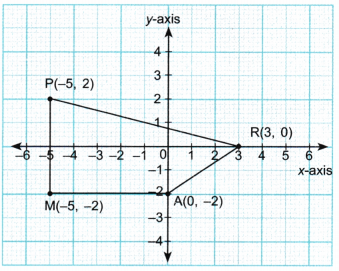
3. Consider the points R (3, 0), A (0, -2), M (-5, -2) and P (-5, 2). If they are joined in the same order, predict:
(i) Two sides of RAMP that are perpendicular to each other.
Ans: Let us observe:
AM joins A(0, -2) to M(-5, -2), so it is horizontal.
MP joins M(-5, -2) to P(-5, 2), so it is vertical.
A horizontal line and a vertical line are perpendicular.
Therefore:
AM ⊥ MP
The two perpendicular sides are AM and MP.
(ii) One side of RAMP that is parallel to one of the axes.
Ans: The line AM is parallel to the x-axis because both points A and M share the same x-coordinate (-2).
The line MP is parallel to the y-axis because both points M and P have the same x-coordinate (-5).
(iii) Two points that are mirror images of each other in one axis. Which axis will this be?
Now plot the points and verily your predictions.
Ans: Compare M (-5, -2) and P (-5, 2)
They have the same x-coordinate and their y-coordinates are equal in magnitude but opposite in sign.
So, they are mirror images of each other in the x-axis.
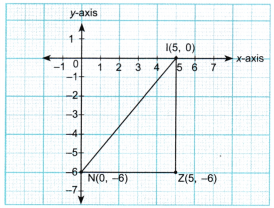
4. Plot point Z (5, -6) on the Cartesian plane. Construct a right-angled triangle IZN and find the lengths of the three sides.
(Comment: Answers may differ from person to person.)
Ans: Point Z is (5, -6).
To form a right-angled triangle easily, take:
I = (5, 0) on the x-axis
N = (0, -6) on the y-axis
Then triangle IZN is right-angled at Z? Let’s check:
IZ is vertical
ZN is horizontal
So, triangle IZN is right-angled at Z.
Coordinates of the points:
I = (5, 0)
Z = (5, -6)
N = (0, -6)
Now find the lengths of the sides:
1. IZ:
Distance between (5, 0) and (5, -6)
= 0 – (-6) = 6 units
2. ZN:
Distance between (5, -6) and (0, -6)
= 5 – 0 = 5 units
3. IN:
Using distance formula:
IN = √[(5 – 0)² + (0 – (-6))²]
= √(5² + 6²)
= √(25 + 36)
= √61 units
Therefore, one possible right-angled triangle is formed by:
I = (5, 0)
Z = (5, -6)
N = (0, -6)
Lengths of the sides:
IZ = 6 units
ZN = 5 units
IN = √61 units
5. What would a system of coordinates be like if we did not have negative numbers? Would this system allow us to locate all the points on a 2-D plane?
Ans: Without negative numbers the coordinates would be limited to zero or positive values only.
Thus,
- On the x-axis, we could mark only the points to the right of the origin.
- On the y-axis, we could mark only the points above the origin.
This would restrict us to locate points only in:
- Quadrant I
- the positive part of the x-axis
- the positive part of the y-axis
- and the origin
We would not be able to locate:
- points in Quadrant II
- points in Quadrant III
- points in Quadrant IV
- points on the negative parts of the axes
Therefore, such a system would not allow us to locate all the points on a 2-D plane.
6. Are the points M (-3, -4), A (0, 0) and G (6, 8) on the same straight line? Suggest a method to check this without plotting and joining the points.
Ans: To check whether the points M (-3, -4), A (0, 0), and G (6, 8) lie on the same straight line using the Distance formula:
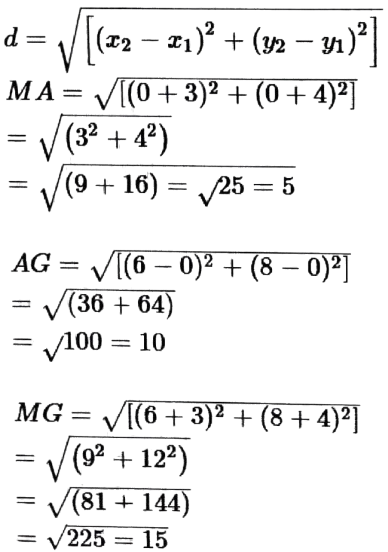
Now checking: MA + AG = 5 + 10 = 15 = MGM
Since the sum of two distances equals the third, the points M,A and G lie on the same straight Line.
7. Use your method (from Problem 6) to check if the points R (-5, -1), B (-2, -5) and C (4, -2) are on the same straight line. Now plot both sets of points and check your answers.
Ans: To check whether the points R (-5, -1), B (-2, -5) and C(4, -12) lie on the same straight line using the distance formula: d
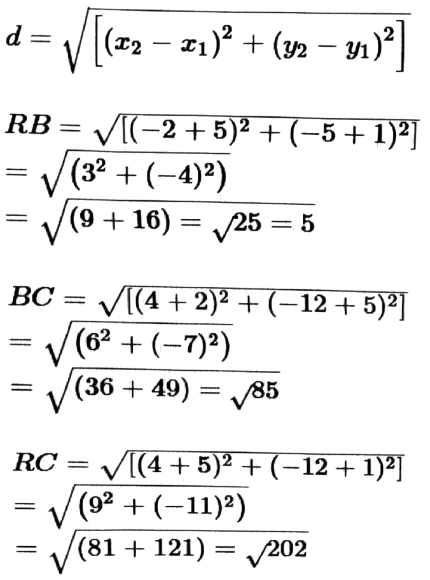
Now: RB + BC = 5 + √85 ≠ √202
Since the sum of two distances is not equal to the third, the points R, B and C. do not lie on the same straight line.
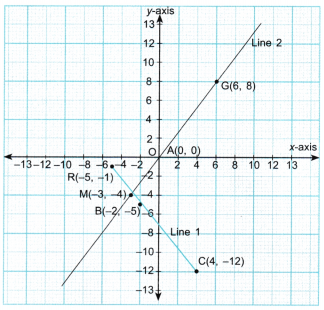
Checking:
Line 1 for points: R (-5, -1), B (-2, -5) and C (4, -12):
Line 2 for points: M (-3, -4), A (0, 0) and G (6, 8) (from Problem 6)
8. Using the origin as one vertex, plot the vertices of:
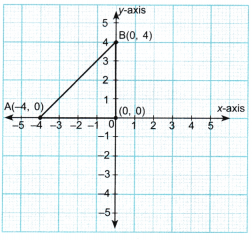
(i) A right-angled isosceles triangle.
Ans: One possible set of vertices of triangle OAB is:
O = (0, 0)
A = (4, 0)
B = (0, 4)
Because:
OA = 4 units
OB = 4 units
OA is perpendicular to OB
So triangle OAB is a right-angled isosceles triangle.
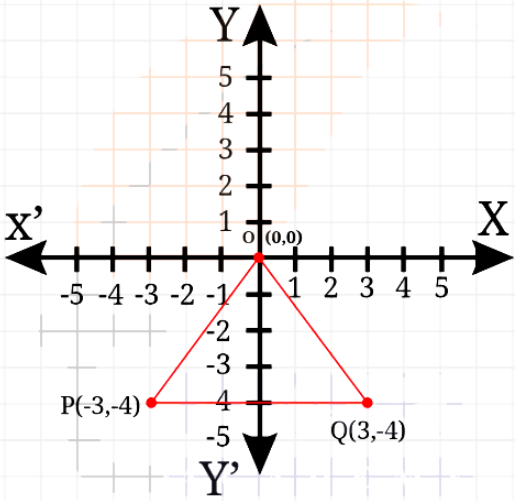
(ii) An isosceles triangle with one vertex in Quadrant III and the other in Quadrant IV.
Ans: One possible set of vertices is:
O = (0, 0),P = (-3, -4),Q = (3, -4)
Explanation:
P lies in Quadrant III
Q Lies in Quadrant IV
OP =OQ = 5 units
So triangle OPQ is an isosceles triangle.
9. The following table shows the coordinates of points S, M and T. In each case, state whether M is the midpoint of segment ST. Justify your answer.
| S | M | T | Is M the midpoint of ST? Yes or No | Reason for your answer |
| (-3, 0) | (0, 0) | (3, 0) | ||
| (2, 3) | (3, 4) | (4, 5) | ||
| (0, 0) | (0, 5) | (0, -10) | ||
| (-8, 7) | (0, -2) | (6, -3) |
When M is the mid-point of ST, can you find any connection between the coordinates of M, S and T?
Ans: Using distance formula:
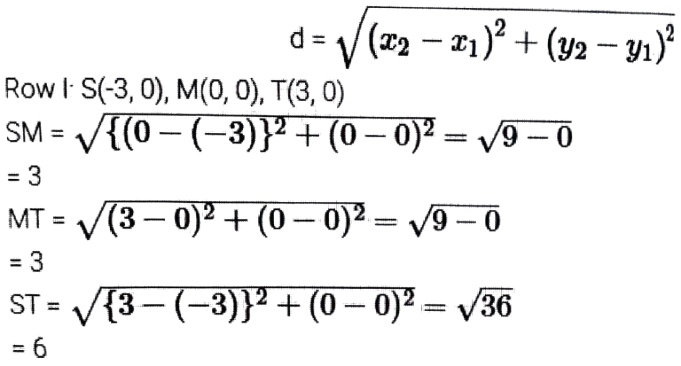
SM + MT= 3 + 3 = 6 = ST
Yes, M is the midpoint of SM and MT.
Row 2: S(2, 3), M(3, 4), T(4, 5)
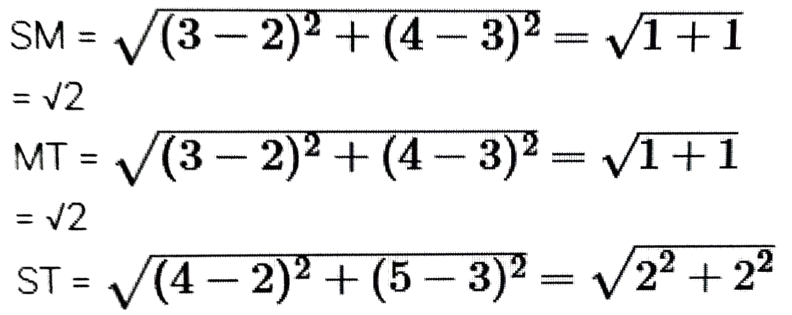
= √8 = 2√2
SM + MT = √2 + √2 = 2√2 = ST
Yes, M is the midpoint of SM and MT.
Row 3: S(0, 0), M(0, 5), T(0, -10)
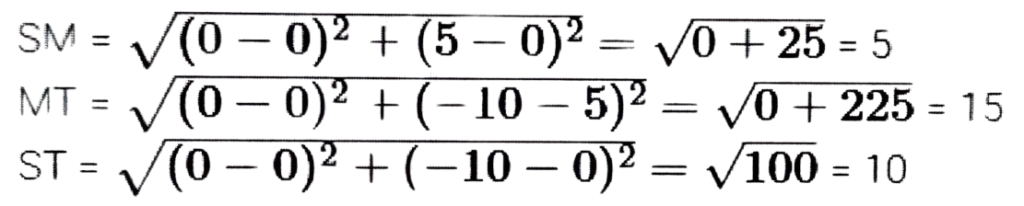
SM + MT = 5+ 15 = 20 ≠ 10
So, M is not the midpoint of SM and MT.
Row 4: S(-8, 7), M(0, -2), T(6, -3)
So, M is not the midpoint of SM and MT.
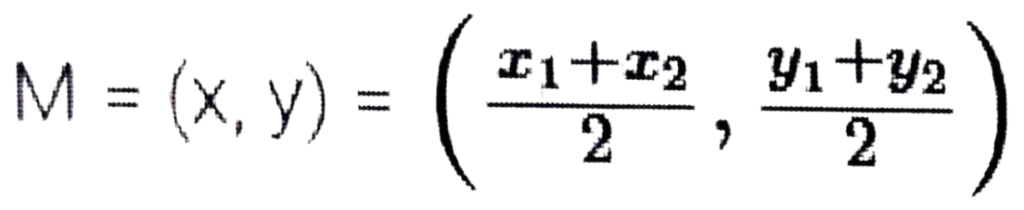
When M is the midpoint of ST, its x-coordinate is the average of the x-coordinates of S and T, and its y-coordinate is the average of the y-coordinates of S and T.
Or
If M = (x, y), S = (x1, y1), and T = (x2, y2),
10. Use the connection you found to find the coordinates of B given that M (-7, 1) is the midpoint of A (3, -4) and B (x, y).
Ans: Given: M (-7, 1) is the midpoint of A (3, -4) and B (x, y).
So, using the concept of distance formula, point M will be equidistant from A and B.
Using distance formula:
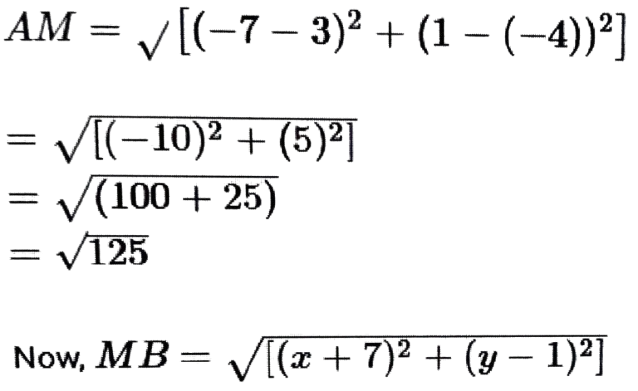
Since Distance AM = Distance MB

Squaring both sides:
(x + 7)2 + (y – 1)2 = 1251
Also, since M is the midpoint, it lies between A and B, so coordinates of B will be such that M divides AB into two equal parts. From symmetry (or balancing coordinates):
From x-coordinates:
Distance from A to M is -7 – 3 = -10
So from M to B must also be -10
x = -7 – 10 = -17
From y-coordinates:
Distance from A to M is 1 – (-4) = 5
So from M to B must also be 5
y = 1 + 5 = 6
Therefore, the coordinates of B = (-17, 6).
11. Let P, Q be points of trisection of AB, with P closer to A, and Q closer to B. Using your knowledge of how to find the coordinates of the midpoint of a segment, how would you find the coordinates of P and Q? Do this for the case when the points are A (4, 7) and B (16, -2).
Ans: To trisect the segment AB, points P and Q divides the line segment into three equal parts.
Given: A(4, 7), B(16, -2)
Let the coordinates of P and Q are (x1, y1) and (x2, y2) respectively.

Here, P is midpoint of A and Q.
So,
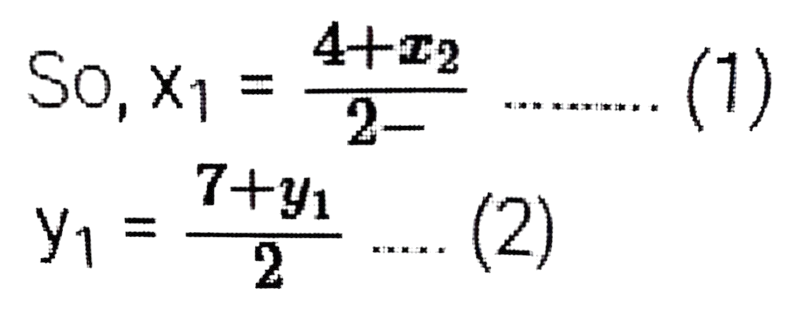
Q is midpoint of P and B, So
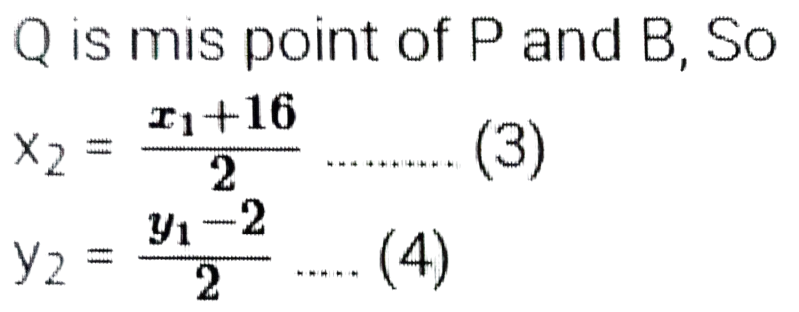
Solving for x-coordinates, from (1):

Substituting (1) into (3), we get

⇒ 4x2 = x2 + 36
⇒ 3x2 =36
⇒ x2 = 12
Then from (1): x1 = 4+12/2 = 8
Solving for y-coordinates, from (2):
y1 = 7+y2/2 and
From (4): y2 = y1-2/2
Substituting (2) into (4) we get

⇒ 4y2 = y2 + 3
⇒ 3y2 = 3
⇒ y2 = 1
Then from (2): y1 = 7+12 = 4
Therefore, P = (8, 4) and Q = (12, 1).
12. (i) Given the points A (1, -8), B (-4,7) and C (-7, -4), show that they lie on a circle K whose center is the origin O (0, 0). What is the radius of circle K?
Ans:
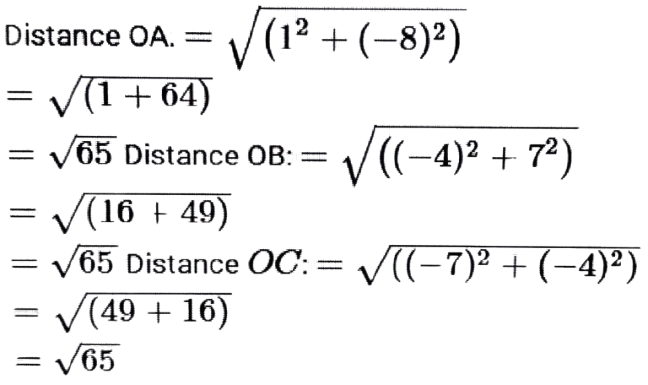
Since all three points are at the same distance from origin, they lie on a circle centred at (0,0).
Radius = √65
Points A, B and C lie on circle K with center (0, 0) and radius √65.
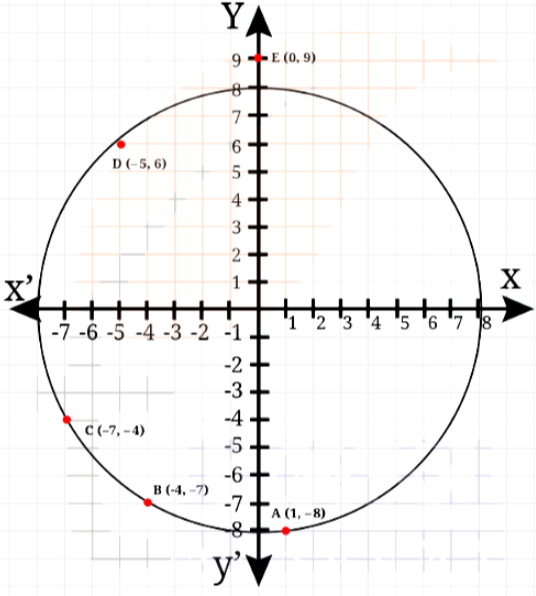
(ii) Given the points D (-5, 6) and E (0, 9), check whether D and E lie within the circle, on the circle, or outside the circle K.
Ans:

Compare with radius:
√65 ≈ 8.06 and √61 ≈ 7.81 < √65
So, D lies inside the circle 9 > √65
So, E lies outside the circle K.
13. The midpoints of the sides of triangle ABC are the points D, E, and F. Given that the coordinates of D, E, and F are (5, 1), (6, 5), and (0, 3), respectively, find the coordinates of A, B and C.
Ans: Let the vertices of triangle ABC be A(x1, y1), B(x2, y2) and C(x3, y3).
Given midpoints: D(5, 1), E(6, 5), and F(0, 5)
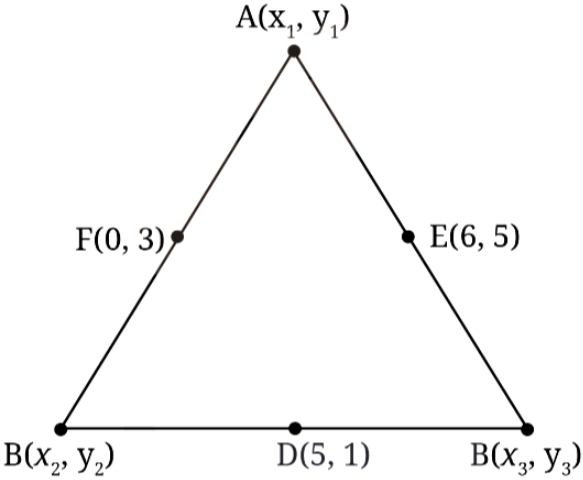
D is midpoint of BC, so using midpoint formula:
x2 + x3 = 10 …… (1)
y2 + y3 = 2 …… (2)
E is midpoint of CA, therefore:
x3 + x1 = 12 …… (3)
y3 + y2 = 10 …… (4)
F is midpoint of AB, therefore:
x1 + x2 = 0 …… (5)
y1 + y2 = 6 …… (6)
Solving for x-coordinates, from (5):
x2 = -x1
Substitute into (1):
-x1 + x3 = 10
⇒ x3 = 10 + x1 …(7)
Substituting into (3):
(10 + x1) + x1 = 12
⇒ 2x1 + 10 = 12
⇒ 2x1 = 2
⇒ x1 = 1
Then: x2 = -1 and x3 = 10 + 1 = 11 from (7)
Solving y-coordinates, from (6):
y3 = 6 – y1
Substituting into (2): (6 – y1) + y3 = 2
⇒ y3 = y1 – 4 …(8)
Substituting into (4): (y1 – 4) + y1 = 10
⇒ 2y1 – 4 = 10
⇒ 2y1 = 14
⇒ y1 = 7
Then y3 = 6 – 7 = -1
⇒ y2 = 7 – 4 = 3 and y3 = 7 – 4 = 3 from (8)
Therefore, the coordinates of the points are A(1, 7), B(-1, -1) and C(11, 3).
14. A city has two main roads which cross each other at the centre of the city. These two roads are along the North-South (N-S) direction and East-West (E-W) direction. All the other streets of the city run parallel to these roads and are 200 m apart. There are 10 streets in each direction.
(i) Using 1 cm = 200 m, draw a model of the city in your notebook. Represent the roads/streets by single lines.
Ans: Drawing the model of the city
Since: 1 cm = 200 m
Each pair of adjacent streets is 200 m apart.
Given that:
10 streets in the N-S direction and 10 streets in the E-W direction
Hence, the model will consist of:
10 vertical parallel lines (for N-S streets)
10 horizontal parallel lines (for E-W streets)
Each consecutive line 1 cm apart, which forms a square grid.
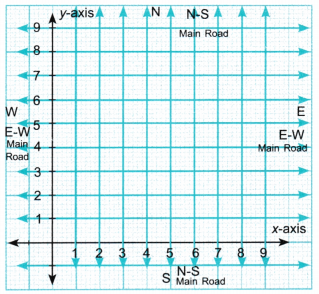
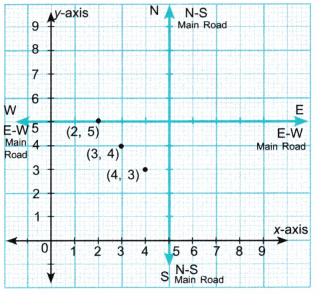
(ii) There are street intersections in the model. Each street intersection is formed by two streets — one running in the N-S direction and another in the E-W direction. Each street intersection is referred to in the following manner: If the second street running in the N-S direction and 5th street in the E-W direction meet at some crossing, then we call this street intersection (2, 5). Using this convention, find:
(a) how many street intersections can be referred to as (4, 3).
(b) how many street intersections can be referred to as (3,4).
Ans: A street intersection is named by: (first number, second number) = (N-S street number, E-W street number)
(4, 3) represents the 4th N-S street and the 3rd E-W street (3,4) represents the 3rd N-S street and the 4th E-W street
Now, one N-S street and one E-W street can meet at only one point.
Therefore:
(a) Only one intersection can be called (4, 3).
(b) Only one intersection can be called (3, 4).
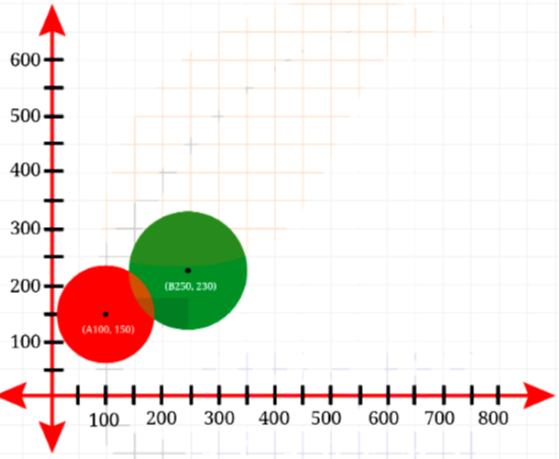
15. A computer graphics program displays images on a rectangular screen whose coordinate system has the origin at the bottom-left corner. The screen is 800 pixels wide and 600 pixels high. A circular icon of radius 80 pixels is drawn with its centre at the point A (100, 150). Another circular icon of radius 100 pixels is drawn with its centre at the point B (250, 230). Determine:
(i) whether any part of either circle lies outside the screen.
(ii) whether the two circles intersect each other.
Ans: (i) No. Each of the two circles lies inside the screen.
(ii) Yes. The two circle intersect each other as shown.
16. Plot the points A (2, 1), B (-1, 2), C (-2, -1), and D (1, -2) in the coordinate plane. Is ABCD a square? Can you explain why? What is the area of this square?
Ans:
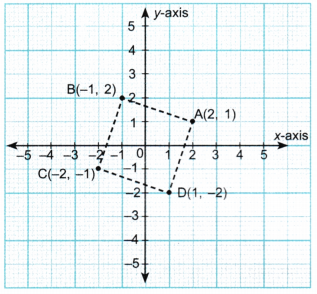
We can check it finding the lengths of sides and diagonals Finding the lengths of all sides:
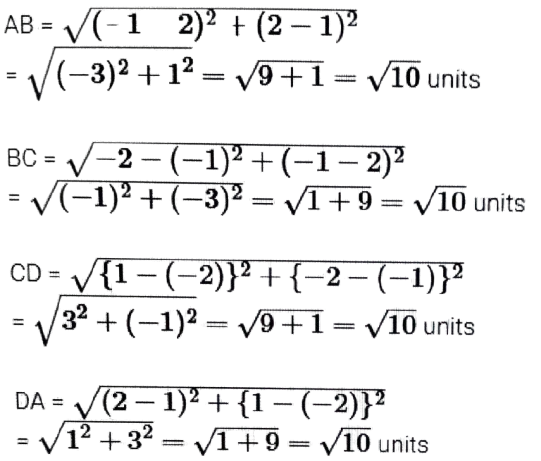
All four sides are equal.
Now, finding diagonals
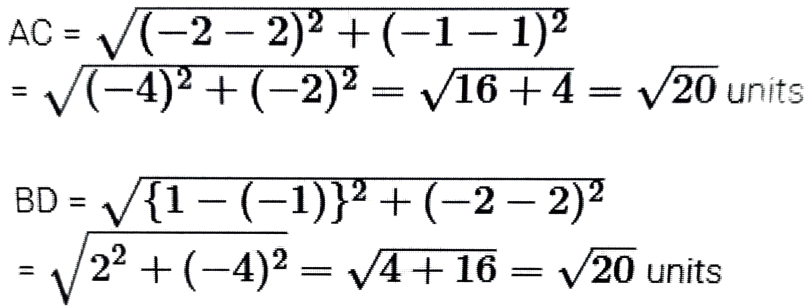
Diagonals AC and BD are equal.
All sides are equal and diagonals are equal, so ABCD is a square.
Area of square ABCD = (side)2 = (√10)2 = 10 square units.
If you find this NCERT Class 9 Maths Chapter 1 Orienting Yourself: The Use of Coordinates post helpful, please share it with your friends. If you find any mistake in the NCERT Class 9 Maths Chapter 1 Orienting Yourself: The Use of Coordinates Solutions, please let us know in the comment box. We will correct it as soon as possible. Your feedback is valuable to us.
Subject Ka Complete Video Solution Dekhein
Step-by-step easy concept explanation aur full questions Answer ke liye watch karein ya app download karein:

 Buy Now