
The AHSEC Class 11 Mathematics Syllabus is designed to develop students’ logical reasoning, analytical thinking and problem-solving abilities. The syllabus connects theoretical mathematical concepts with practical applications and encourages students to understand mathematics through conceptual clarity, creative inquiry and experiential learning.
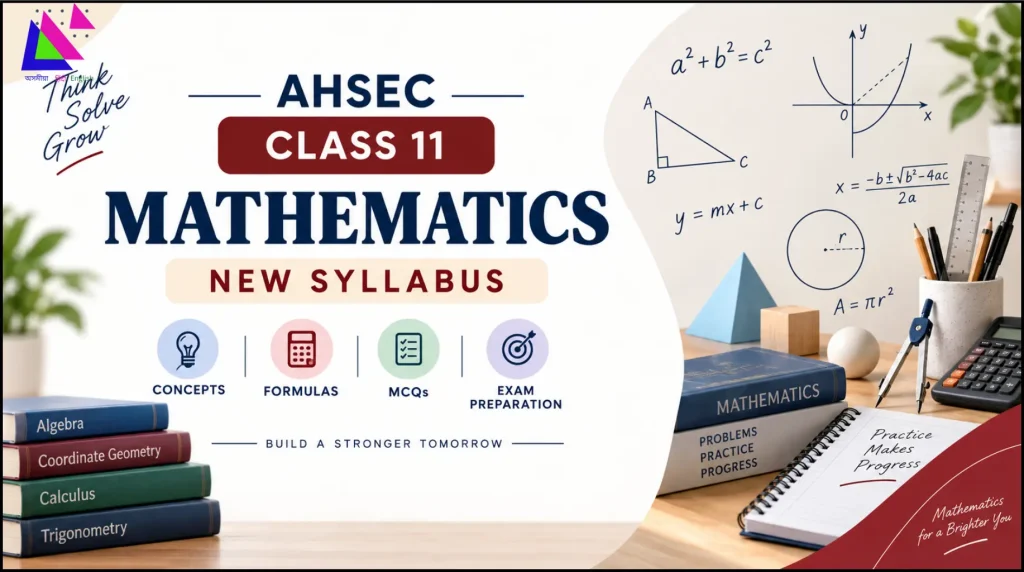
The Class 11 Mathematics course covers Sets and Functions, Algebra, Coordinate Geometry, Calculus, Statistics and Probability, along with Infinite Series and Mathematical Modelling under the Appendix. The subject also includes 20 marks for Project Work.
AHSEC Class 11 Mathematics Syllabus Overview
| Particulars | Details |
| Class | XI |
| Subject | Mathematics |
| Theory Marks | 80 |
| Project Marks | 20 |
| Total Marks | 100 |
| Time Duration | 3 Hours |
| Theory Periods | 180 |
| Project Periods | 20 |
| Total Periods | 200 |
| Official Notification | Click Here |
The official syllabus specifies one paper of 100 marks with a three-hour examination, with the evaluation scheme divided into 80 marks Theory and 20 marks Project Work.
AHSEC Class 11 Mathematics Unit-wise Syllabus
| Unit | Topic | Marks |
| Unit I | Sets and Functions | 18 |
| Unit II | Algebra | 22 |
| Unit III | Coordinate Geometry | 20 |
| Unit IV | Calculus | 10 |
| Unit V | Statistics and Probability | 10 |
| Appendix | 1. Infinite Series2. Mathematical Modelling | — |
| Project Work | Project Work | 20 |
| Total | 100 |
Also Read: AHSEC Class 11 Education Syllabus: Complete Details
Chapter-wise Details
Unit I: Sets and Functions
This unit carries 18 marks and includes Sets, Relations and Functions, and Trigonometric Functions.
1. Sets
- Sets and their representations
- Empty Set
- Finite and Infinite Sets
- Equal Sets
- Subsets
- Subsets of the set of real numbers, especially intervals
- Universal Set
- Venn Diagrams
- Union and Intersection of Sets
- Difference of Sets
- Complement of a Set
2. Relations and Functions
- Cartesian Product of Sets
- Number of Elements in the Cartesian Product of Two Finite Sets
- Cartesian Product of Real Numbers
- Definition of Relation
- Pictorial Diagrams
- Domain, Co-domain and Range
- Function as a Special Kind of Relation
- Pictorial Representation of a Function
- Real-valued Functions of a Real Variable
- Constant Function
- Identity Function
- Polynomial Function
- Rational Function
- Modulus Function
- Signum Function
- Greatest Integer Function
- Graphs of Functions
- Sum, Difference, Product and Quotient of Functions
3. Trigonometric Functions
- Positive and Negative Angles
- Measurement of Angles in Radians and Degrees
- Conversion between Radian and Degree Measures
- Trigonometric Functions using Unit Circle
- Identity \(\sin^2x+\cos^2x=1\)
- Signs of Trigonometric Functions
- Graphs of Trigonometric Functions
- Compound Angles
- Trigonometric Identities
Unit II: Algebra
Algebra carries 22 marks and includes the following chapters:
1. Complex Numbers and Quadratic Equations
- Need for Complex Numbers
- Algebraic Properties of Complex Numbers
- Modulus of a Complex Number
- Conjugate of a Complex Number
- Argand Plane
- Polar Representation
2. Linear Inequalities
- Linear Inequalities
- Algebraic Solutions of Linear Inequalities in One Variable
- Representation on the Number Line
3. Permutations and Combinations
- Fundamental Principle of Counting
- Factorial \(n\)
- Permutations
- Combinations
- Derivation of Formulae
- Relationship between Permutations and Combinations
- Simple Applications
4. Binomial Theorem
- Binomial Theorem for Positive Integral Indices
- Statement and Proof
- Pascal’s Triangle
- Simple Applications
5. Sequence and Series
- Sequence and Series
- Geometric Progression (G.P.)
- General Term of a G.P.
- Sum of \(n\) Terms of a G.P.
- Geometric Mean (G.M.)
- Relation between A.M. and G.M.
Unit III: Coordinate Geometry
Coordinate Geometry carries 20 marks and covers Straight Lines, Conic Sections and Three-dimensional Geometry.
1. Straight Lines
- Revision of Two-dimensional Geometry
- Slope of a Line
- Angle between Two Lines
- Various Forms of Equation of a Line
- Lines Parallel to the Axes
- Point-Slope Form
- Slope-Intercept Form
- Two-Point Form
- Intercept Form
- General Equation of a Line
- Distance of a Point from a Line
2. Conic Sections
- Section of a Cone
- Circle
- Ellipse
- Parabola
- Hyperbola
- Point as a Degenerated Conic
- Straight Line as a Degenerated Conic
- Pair of Intersecting Lines
- Standard Equations of Parabola, Ellipse and Hyperbola
- Simple Properties of Conic Sections
- Standard Equation of a Circle
3. Introduction to Three-dimensional Geometry
- Coordinate Axes in Three Dimensions
- Coordinate Planes
- Coordinates of a Point
- Distance between Two Points
Unit IV: Calculus
The Calculus unit carries 10 marks.
- Limits and Derivatives
- Intuitive Idea of Limits
- Limits of Polynomial Functions
- Limits of Rational Functions
- Limits of Trigonometric Functions
- Limits of Exponential Functions
- Limits of Logarithmic Functions
- Definition of Derivative
- Derivative and Slope of Tangent to a Curve
- Derivative of Sum of Functions
- Derivative of Difference of Functions
- Derivative of Product of Functions
- Derivative of Quotient of Functions
- Derivatives of Polynomial Functions
- Derivatives of Trigonometric Functions
Unit V: Statistics and Probability
This unit carries 10 marks and is divided into Statistics and Probability.
1. Statistics
- Measures of Dispersion
- Range
- Mean Deviation
- Variance
- Standard Deviation
- Ungrouped Data
- Grouped Data
2. Probability
- Events
- Occurrence of Events
- ‘Not’, ‘And’ and ‘Or’ Events
- Exhaustive Events
- Mutually Exclusive Events
- Axiomatic or Set-theoretic Probability
- Probability of an Event
- Probability of ‘Not’, ‘And’ and ‘Or’ Events
- Appendix
The syllabus also includes two additional areas under the Appendix:
1. Infinite Series
- Binomial Theorem for Any Index
- Infinite Geometric Series
- Exponential Series
- Logarithmic Series
2. Mathematical Modelling
- Mathematical Modelling concepts developed up to Class X
- Modelling Real-life Problems
- Environmental and Travel-related Problems
- Connecting Mathematics with Other Subjects
- Formulating a Mathematical Model
- Finding Solutions
- Interpreting Solutions in the Problem Situation
- Evaluating the Model
Project Work
Project Work carries 20 marks. The objective is to help students apply mathematical concepts to practical situations, encourage exploration and creativity, and develop logical presentation and communication skills.
The project assessment is based on:
| Criteria | Marks |
| Relevance of the Topic | 3 |
| Mathematical Content and Understanding | 6 |
| Presentation and Creativity | 3 |
| Viva-Voce | 8 |
| Total | 20 |
Important Topics for AHSEC Class 11 Mathematics Preparation
Students should focus on:
- Sets and Venn Diagrams
- Relations and Functions
- Trigonometric Functions and Identities
- Complex Numbers
- Quadratic Equations
- Linear Inequalities
- Permutations and Combinations
- Binomial Theorem
- Sequence and Series
- Straight Lines
- Conic Sections
- Three-dimensional Geometry
- Limits and Derivatives
- Statistics
- Probability
- Infinite Series
- Mathematical Modelling
Study Tips for AHSEC Class 11 Mathematics
- Understand the concept before memorising formulas.
- Maintain a separate formula sheet for quick revision.
- Practise numerical problems regularly.
- Give special attention to Algebra and Coordinate Geometry, which carry higher marks.
- Practise Trigonometric identities and their applications repeatedly.
- Solve problems based on Permutations and Combinations, Binomial Theorem and Progressions.
- Practise graphs and equations in Coordinate Geometry.
- Build a strong understanding of Limits and Derivatives before moving to more advanced Calculus.
- Revise Statistics and Probability through regular problem-solving.
- Complete the Project Work carefully and prepare for the Viva-Voce.
Conclusion
The AHSEC Class 11 Mathematics Syllabus provides a strong foundation in mathematical reasoning, algebraic thinking, geometry, calculus, statistics and probability. The syllabus includes five main units, along with Infinite Series and Mathematical Modelling in the Appendix and a separate 20-mark Project Work component.
Students should focus on conceptual clarity, regular practice and logical problem-solving. Consistent revision and practice of important formulas and numerical problems will help students prepare effectively for the Class 11 Mathematics examination.
FAQs
1. What is the total marks for AHSEC Class 11 Mathematics syllabus?
Ans: Mathematics carries 100 marks, consisting of 80 marks for Theory and 20 marks for Project Work.
2. How many units are included in Class 11 Mathematics?
Ans: There are five main units: Sets and Functions, Algebra, Coordinate Geometry, Calculus, and Statistics and Probability.
3. Which unit carries the highest marks?
Ans: Algebra carries the highest marks with 22 marks, followed by Coordinate Geometry with 20 marks.
4. What is included in the Appendix?
Ans: The Appendix includes Infinite Series and Mathematical Modelling.
5. How many marks does Mathematics Project Work carry?
Ans: Project Work carries 20 marks, including marks for relevance, mathematical understanding, presentation and Viva-Voce.
Subject Ka Complete Video Solution Dekhein
Step-by-step easy concept explanation aur full questions Answer ke liye watch karein ya app download karein:




 Buy Now