
NCERT Class 9 Physical Education Chapter 21 Samagra Svasthya Solutions English Medium As Per New Syllabus. to each chapter is provided in the list so that you can easily browse through different chapters NCERT Class 9 Physical Education Chapter 21 Samagra Svasthya Notes and select need one. NCERT Class 9 Physical Education Question Answers Download PDF. NCERT Class 9 Physical Education And Well – Being Texbook Solutions.
NCERT Class 9 Physical Education Chapter 21 Samagra Svasthya
Also, you can read the NCERT book online in these sections Solutions by Expert Teachers as per Central Board of Secondary Education (CBSE) Book guidelines. CBSE Class 9 Physical Education And Well – Being Textual Solutions are part of All Subject Solutions. Here we have given NCERT Class 9 Physical Education And Well – Being Notes, CBSE Class 9 Physical Education And Well – Being Textbook Solutions for All Chapters, You can practice these here.
Samagra Svasthya (Yoga for Holistic Health)
Chapter: 21
| Unit – 6 Yoga for Holistic Health and Personal Excellence |
Activity:
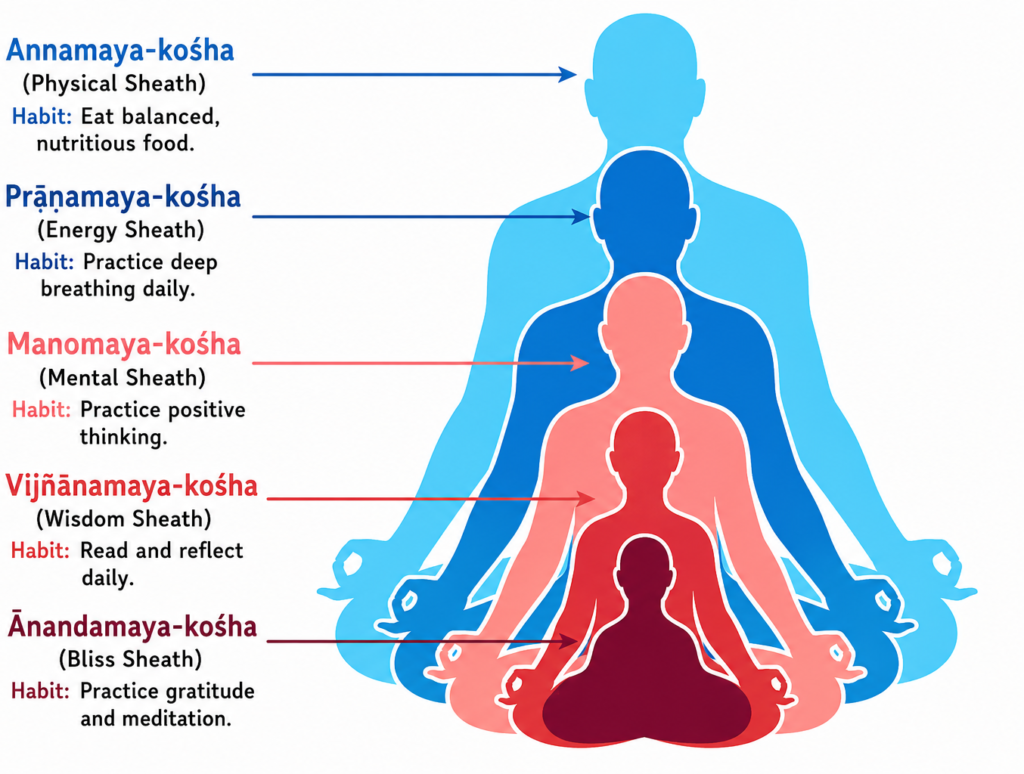
1. Draw five concentric circles, labelling each kosha and write one habit that strengthens each sheath.
Ans:
| CHECK YOUR PROGRESS |
Answer the following:
1. Am I healthy in all dimensions?
Tick what you are following on a daily basis:
(a) Physical Dimension:
(i) Do I eat healthy food regularly?
Ans: Yes, I eat a nutritious, sāttvika diet regularly to maintain a strong and active body.
(ii) Do I get enough sleep (7–8 hours)?
Ans: Yes, I get regulated sleep every night, which helps my body repair tissues, restore energy, and stay fresh.
(iii) How often do I play, exercise, or do yoga āsana, prāṇāyāma, dhyāna?
Ans: I practice physical activity daily, such as 15 minutes of yoga āsanas, Sūrya-namaskāra, or deep breathing (prāṇāyāma) to maintain my stamina and flexibility.
(iv) Do I feel energetic throughout the day, or tired quickly?
Ans: I feel steady, energetic, and active throughout the day, which shows that my physical and energy sheaths are in balance.
(b) Mind and Emotions:
(i) Do I learn with focus and what do you mean by learning with positive thinking?
Ans: Yes, I learn with focus. Learning with positive thinking means keeping the mind free from negative thoughts, overthinking, and worry, allowing for calm and confident concentration.
(ii) Am I able to manage emotions like anger, sadness, and stress without getting too disturbed?
Ans: Yes, I am able to regulate emotions like joy, fear, anger, and sadness, and I can cope with daily stress without losing my emotional balance.
(iii) Do I treat everyone with compassion and friendliness?
Ans: Yes, I show empathy, understanding, and treat those around me with care and compassion.
(c) Intellect and Social:
(i) Do I make thoughtful decisions?
Ans: Yes, I use my wisdom and intellect to distinguish right from wrong and make clear, ethical decisions.
(ii) Do I listen and cooperate with friends/family?
Ans: Yes, I build good relationships by actively cooperating, sharing, and communicating positively with my family and friends.
(iii) Do I respect differences in opinions?
Ans: Yes, I remain open to new ideas, reflect on my actions, and respect others in my community.
(d) Spiritual:
(i) Does contentment make me feel peaceful and happy inside?
Ans: Yes, practicing contentment brings me inner peace, harmony, and joy that does not depend on external causes or achievements.
(ii) Do I practice silence, meditation, or prayer?
Ans: Yes, practicing contentment brings me inner peace, harmony, and joy that does not depend on external causes or achievements.
2. When do I feel connected to something bigger than myself?
Ans: You feel connected to something bigger than yourself when you tap into your spiritual dimension, specifically the Ānandamaya-kośha (bliss sheath). This connection is experienced as a state of inner peace, contentment, and joy that occurs without any external cause. You can actively nurture this feeling by taking time to spend in nature, engaging in 5 minutes of silent sitting, or practicing gratitude by regularly writing down the things you are thankful for.
3. Which kośha do you take care of the most in daily life? Which one needs more attention?
Ans: In my daily life, I take care of my Annamaya-kośha (physical sheath) the most by eating a nutritious diet, getting enough sleep, and playing sports to keep my body active and strong.
However, the one that needs more attention is my Manomaya-kośha (mind sheath). I often find myself overthinking, worrying about exams, and experiencing mood swings or stress. To improve this, I need to focus on managing my negative thoughts and emotions. I also need to pay a little more attention to my Prāṇamaya-kośha (life energy sheath) by practicing deep breathing or prāṇāyāma to reduce my fatigue and maintain steady energy and focus throughout the day.
4. What small steps can I start today to move towards “holistic health”?
Ans: Holistic well-being is not achieved overnight; it is a gradual journey developed through simple, consistent daily habits.
Based on the chapter’s recommended activities, you can start these small steps today:
(i) For your body: Begin with 15 minutes of daily yoga practice, including āsanas and Sūrya-namaskāra. Adopt a healthy, sāttvika diet and ensure you get adequate rest and sleep.
(ii) For your energy: Practice 5 minutes of deep breathing or prāṇāyāma (such as Nāḍī-śhodhana or Bhastrikā) to improve your vitality and alertness.
(iii) For your mind and intellect: Engage in guided journaling to reflect on strong emotions and make an effort to choose the most ethical response when faced with difficult decisions.
(iv) For your inner peace: Spend time in nature, sit in silence for 5 minutes, and start a daily gratitude practice to nurture inner joy.

 Buy Now