
NCERT Class 8 Science Chapter 12 How Nature Works in Harmony
Probe and ponder
1. How might the loss of forest cover and changes in rainfall patterns lead to elephants entering human farms and villages?
Ans: Elephants enter farms and villages in search of food and water when forests become dry and their natural habitat shrinks.
2. Imagine you are a tree in a dense forest. What kind of relationships would you have with water, sunlight, other animals, and other components of the forest?
Ans: I would depend on water, sunlight, and soil for growth. I would provide food and shelter to animals and help maintain the forest’s balance.
3. Do you think the Earth can thrive without humans? Can humans survive without the Earth?
Ans: Yes, Earth can thrive without humans, but humans cannot survive without Earth because it provides us with air, water, and food.
4. If two kinds of birds compete for the same fruit, how might their way of living change over time?
Ans: They may eat different fruits, feed at different times, or live in different areas to reduce competition.
5. Can human actions cause natural disasters?
Ans: Yes, deforestation and pollution can increase the risk of floods, soil erosion, and landslides.
Keep the curiosity alive
1. How might the loss of forest cover and changes in rainfall patterns lead to elephants to enter human farms and villages? (Page 190)
Ans: Ans: Loss of forest cover reduces vegetation and natural habitats, while changes in rainfall patterns may cause waterholes to dry up, making food and water scarce in elephants’ natural habitats. As a result, elephants may enter nearby farms and villages in search of food and water, where they find crops like bananas and sugarcane. This can lead to crop damage and sometimes cause harm to people and domestic animals.
2. Imagine you are a tree in a dense forest. What kind of relationships would you have with water, sunlight, other animals, and other components of the forest?
Ans: As a tree in a dense forest, I would have the following relationships:
(i) Water: I would absorb water from the soil through my roots for growth and photosynthesis.
(ii) Sunlight: I would use sunlight to prepare my food through photosynthesis.
(iii) Other Animals: I would provide food, shelter, and oxygen to animals. Birds and insects
would also help in pollination and seed dispersal.
(iv) Other Components: I would absorb nutrients from the soil, release oxygen into the air, and help retain soil moisture and prevent soil erosion.
3. Do you think the Earth can thrive without humans? Can humans survive without the Earth?
Ans: (i) Earth without humans: Yes, the Earth can thrive without humans because natural ecosystems, such as forests and aquatic habitats, can function through natural interactions like food chains and nutrient cycling without human interference.
(ii) Humans without Earth: No, humans cannot survive without the Earth because they depend on it for essential resources such as air, water, food, and shelter.
4. If two kinds of birds compete for the same fruit, how might their way of living change over time?
Ans: If two kinds of birds compete for the same fruit, they may gradually change their feeding habits to reduce competition. For example, they may start feeding at different times or on different types of food. One species may also move to another area in search of food. These changes may help them survive in the same habitat.
5. Can human actions cause natural disasters?
Ans: Yes, human actions can cause or worsen natural disasters. Activities such as deforestation, mining, construction, and pollution can disturb the natural balance of the environment. These activities may increase the risk of floods, landslides, soil erosion, and droughts.
Keep the curiosity alive
1. Refer to the given diagram (Fig. 12.19) and select the wrong statement.
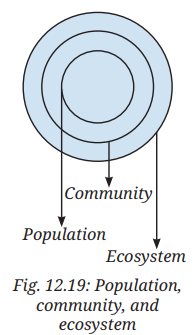
(i) A community is larger than a population.
(ii) A community is smaller than an ecosystem.
(iii) An ecosystem is part of a community.
Ans: (iii) An ecosystem is part of a community.
2. A population is part of a community. If all decomposers suddenly disappear from a forest ecosystem, what changes do you think would occur? Explain why decomposers are essential.
Ans: If all decomposers suddenly disappeared from a forest ecosystem, dead plants and animals would start accumulating, and nutrients would not return to the soil. As a result, soil fertility would decrease, affecting plant growth. This would also reduce the food available to herbivores and carnivores, disturbing the food web.
Importance of Decomposers: Decomposers, such as fungi and bacteria, break down dead plants and animals into simpler substances and return essential nutrients to the soil. They help recycle nutrients and maintain the balance of the ecosystem.
3. Selvam from Cuddalore district, Tamil Nadu, shared that his village was less affected by the 2004 Tsunami compared to nearby villages due to the presence of mangrove forests. This surprised Sarita, Shabnam, and Shijo. They wondered if mangroves were protecting the village. Can you help them understand this?
Ans: Yes, mangrove forests helped protect the village from the impact of the tsunami. They act as natural barriers by reducing the force of strong waves and winds. Their dense roots hold the soil firmly and help prevent soil erosion. Thus, mangrove forests reduce the impact of tsunamis and floods on nearby coastal areas.
4. Look at this food chain:
Grass → Grasshopper → Frog → Snake
If frogs disappear from this ecosystem, what will happen to the population of grasshoppers and snakes? Why?
Ans: If frogs disappear from this ecosystem, the population of grasshoppers will increase because there will be fewer predators to eat them. On the other hand, the population of snakes will decrease because frogs are one of their food sources. This will disturb the balance of the food chain.
5. In a school garden, students noticed fewer butterflies the previous season. What could be the possible reasons? What steps can students take to have more butterflies on campus?
Ans: The possible reasons for fewer butterflies may include a lack of flowering plants, excessive use of pesticides, habitat loss, and changes in weather conditions.
Students can take the following steps to attract more butterflies to the school campus:
(i) Plant more flowering plants that provide nectar for butterflies.
(ii) Grow plants on which butterflies can lay their eggs.
(iii) Avoid using harmful chemical pesticides.
(iv) Provide clean water and suitable places for butterflies to rest.
(v) Protect the garden and maintain a green environment.
6. Why is it not possible to have an ecosystem with only producers and no consumers or decomposers?
Ans: An ecosystem needs consumers to regulate the population of producers (e.g., herbivores eat plants) and decomposers to recycle dead matter into nutrients for producers. Without consumers, producers may grow excessively and face competition for resources like sunlight, water, and space. Without decomposers, dead plants and animals would accumulate, and essential nutrients would not return to the soil. This would disturb the food chain and nutrient cycle, affecting the overall balance of the ecosystem. 7. Observe two different places near your home or school (e.g., a park and a roadside). List the living and non-living components you see. How are the two ecosystems different?
8. ‘Human-made ecosystems like agricultural fields are necessary, but they must be made sustainable.’ Comment on the statement
Ans: Human-made ecosystems like agricultural fields are important for food production, but they must be managed sustainably. Excessive use of chemical fertilisers and pesticides, overuse of water, and growing the same crop repeatedly can harm the environment. Therefore, farmers should adopt organic farming, crop rotation, and proper water management to maintain ecological balance.
9. If the Indian hare population (Fig. 12.20) drops because of a disease, how would it affect the number of other organisms?
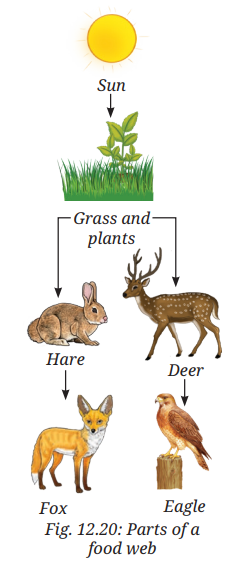
Ans: If the hare population decreases, the number of foxes may also decrease due to a shortage of food. On the other hand, the deer population may increase because there will be less competition for grass and plants. As a result, the number of eagles may also increase due to the availability of more deer.
Conclusion:
NCERT Class 8 Science Chapter 12 How Nature Works in Harmony Textual Questions and Answers help students understand the key concepts and revise the chapter for their exams.

Parimol Roy, BA graduate and HR professional at Dev Library, specializes in website content management and SEO for educational resources.
Subject Ka Complete Video Solution Dekhein
Step-by-step easy concept explanation aur full questions Answer ke liye watch karein ya app download karein:


 Buy Now