
NCERT Class 8 Science Chapter 11 Keeping Time with the Skies
Probe and ponder
(i) Have you ever seen the Moon during the day? Why do you think it is sometimes visible when the Sun is up?
Ans:Yes, I have seen the Moon during the day. The Moon is sometimes visible during the daytime because it reflects sunlight and its position in the sky allows us to see it even when the Sun is up.
(ii) Imagine you lived on the Moon instead of Earth. What would you mean by a day, a month or a year?
Ans: (i) Day: The time taken by the Moon to complete one rotation on its axis.
(ii) Month: The time taken by the Moon to complete one revolution around the Earth.
(iii) Year: The time taken by the Moon to complete one revolution around the Sun along with the Earth.
(iii) What would happen if Earth had two moons instead of one? How would that change the night sky?
Ans: If Earth had two moons, the night sky would look more beautiful and brighter. We would see two moons at different positions and phases. They might also cause different patterns of tides on Earth.
(iv) If we didn’t have clocks or calendars, how else could we measure time?
Ans: Without clocks or calendars, we could measure time by observing natural events such as sunrise and sunset, the changing position of the Sun, the length of shadows, the phases of the Moon and the changing seasons.
Keep the curiosity alive
1. State whether the following statements are True or False.
(i) We can only see that part of the Moon which reflects sunlight towards us.
Ans: True.
(ii) The shadow of Earth blocks sunlight from reaching the Moon causing phases.
Ans: False.
(iii) Calendars are based on various astronomical cycles which repeat in a predictable manner.
Ans: True.
(iv) The Moon can only be seen at night.
Ans: False.
2. Amol was born on 6th of May on a full Moon day. Does his birthday fall on the full Moon day every year? Explain your answer.
Ans: No, Amol’s birthday will not fall on a full Moon day every year. This is because the Moon takes about 29.5 days to complete one cycle of phases, whereas a calendar year has about 365 days. Therefore, the date of the full Moon changes every year.
3. Name two things that are incorrect in Fig. 11.10
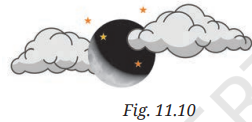
Ans: (i) The stars are shown too close to the Moon and appear unusually large.
(ii) The dark part of the Moon is shown as if it is caused by Earth’s shadow. However, the phases of the Moon occur due to the changing positions of the Sun, Earth and Moon, not because of Earth’s shadow.
4. Look at the pictures of the Moon in Fig. 11.11, and answer the following questions.
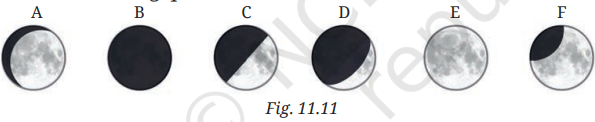
(i) Write the correct panel number corresponding to the phases of the Moon shown in the pictures above.
| Phase of the Moon | Picture Label |
| D | |
| E | |
| A | |
| C | |
| B |
Ans:
| Phase of the Moon | Picture Label |
| Three days after New Moon | D |
| Full Moon | E |
| Three days after Full Moon | A |
| A week after Full Moon | C |
| Day of New Moon | B |
(ii) List the picture labels of the phases of the Moon that are never seen from Earth.
Ans: C and F.
5. Malini saw the Moon overhead in the sky at sunset.
(i) Draw the phase of the Moon that Malini saw.
(ii) Is the Moon in the waxing or the waning phase?
Ans:
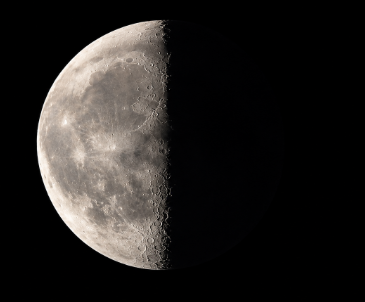
When Malini sees the Moon directly overhead at sunset, it means:
(i) The Sun is setting in the west.
(ii) The Moon is positioned almost 90° away from the Sun in the sky.
(iii) At this position, we see half of the Moon’s illuminated portion.
(iv) This phase is called the First Quarter Moon (प्रथम अर्धचंद्र).
6. Ravi said, “I saw a crescent Moon, and it was rising in the East, when the Sun was setting.” Kaushalya said, “Once I saw the gibbous Moon during the afternoon in the East.” Who out of the two is telling the truth?
Ans: Kaushalya is telling the truth because a gibbous Moon can be seen in the eastern sky during the afternoon.
Ravi’s statement is incorrect because a crescent Moon does not rise in the East at sunset. A waxing crescent is visible in the western sky after sunset, while a waning crescent rises in the East before sunrise.
7. Scientific studies show that the Moon is getting farther away from the Earth and slower in its revolution. Will luni-solar calendars need an intercalary month more often or less often?
Ans: Luni-solar calendars will need an intercalary month less often because as the Moon moves farther away from the Earth and revolves more slowly, the duration of a lunar month increases. As a result, the lunar year becomes longer and the difference between the lunar year and the solar year becomes smaller.
8. A total of 37 full Moons happen during 3 years in a solar calendar. Show that at least two of the 37 full moons must happen during the same month of the solar calendar.
Ans: Yes, at least two full Moons must happen in the same month of the solar calendar.
- A solar calendar has 12 months in a year.
- In 3 years, there are 12 × 3 = 36 months.
- But there are 37 full moons in these 36 months.
Therefore, at least one month must have two full Moons.
9. On a particular night, Vaishali saw the Moon in the sky from sunset to sunrise. What phase of the Moon would she have noticed?
Ans: Vaishali would have noticed a Full Moon because the Full Moon rises around sunset and remains visible throughout the night until sunrise.
10. If we stopped having leap years, in approximately how many years would the Indian Independence day happen in winter?
Ans: Without leap years, the calendar would shift by approximately 1 day every 4 years.
(i) There are approximately 183 days between 15 August and mid-February.
The calendar shifts by 1 day every 4 years.
Therefore, 183 × 4 = 732 years.
Hence, in approximately 730–732 years, 15th August would fall in the winter season.
11. What is the purpose of launching artificial satellites?
Ans: Artificial satellites are launched for:
(i) Communication.
(ii) Navigation.
(iii) Weather monitoring.
(iv) Scientific research.
(v) Disaster management.
(vi) Earth observation.
12. On which periodic phenomenon are the following measures of time based:
(i) day.
(ii) month.
(iii) year?
Ans: (i) Day: Earth’s rotation on its axis.
(ii) Month: The Moon’s revolution around the Earth (cycle of Moon phases).
(iii) Year: Earth’s revolution around the Sun.
Conclusion:
NCERT Class 8 Science Chapter 11 Keeping Time with the Skies Textual Questions and Answers help students understand the key concepts and revise the chapter for their exams.

Parimol Roy, BA graduate and HR professional at Dev Library, specializes in website content management and SEO for educational resources.
Subject Ka Complete Video Solution Dekhein
Step-by-step easy concept explanation aur full questions Answer ke liye watch karein ya app download karein:


 Buy Now