
NCERT Class 8 Science Chapter 9 The Amazing World of Solutes, Solvents, and Solutions
Probe and ponder
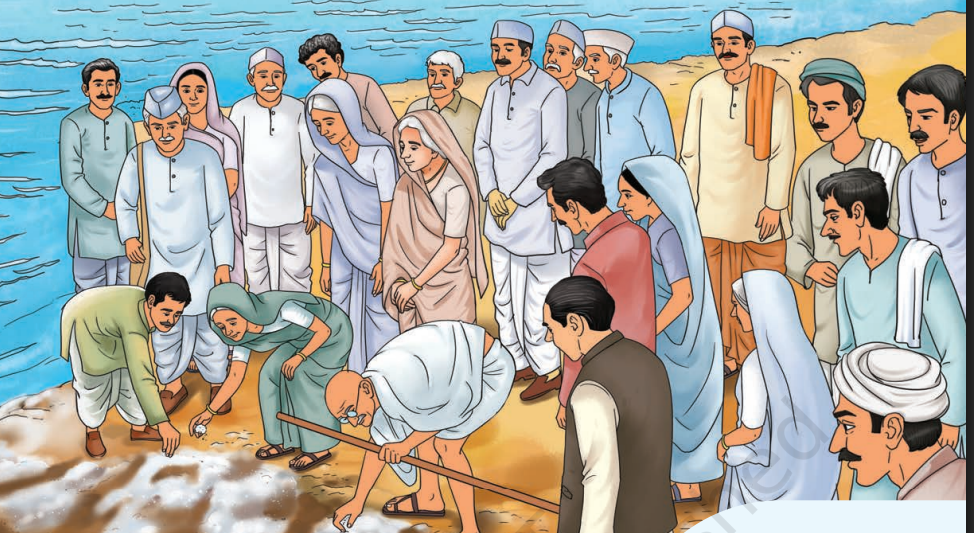
1. What do you think is happening in the picture above?
Ans: People are collecting salt from seawater through the process of evaporation. They allow the water to evaporate, leaving salt behind.
2. What happens when you add too much sugar to your tea and it stops dissolving? How can you solve this problem?
Ans: When too much sugar is added, the tea becomes saturated and extra sugar does not dissolve. We can solve this by heating the tea or adding more water.
3. Why do sugar and salt dissolve in water but not in oil? Why is water considered a good solvent?
Ans: Sugar and salt dissolve in water because water can attract and separate their particles. They do not dissolve in oil because oil has different properties. Water is called a good solvent because it can dissolve many substances.
4. Why are water bottles usually tall and cylindrical in shape instead of spherical?
Ans: Water bottles are usually tall and cylindrical because they are easy to hold, carry and store. They can also stand upright and fit easily in bags and refrigerators.
1. State whether the following statements are True [T] or False [F]. Correct the false statements.
(i) Oxygen gas is more soluble in hot water rather than in cold water.
Ans: False. Oxygen gas is more soluble in cold water than in hot water.
(ii) A mixture of sand and water is a solution.
Ans: False. A mixture of sand and water is a non-uniform mixture.
(iii) The amount of space occupied by any object is called its mass.
Ans: False. The amount of space occupied by an object is called its volume.
(iv) An unsaturated solution has more solute dissolved than a saturated solution.
Ans: False. An unsaturated solution can dissolve more solute at a given temperature.
(v) The presence of different gases in the atmosphere is also a uniform mixture.
Ans: True.
2. Fill in the blanks.
(i) The volume of a solid can be measured by the method of displacement, where the solid is __________ in water and the ____________ in water level is measured.
Ans: Immersed; increase.
(ii) The maximum amount of _______________ dissolved in _______________ at a particular temperature is called solubility at that temperature.
Ans: Solute; a fixed quantity of solvent.
(iii) Generally, the density ____________ with increase in temperature.
Ans: Decreases.
(iv) The solution in which glucose has completely dissolved in water, and no more glucose can dissolve at a given temperature, is called a __________ solution of glucose.
Ans: Saturated.
3. You pour oil into a glass containing some water. The oil floats on top. What does this tell you?
(i) Oil is denser than water.
(ii) Water is denser than oil.
(iii) Oil and water have the same density.
(iv) Oil dissolves in water.
Ans: (ii) Water is denser than oil.
4. A stone sculpture weighs 225 g and has a volume of 90 cm3 . Calculate its density and predict whether it will float or sink in water.
Ans:
Given:
(i) Mass = 225 g.
(ii) Volume = 90 cm³.
Formula:
Density=MassVolume
Calculation:
=22590
=2.5g/cm3
Therefore:
(i) Density of the stone sculpture = 2.5 g/cm³.
(ii) The density of water is approximately 1 g/cm³.
(iii) Since the density of the stone sculpture is greater than that of water, it will sink in water.
5. Which one of the following is the most appropriate statement, and why are the other statements not appropriate?
(i) A saturated solution can still dissolve more solute at a given temperature.
(ii) An unsaturated solution has dissolved the maximum amount of solute possible at a given temperature.
(iii) No more solute can be dissolved into the saturated solution at that temperature.
(iv) A saturated solution forms only at high temperatures.
Ans: (iii) No more solute can be dissolved into the saturated solution at that temperature.
Explanation:
(i) Incorrect. A saturated solution cannot dissolve more solute at a particular temperature.
(ii) Incorrect. An unsaturated solution can still dissolve more solute.
(iii) Correct. A saturated solution contains the maximum amount of dissolved solute at a particular temperature.
(iv) Incorrect. A saturated solution can form at any temperature, depending on the amount of solute and solvent.
6. You have a bottle with a volume of 2 litres. You pour 500 mL of water into it. How much more water can the bottle hold?
Ans: Given:
(i) Total volume of bottle = 2 L = 2000 mL.
(ii) Water already poured = 500 mL.
Calculation:
Remaining capacity = Total volume − Water already poured.
=2000-500
=1500mL
Therefore, the bottle can hold 1500 mL or 1.5 L more water.
7. An object has a mass of 400 g and a volume of 40 cm³. What is its density?
Ans:
Given:
(i) Mass = 400 g.
(ii) Volume = 40 cm³.
Formula:
Density=MassVolume
Calculation:
=40040
=10g/cm3
Therefore, the density of the object is 10 g/cm³.
8. Analyse Fig. 9.25a and 9.25b. Why does the unpeeled orange float, while the peeled one sinks? Explain.
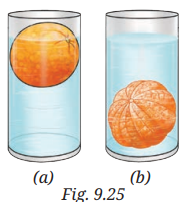
Ans: (i) The unpeeled orange floats because its peel contains tiny air pockets that make its overall density lower than water.
(ii) When the orange is peeled, these air pockets are removed.
(iii) As a result, the density of the peeled orange becomes greater than that of water.
(iv) Therefore, the unpeeled orange floats, while the peeled orange sinks in water.
9. Object A has a mass of 200 g and a volume of 40 cm³. Object B has a mass of 240 g and a volume of 60 cm³. Which object is denser?
Ans:
Given:
Object A:
(i) Mass = 200 g.
(ii) Volume = 40 cm³.
Object B:
(i) Mass = 240 g.
(ii) Volume = 60 cm³.
Formula:
Density=MassVolume
Calculation:
Density of Object A:
=20040=5g/cm3
Density of Object B:
=24060=4g/cm3
Therefore:
(i) Density of Object A = 5 g/cm³.
(ii) Density of Object B = 4 g/cm³.
Object A is denser than Object B because its density is higher.
10. Reema has a piece of modeling clay that weighs 120 g. She first moulds it into a compact cube that has a volume of 60 cm3 . Later, she flattens it into a thin sheet. Predict what will happen to its density.
Ans: (i) Mass of modelling clay = 120 g.
(ii) Volume of modelling clay = 60 cm³.
(iii) Density is calculated by dividing mass by volume.
Density=12060
=2g/cm3
(iv) When the clay is flattened into a thin sheet, its shape changes but its mass and volume remain the same.
(v) Therefore, its density will remain unchanged at 2 g/cm³.
11. A block of iron has a mass of 600 g and a density of 7.9 g/cm³. What is its volume?
Ans:
Given:
(i) Mass = 600 g.
(ii) Density = 7.9 g/cm³.
Formula:
Density=MassVolume
Therefore,
Volume=MassDensity
Calculation:
=6007.9
=75.95cm3
Therefore, the volume of the iron block is 75.95 cm³.
12. You are provided with an experimental setup as shown in Fig. 9.26a and 9.26b. On keeping the test tube (Fig 9.26b) in a beaker containing hot water (~70 °C), the water level in the glass tube rises. How does it affect the density?
Ans: (i) When the test tube is placed in hot water, the water inside gets heated.
(ii) Due to heating, the water expands and its volume increases.
(iii) The mass of water remains unchanged.
(iv) As the volume increases, the density decreases.
Therefore, the density of water in setup (b) will decrease.
Conclusion:
NCERT Class 8 Science Chapter 9 The Amazing World of Solutes, Solvents, and Solutions Textual Questions and Answers help students understand the key concepts and revise the chapter for their exams.

Parimol Roy, BA graduate and HR professional at Dev Library, specializes in website content management and SEO for educational resources.
Subject Ka Complete Video Solution Dekhein
Step-by-step easy concept explanation aur full questions Answer ke liye watch karein ya app download karein:


 Buy Now