
NCERT Class 8 Science Chapter 10 Light: Mirrors and Lenses
Probe and ponder
1. Can we make mirrors which can give enlarged or diminished images?
Ans: Yes, we can make mirrors that produce enlarged or diminished images.
(i) Concave mirrors can form both enlarged and diminished images depending on the distance of the object from the mirror.
(ii) Convex mirrors always produce diminished images.
2. On the side-view mirrors of vehicles, there is a warning that says “Objects in mirror are closer than they appear”. Why is this warning written there?
Ans: This warning is written because side-view mirrors of vehicles are convex mirrors.
(i) Convex mirrors form smaller images of objects.
(ii) Due to their smaller size, objects appear farther away than they actually are.
(iii) This warning helps drivers judge the distance of vehicles behind them and avoid accidents.
3. Why is there a curved line on some reading glasses?
Ans: The curved line on reading glasses is due to the convex shape of the lens. These lenses are thicker in the middle and thinner at the edges, causing light rays to converge (bend inward) and improve near vision for individuals with presbyopia. This curvature is essential for correcting the vision by focusing light properly on the retina.
4. How can we distinguish between concave and convex mirrors?
Ans: We can distinguish between concave and convex mirrors by observing their shape and the way they reflect light.
Concave Mirror:
(i) Its reflecting surface curves inwards.
(ii) It causes parallel light rays to converge at a focal point.
(iii) It can form both real and virtual images.
Convex Mirror:
(i) Its reflecting surface curves outwards.
(ii) It causes parallel light rays to diverge.
(iii) It always forms virtual and diminished images.
5. We have observed images formed by three types of mirrors – plane, concave, and convex. But are there any laws that govern the image formation?
Ans: Yes, image formation by mirrors follows the two laws of reflection.
(i) The angle of incidence is equal to the angle of reflection.
(ii) The incident ray, the normal at the point of incidence, and the reflected ray all lie in the same plane.
6. Are the laws of reflection applicable to spherical mirrors also?
Ans: Yes, the laws of reflection are applicable to all types of mirrors, including spherical mirrors.
(i) The angle of incidence is equal to the angle of reflection.
(ii) The incident ray, the normal, and the reflected ray all lie in the same plane.
These laws apply to both concave and convex mirrors.
7. What changes can be seen in the objects when viewed through lenses?
Ans: When objects are viewed through lenses, their size and orientation may change.
(i) A convex lens can make an object appear erect and enlarged when it is placed at a small distance.
(ii) As the object moves farther away, its image appears inverted. It is initially enlarged and then becomes smaller.
(iii) A concave lens always makes an object appear erect and diminished in size.
8. Do lenses also converge or diverge the light beam? (Page 163)
Ans: Yes, lenses can both converge and diverge light beams.
(i) A convex lens converges the light beam and is called a converging lens.
(ii) A concave lens diverges the light beam and is called a diverging lens.
9. Since a convex lens converges a light beam, can it also burn a paper?
| Column I | Column II |
| (i) Concave mirror | (a) Spherical mirror with a reflecting surface that curves inwards. |
| (ii) Convex mirror | (b) It forms an image which is always erect and diminished in size. |
| (iii) Convex lens | (c) Object placed behind it may appear inverted at some distance. |
| (iv) Concave lens | (d) Object placed behind it always appears diminished in size. |
Ans: Yes, a convex lens can burn a piece of paper.
(i) It converges the Sun’s rays at a small point on the paper.
(ii) This concentrates sunlight and produces sufficient heat at that point.
(iii) The heat can ignite the paper and make it burn.
Safety: Never look directly at the Sun or through a convex lens.
10. The following question is based on Assertion/Reason.
Assertion: Convex mirrors are preferred for observing the traffic behind us.
Reason: Convex mirrors provide a significantly larger view area than plane mirrors. Choose the correct option:
(i) Both Assertion and Reason are correct and Reason is the correct explanation for Assertion.
(ii) Both Assertion and Reason are correct but Reason is not the correct explanation for Assertion.
(iii) Assertion is correct but Reason is incorrect.
(iv) Both Assertion and Reason are incorrect.
Ans: (i) Both Assertion and Reason are correct and Reason is the correct explanation for Assertion.
11. In Fig. 10.27, note that O stands for object, M for mirror, and I for image. Which of the following statements is true?
(i) Figure (a) indicates a plane mirror and Figure (b) indicates a concave mirror.
(ii) Figure (a) indicates a convex mirror and Figure (b) indicates a concave mirror.
(iii) Figure (a) indicates a concave mirror and Figure (b) indicates a convex mirror.
(iv) Figure (a) indicates a plane mirror and Figure (b) indicates a convex mirror.
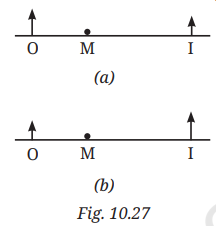
Ans: (i) Figure (a) indicates a plane mirror and Figure (b) indicates a concave mirror.
12. Place a pencil behind a transparent glass tumbler (Fig. 10.28a). Now fill the tumbler halfway with water (Fig. 10.28b). How does the pencil appear when viewed through the water? Explain why its shape appears changed.
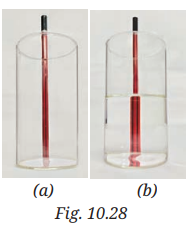
Ans: When viewed through the water-filled tumbler, the pencil appears bent or displaced at the water level. Its shape appears changed due to the refraction of light. Light bends when it passes from water to air, making the pencil appear to be in a different position.
Conclusion:
NCERT Class 8 Science Chapter 10 Light: Mirrors and Lenses Textual Questions and Answers help students understand the key concepts and revise the chapter for their exams.

Parimol Roy, BA graduate and HR professional at Dev Library, specializes in website content management and SEO for educational resources.
Subject Ka Complete Video Solution Dekhein
Step-by-step easy concept explanation aur full questions Answer ke liye watch karein ya app download karein:


 Buy Now