
NCERT Class 8 Science Chapter 7 Particulate Nature of Matter
Probe and ponder
1. Why is it possible to pile up stones or sand, but not a liquid like water?
Ans: Stones and sand can form a pile because they stay in one place. Water flows and spreads out, so it cannot form a pile.
2. Why does water take the shape of folded hands but lose that shape when released?
Ans: Water takes the shape of folded hands because liquids have no fixed shape. When released, it flows away and takes the shape of the surface below.
3. We cannot see air, so how does it add weight to an inflated balloon?
Ans: Air has mass and occupies space. When air is filled into a balloon, its weight increases.
4. Is the air we breathe today the same that existed thousands of years ago?
Ans: Yes, some of the air we breathe today may have existed thousands of years ago. Air is continuously recycled through natural processes, such as photosynthesis and respiration.
Keep the curiosity alive
1. Choose the correct option.
The primary difference between solids and liquids is that the constituent particles are:
(i) Closely packed in solids, while they are stationary in liquids.
(ii) Far apart in solids and have fixed position in liquids.
(iii) Always moving in solids and have fixed position in liquids.
(iv) Closely packed in solids and move past each other in liquids.
Ans: (iv) Closely packed in solids and move past each other in liquids.
2. Which of the following statements are true? Correct the false statements.
(i) Melting ice into water is an example of the transformation of a solid into a liquid.
Ans: True.
(ii) Melting process involves a decrease in interparticle attractions during the transformation.
Ans: True.
(iii) Solids have a fixed shape and a fixed volume.
Ans: True.
(iv) The interparticle interactions in solids are very strong, and the interparticle spaces are very small.
Ans: True.
(v) When we heat camphor in one corner of a room, the fragrance reaches all corners of the room.
Ans: True.
(vi) On heating, we are adding energy to the camphor, and the energy is released as a smell.
Ans: False.
Correct statement: On heating, energy is supplied to camphor, causing it to change directly into vapour. The vapour particles spread throughout the room, producing the fragrance.
3. Choose the correct answer with justification. If we could remove all the constituent particles from a chair, what would happen?
(i) Nothing will change.
(ii) The chair will weigh less due to lost particles.
(iii) Nothing of the chair will remain.
Ans: (iii) Nothing of the chair will remain.
Justification: A chair is made up of constituent particles. If all these particles are removed, nothing of the chair will remain because matter is composed of these particles.
4. Why do gases mix easily, while solids do not?
Ans: Gases mix easily because their particles are far apart and move freely in all directions. In solids, particles are tightly packed and held together by strong forces of attraction. Therefore, solids do not mix easily.
5. When spilled on the table, milk in a glass tumbler, flows and spreads out, but the glass tumbler stays in the same shape. Justify this statement.
Ans: Milk is a liquid, so its particles can move past one another, allowing it to flow and spread out. A glass tumbler is a solid whose particles are tightly packed and held together by strong forces of attraction. Therefore, it retains its fixed shape.
6. Represent diagrammatically the changes in the arrangement of particles as ice melts and transforms into water vapour.
Ans: The arrangement of particles changes as follows:
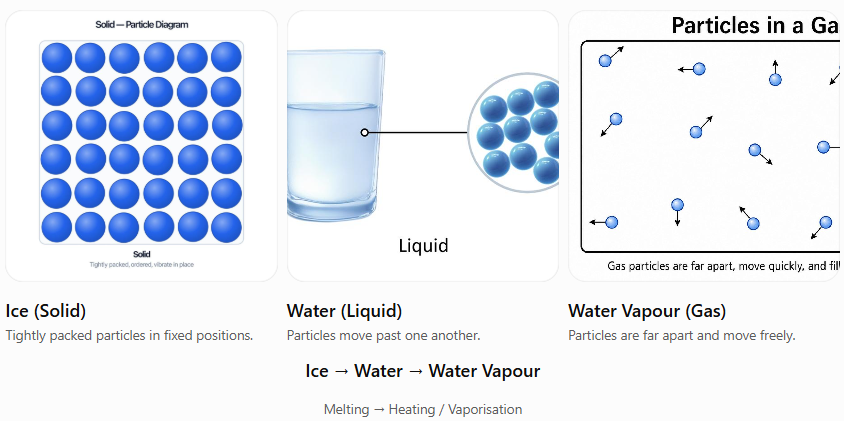
Explanation:
(i) In ice, particles are closely packed and vibrate about fixed positions.
(ii) On heating, ice melts into water, and particles gain energy and move past one another.
(iii) On further heating, water changes into water vapour. The particles move freely and become far apart.
7. Draw a picture representing particles present in the following:
(i) Aluminium foil.
(ii) Glycerin.
(iii) Methane gas.
Ans:
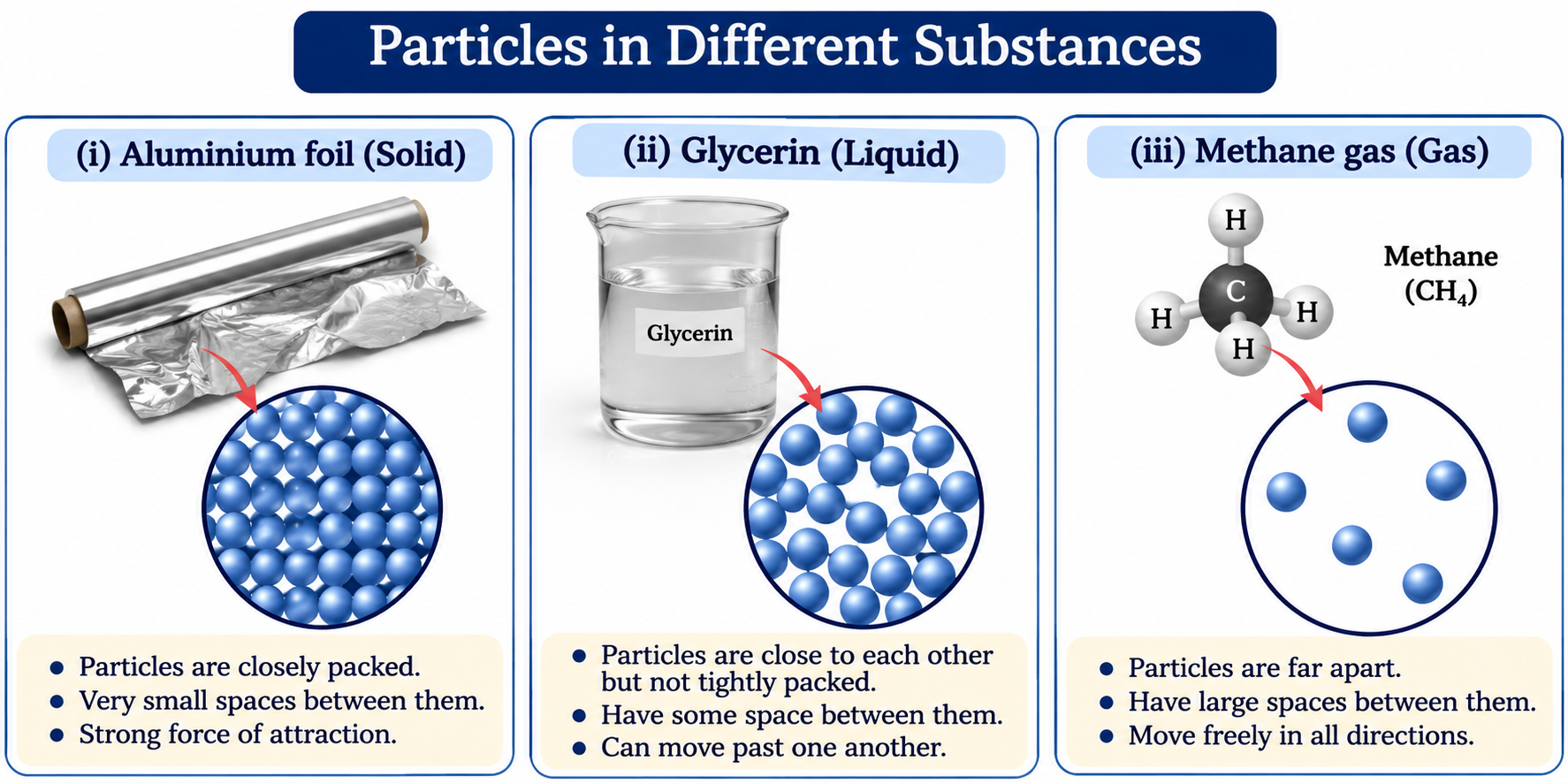
(i) Aluminium foil – Solid: Particles are closely packed together.
(ii) Glycerin – Liquid: Particles are close to each other but can move past one another.
(iii) Methane gas – Gas: Particles are far apart and move freely in all directions.
8. Observe Fig. 7.16a which shows the image of a candle that was just extinguished after burning for some time. Identify the different states of wax in the figure and match them with Fig.
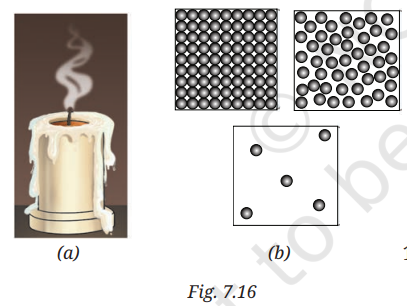
Ans: The candle shows wax in three different states:
(i) Solid wax: The candle body represents the solid state. Its particles are closely packed (top-left diagram).
(ii) Liquid wax: The melted wax flowing down the candle represents the liquid state. Its particles are close together but can move past one another (top-right diagram).
(iii) Wax vapour: The smoke-like wax vapour represents the gaseous state. Its particles are far apart (bottom diagram).
9. Why does the water in the ocean taste salty, even though the salt is not visible? Explain.
Ans: Ocean water tastes salty because salt is dissolved in it. The salt particles are very small and spread uniformly throughout the water. They occupy the spaces between water particles and cannot be seen with the naked eye.
10. Grains of rice and rice flour take the shape of the container when placed in different jars. Are they solids or liquids? Explain.
Ans: Grains of rice and rice flour are solids, not liquids. Each grain or particle of rice flour has a definite shape and volume. They appear to take the shape of the container because the individual solid particles can move and settle into different positions.
Conclusion:
NCERT Class 8 Science Chapter 7 Particulate Nature of Matter Textual Questions and Answers help students understand the key concepts and revise the chapter for their exams.

Parimol Roy, BA graduate and HR professional at Dev Library, specializes in website content management and SEO for educational resources.
Subject Ka Complete Video Solution Dekhein
Step-by-step easy concept explanation aur full questions Answer ke liye watch karein ya app download karein:


 Buy Now