
NCERT Class 8 Science Chapter 6 Pressure, Winds, Storms, and Cyclones
Probe and ponder
1. Why are winds stronger on some days than on others?
Ans: Winds are stronger on some days because of differences in air pressure. Air moves from high-pressure areas to low-pressure areas, creating wind.
2. Why are water tanks usually placed at a height?
Ans: Water tanks are placed at a height so that gravity helps water flow through pipes to different places.
3. Can air pressure really crush us?
Ans: Yes, air pressure can crush objects if the pressure outside is much greater than the pressure inside them. However, our body normally balances the outside air pressure.
4. What causes storms and cyclones? If the Earth stopped rotating, would cyclones still form?
Ans: Storms and cyclones are mainly caused by differences in air pressure and the movement of warm, moist air. If the Earth stopped rotating, cyclones would be greatly affected because Earth’s rotation helps them develop and spin.
Keep the Curiosity Alive
1. Choose the correct statement.
(i) Look at Fig. 6.21 carefully. Vessel R is filled with water. When pouring of water is stopped, the level of water will be __________.
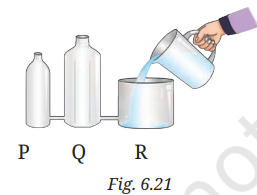
(a) The highest in vessel P.
(b) The highest in vessel Q.
(c) The highest in vessel R.
(d) Equal in all three vessels.
Ans: (d) Equal in all three vessels.
Explanation: When the vessels are connected, water reaches the same level in all three vessels, irrespective of their shapes.
(ii) A rubber sucker (M) is pressed on a flat smooth surface and an identical sucker (N) is pressed on a rough surface:
(a) Both M and N will stick to their surfaces.
(b) Both M and N will not stick to their surfaces.
(c) M will stick but N will not stick.
(d) M will not stick but N will stick.
Ans: (c) M will stick but N will not stick.
Explanation: A rubber sucker sticks to a smooth surface because air is pushed out from beneath it, creating lower pressure inside. A rough surface allows air to enter, so the sucker cannot stick properly.
(iii) A water tank is placed on the roof of a building at a height ‘H’. To get water with more pressure on the ground floor, one has to:
(a) Increase the height ‘H’ at which the tank is placed.
(b) Decrease the height ‘H’ at which the tank is placed.
(c) Replace the tank with another tank of the same height that can hold more water.
(d) Replace the tank with another tank of the same height that can hold less water.
Ans: (a) Increase the height ‘H’ at which the tank is placed.
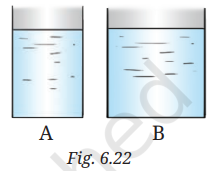
(iv) Two vessels, A and B contain water up to the same level as shown in Fig. 6.22. Pₐ and Pᵦ are the pressures at the bottom of the vessels. Fₐ and Fᵦ are the forces exerted by the water at the bottom of the vessels.
(a) Pₐ = Pᵦ, Fₐ = Fᵦ.
(b) Pₐ = Pᵦ, Fₐ < Fᵦ.
(c) Pₐ < Pᵦ, Fₐ = Fᵦ.
(d) Pₐ > Pᵦ, Fₐ > Fᵦ.
Ans: (b) Pₐ = Pᵦ, Fₐ < Fᵦ.
2. State whether the following statements are True [T] or False [F].
(i) Air flows from a region of higher pressure to a region of lower pressure.
Ans: True [T].
(ii) Liquids exert pressure only at the bottom of a container.
Ans: False [F].
(iii) Weather is stormy at the eye of a cyclone.
Ans: False [F].
(iv) During a thunderstorm, it is safer to be in a car.
Ans: True [T].
3. Fig. 6.23 a shows a boy lying horizontally, and Fig. 6.23b shows the boy standing vertically on a loose sand bed. In which case does the boy sink more in sand? Give reasons.
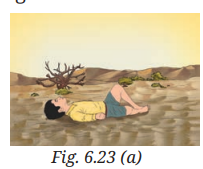
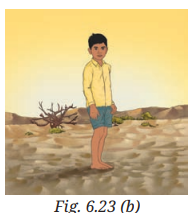
Ans: The boy sinks more in the sand when he stands vertically (Fig. 6.23 b). This is because the area of contact between his feet and the sand is smaller than the area of contact when he lies horizontally. As pressure increases when the area decreases, he exerts more pressure on the sand while standing.
4. An elephant stands on four feet. If the area covered by one foot is 0.25 m2 , calculate the pressure exerted by the elephant on the ground if its weight is 20000 N.
Ans:
Given,
Weight of the elephant = 20000 N.
Area covered by one foot = 0.25 m².
Total area covered by four feet:
= 4 × 0.25
= 1 m².
We know that,
Pressure = Force / Area
Putting the values,
Pressure = 20000 / 1
= 20000 N/m².
Therefore, the pressure exerted by the elephant on the ground is 20,000 Pa.
5. There are two boats, A and B. Boat A has a base area of 7 m², and 5 persons are seated in it. Boat B has a base area of 3.5 m², and 3 persons are seated in it. If each person has a weight of 700 N, find out which boat will experience more pressure on its base and by how much?
Ans:
Given:
Weight of each person = 700 N.
For Boat A:
Number of persons = 5.
Total weight = 5 × 700 = 3500 N.
Base area = 7 m².
We know that,
Pressure = Force / Area
= 3500 / 7
= 500 N/m².
For Boat B:
Number of persons = 3.
Total weight = 3 × 700 = 2100 N.
Base area = 3.5 m².
Pressure = Force / Area
= 2100 / 3.5
= 600 N/m².
Difference in pressure = 600 − 500
= 100 N/m².
Therefore, Boat B will experience more pressure on its base by 100 N/m².
6. Would lightning occur if air and clouds were good conductors of electricity? Give reasons for your
Ans: No, lightning would not occur in the usual way if air and clouds were good conductors of electricity. This is because electric charges would flow freely through them instead of accumulating. Therefore, a large build-up of opposite electric charges would not take place to produce a sudden electric discharge called lightning.
7. What will happen to the two identical balloons A and B as shown in Fig. 6.24 when water is filled into the bottle up to a certain height. Will both the balloons bulge? If yes, will they bulge equally? Explain your
Ans: Yes, both the balloons will bulge when water is filled into the bottle because liquids exert pressure on the walls of their containers.
However, they will not bulge equally. The balloon placed at a greater depth will bulge more than the balloon placed at a smaller depth because liquid pressure increases with the height of the liquid column above it. Therefore, the lower balloon will bulge more than the upper balloon.
8. Explain how a storm becomes a cyclone.
Ans: A storm can develop into a cyclone under certain weather conditions, especially over warm ocean waters.
(i) Warm ocean water heats the air above it, causing the warm and moist air to rise.
(ii) As the moist air rises, water vapour condenses into raindrops and releases heat into the atmosphere.
(iii) The released heat warms the rising air further, making it rise higher and creating a very low-pressure area.
(iv) Air from the surrounding high-pressure regions rushes towards this low-pressure area.
(v) Earth’s rotation causes the moving air to spin.
(vi) This process continues, forming a spinning system of clouds, strong winds and rain around a low-pressure centre. This system is called a cyclone.
9. Fig. 6.25 shows trees along the sea coast in a summer afternoon. Identify which side is land—A or B. Explain your answer.
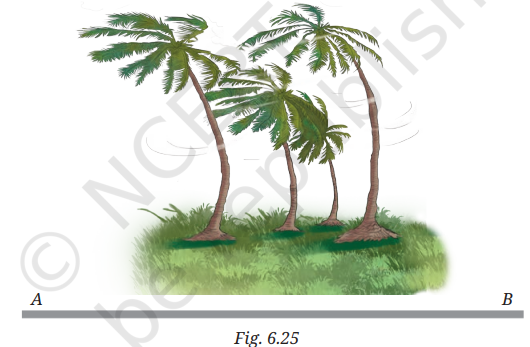
Ans: Side A is the land and side B is the sea.
During a summer afternoon, land gets heated faster than the sea. The warm air above the land rises, creating a low-pressure area. Cooler air from the sea moves towards the land to take its place. This movement of air is called sea breeze. The trees bend towards side A due to the wind blowing from side B (sea) towards side A (land). Therefore, side A is the land and side B is the sea.
10. Describe an activity to show that air flows from a region of high pressure to a region of low pressure.
Ans: The following activity demonstrates the flow of air from high pressure to low pressure.
Activity:
(i) Take two similar balloons and a drinking straw.
(ii) Connect one end of the straw to an uninflated balloon and the other end to an inflated balloon.
(iii) Secure both ends properly to prevent air leakage.
(iv) Observe the changes in the sizes of both balloons.
Observation: The inflated balloon becomes smaller, while the uninflated balloon becomes bigger.
Conclusion: Air moves from a region of high pressure to a region of low pressure until the pressure in both balloons becomes equal.
11. What is a thunderstorm? Explain the process of its formation.
Ans: A storm accompanied by lightning and thunder is called a thunderstorm.
(i) Warm and moist air rises, creating a low-pressure area.
(ii) Cooler air from surrounding regions moves towards this area.
(iii) The rising warm air expands and cools, forming clouds.
(iv) Water droplets and ice particles rub against each other, producing electric charges.
(v) When opposite charges meet, lightning occurs, and the rapid expansion of heated air produces thunder.
12. Explain the process that causes lightning.
Ans: Lightning is caused by the sudden flow of electric charges within clouds, between clouds, or between clouds and the ground.
(i) Strong upward and downward winds cause water droplets and ice particles to rub against each other.
(ii) This produces electric charges within the clouds.
(iii) Positive charges move to the upper part, while negative charges occupy the lower part of the clouds.
(iv) When the build-up of charges becomes very large, the insulating property of air breaks down.
(v) A sudden flow of electric charges takes place, producing a bright flash of light called lightning.
13. Explain why holes are made in banners and hoardings.
Ans: Holes are made in banners and hoardings to allow air to pass through them easily. During strong winds, air exerts a large force on banners and hoardings. The holes reduce the effective area on which the wind acts and allow some air to pass through. As a result, the force exerted by the wind is reduced, preventing banners and hoardings from being torn or blown away.
Conclusion:
NCERT Class 8 Science Chapter 6 Pressure, Winds, Storms, and Cyclones Textual Questions and Answers help students understand the key concepts and revise the chapter for their exams.

Parimol Roy, BA graduate and HR professional at Dev Library, specializes in website content management and SEO for educational resources.
Subject Ka Complete Video Solution Dekhein
Step-by-step easy concept explanation aur full questions Answer ke liye watch karein ya app download karein:


 Buy Now