
NCERT Class 8 Science Chapter 3 Health: The Ultimate Treasure
Probe and ponder
1. How does your body respond to an infection such as common cold?
Ans: When we catch a common cold, our immune system fights against the virus. We may get a runny nose, cough, sneezing, sore throat or fever. These symptoms gradually disappear as our body fights the infection.
2. We rarely see cases of smallpox or polio these days, but diseases like diabetes and heart problems are more common. Why?
Ans: Smallpox and polio cases have reduced due to vaccination programmes. But diabetes and heart problems are increasing because many people eat unhealthy food, do not exercise regularly and follow an unhealthy lifestyle.
3. Could climate change lead to new types of diseases?
Ans: Yes, climate change can increase the spread of diseases. Changes in temperature and rainfall help mosquitoes and other disease-causing organisms to grow and spread diseases like malaria and dengue to new areas.
4. How do emotions like stress or worry affect us and make us sick?
Ans: Too much stress and worry can affect our body and mind. They can cause headaches, tiredness, sleep problems and make it difficult to concentrate. Long-term stress can also affect our ability to fight diseases.
5. Why do some groups of people get affected more than others during disease outbreaks?
Ans: Children, elderly people and people with weak immunity are more likely to get affected during disease outbreaks. Poor nutrition, lack of vaccination, overcrowding and poor sanitation can also increase the chances of getting sick.
Keep the curiosity alive
1. Group the diseases shown in the images as communicable or non-communicable.
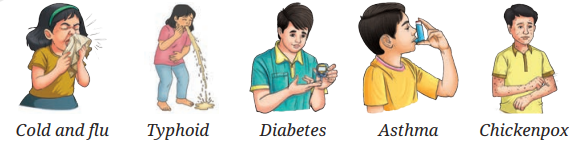
Ans: (i) Communicable Diseases:
1. Cold and flu.
2. Typhoid.
3. Chickenpox.
(ii) Non-communicable Diseases:
1. Diabetes.
2. Asthma.
2. Diseases can be broadly grouped into communicable and non-communicable diseases. From the options given below, identify the non-communicable diseases.
(i) Typhoid
(ii) Asthma
(iii) Diabetes
(iv) Measles
(a) (i) and (ii)
(b) (ii) and (iii)
(c) (i) and (iv)
(d) (ii) and (iv)
Ans: Option (b) (ii) and (iii) – Asthma and Diabetes.
3. There is a flu outbreak in your school. Several classmates are absent, while some are still coming to school coughing and sneezing.
(i) What immediate actions should the school take to prevent further spread?
Ans: (a) Advise students who are unwell to stay at home and rest.
(b) Encourage everyone to cover their mouth and nose while coughing or sneezing.
(c) Ensure regular handwashing with soap and water.
(d) Encourage the use of masks in crowded places.
(e) Keep classrooms and surroundings clean.
(ii) If your classmate, who shares the bench with you, starts showing symptoms of the flu, how can you
respond in a considerate way without being rude or hurtful?
Ans: (a) Speak politely and show concern for your classmate.
(b) Suggest that they inform the teacher and seek medical advice.
(c) Avoid sharing personal items with them.
(d) Encourage them to wear a mask and cover their mouth and nose while coughing or sneezing.
(iii) How can you protect yourself and others from getting infected in this situation?
Ans: (a) Wash hands frequently with soap and water.
(b) Cover your mouth and nose while coughing or sneezing.
(c) Avoid sharing personal items like towels and handkerchiefs.
(d) Wear a mask in crowded places.
(e) Maintain cleanliness and keep your surroundings clean.
(f) Stay at home and rest if you become unwell.
4. Your family is planning to travel to another city where malaria is prevalent.
(i) What precautions should you take before, during, and after the trip?
Ans: (a) Use mosquito nets and repellents.
(b) Wear long-sleeved clothes to protect yourself from mosquito bites.
(c) Avoid areas with stagnant water.
(d) Keep your surroundings clean and prevent mosquito breeding.
(e) Stay alert for symptoms such as high fever, sweating and periodic chills after the trip.
(ii) How can you explain the importance of mosquito nets or repellents to your sibling?
Ans: I would explain that mosquitoes can spread diseases like malaria. Mosquito nets and repellents help protect us from mosquito bites and reduce the risk of infection.
(iii) What could happen if travellers ignore health advisories in such areas?
Ans: Travellers may get infected with malaria or other mosquito-borne diseases. They may develop high fever, profuse sweating and periodic chills and may require medical treatment.
5. Your uncle has started smoking just to fit in with his friends, even though it is well known that smoking can seriously harm health and even cause death.
(i) What would you say to him to make him stop, without being rude?
Ans: I would politely explain to him that smoking is harmful to health and can cause serious diseases, including cancer. I would encourage him to avoid smoking and adopt a healthy lifestyle.
(ii) What would you do if your friend offers you a cigarette at a party?
Ans: (a) I would politely refuse the cigarette.
(b) I would explain that smoking is harmful to health.
(c) I would encourage my friend to avoid such harmful habits.
(iii) How can schools help prevent students from indulging in such harmful habits?
Ans: (a) Organise awareness programmes about the harmful effects of smoking, tobacco and alcohol.
(b) Educate students about the importance of a healthy lifestyle.
(c) Encourage students to participate in sports and other healthy activities.
(d) Arrange counselling sessions to help students make healthy choices.
(e) Create a supportive environment where students feel comfortable discussing their problems.
6. Saniya claims to her friend Vinita that “Antibiotics can cure any infection, so we don’t need to worry about diseases.” What question(s) can Vinita ask her to help Saniya understand that her statement is incorrect?
Ans: Vinita can ask Saniya the following questions:
(i) Do antibiotics work against viral infections?
(ii) Can antibiotics cure diseases caused by protozoa?
(iii) Do you know that antibiotics work only against bacterial infections?
(iv) What can happen if antibiotics are used unnecessarily or an incomplete dose is taken?
These questions will help Saniya understand that antibiotics do not cure every infection. They work only against bacterial infections.
7. The following table contains information about the number of dengue cases reported in a hospital over a period of one year:
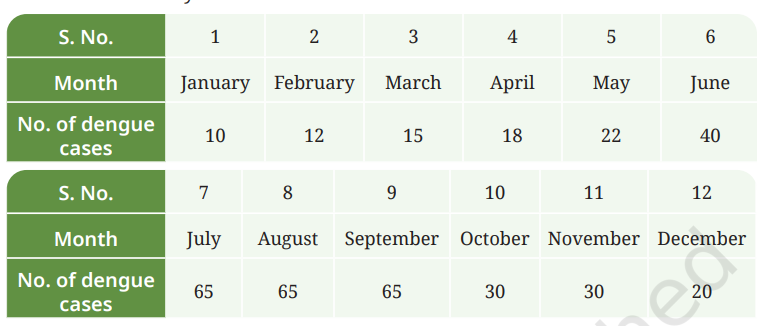
Make a bar graph of the number of cases on the Y-axis and the month on the X-axis. Critically analyse your findings and answer the following:
(i) In which three months were the dengue cases highest?
Ans: The dengue cases were highest in July, August and September, with 65 cases each.
(ii) In which month(s) were the cases lowest?
Ans: The cases were lowest in January, with 10 cases.
(iii) What natural or environmental factors during the peak months might contribute to the increase in dengue cases?
Ans: Heavy rainfall, stagnant water and warm, humid weather during the monsoon season may increase mosquito breeding, leading to a rise in dengue cases.
(iv) Suggest a few preventive steps that the community or government can take before the peak season to reduce the spread of dengue.
Ans: (a) Remove stagnant water from surroundings.
(b) Keep drains and water containers clean and covered.
(c) Conduct awareness campaigns about dengue prevention.
(d) Use mosquito nets and repellents.
(e) Organise regular cleaning drives to prevent mosquito breeding.
8. Imagine you are in charge of a school health campaign. What key messages would you use to reduce communicable and non-communicable diseases?
Ans: I would use the following key messages:
(i) To prevent communicable diseases:
(a) Wash hands regularly with soap and water.
(b) Cover your mouth and nose while coughing or sneezing.
(c) Avoid sharing personal items like towels and handkerchiefs.
(d) Keep food, drinking water and surroundings clean.
(e) Take recommended vaccines and use mosquito nets and repellents.
(ii) To prevent non-communicable diseases:
(a) Eat a healthy and balanced diet.
(b) Exercise regularly and stay physically active.
(c) Limit screen time and get enough sleep.
(d) Avoid tobacco, alcohol and addictive drugs.
(e) Practise yoga and simple breathing exercises to manage stress.
9. It is recommended that we should not take an antibiotic for a viral infection like a cold, a cough, or flu. Can you provide the possible reason for this recommendation?
Ans: Antibiotics work only against bacterial infections because they target parts of bacterial cells that are different from human or other animal cells. They do not work against viruses. Unnecessary use of antibiotics can also lead to antibiotic resistance, making bacterial infections harder to treat.
10. Which disease(s) among the following may spread if drinking water gets contaminated by the excreta from an infected person?
Hepatitis A, Tuberculosis, Poliomyelitis, Cholera, Chickenpox.
Ans: The diseases that may spread through contaminated drinking water are:
(i) Hepatitis A.
(ii) Poliomyelitis.
(iii) Cholera.
Conclusion:
NCERT Class 8 Science Chapter 3 Health: The Ultimate Treasure Textual Questions and Answers provide students with clear explanations of the chapter’s important concepts. By studying these answers and revising the key points, students can improve their understanding of the topic and prepare more effectively for their examinations.

Parimol Roy, BA graduate and HR professional at Dev Library, specializes in website content management and SEO for educational resources.
Subject Ka Complete Video Solution Dekhein
Step-by-step easy concept explanation aur full questions Answer ke liye watch karein ya app download karein:


 Buy Now