
NIOS Class 12 Physics Chapter 15 Electric Charge and Electric Field Solutions English Medium As Per New Syllabus to each chapter is provided in the list so that you can easily browse throughout different chapters NIOS Class 12 Physics Chapter 15 Electric Charge and Electric Field Notes in English and select need one. NIOS Class 12 Physics Solutions English Medium Download PDF. NIOS Study Material of Class 12 Physics Notes Paper Code: 312.
NIOS Class 12 Physics Chapter 15 Electric Charge and Electric Field
Also, you can read the NIOS book online in these sections Solutions by Expert Teachers as per National Institute of Open Schooling (NIOS) Book guidelines. These solutions are part of NIOS All Subject Solutions. Here we have given NIOS Class 12 Physics Notes, NIOS Senior Secondary Course Physics Solutions in English for All Chapter, You can practice these here.
Electric Charge and Electric Field
Chapter: 15
| Module-V: Electricity and Magnetism |
INTEXT QUESTIONS 15.1
1. A glass rod when rubbed with silk cloth acquires a charge q = +3.2×10⁻¹⁷ C.
(i) Is silk cloth also charged?
(ii) What is the nature and magnitude of the charge on silk cloth?
Ans: (i) Yes, silk cloth is also charged.
When a glass rod is rubbed with silk cloth, electrons are transferred from the glass rod to the silk cloth. Since charge is conserved, both materials acquire equal and opposite charges.
(ii) Nature: Negative charge, Magnitude: 3.2×10⁻¹⁷ C
Since electrons are transferred from glass to silk, the silk becomes negatively charged. By conservation of charge, the magnitude of charge on silk is equal to the charge on glass rod but opposite in sign.
2. There are two identical metallic spheres A and B. A is given a charge + Q. Both spheres are then brought in contact and then separated.
(i) Will there be any charge on B?
(ii) What will the magnitude of charge on B, if it gets charged when in contact with A?
Ans: (i) Yes, there will be a charge on B.
When two conducting distributes equally between them due to electrostatic repulsion.
(ii) Magnitude of charge on B = +Q/2 .
Since both spheres are identical, the total charge +Q gets distributed equally between A and B. Therefore, each sphere will have charge +Q/2.
3. A charged object has q = 4.8 ×10⁻¹⁶ C. How many units of fundamental charge are there on the object? (Take e = 1.6 ×10⁻¹⁹ C)
Ans: Given: Charge on object, q = 4.8 × 10⁻¹⁶ C
Electronic charge, e = 1.6 × 10⁻¹⁹ C
Since charge is quantized, q = Ne,
where N is the number of fundamental charge units.
N = q/e
= (4.8 × 10⁻¹⁶)/(1.6 × 10⁻¹⁹)
N = 4.8/1.6 × 10⁻¹⁶⁺¹⁹
= 3.0 × 10³
N = 3000 units of fundamental charge
INTEXT QUESTIONS 15.2
1. Two charges q₁ = 16μC and q₂ = 9 μC are separated by a distance 12m. Determine the magnitude of the force experienced by q₁ due to q₂ and also the direction of this force. What is the direction of the force experienced by q₂ due to q₁?
Ans: Given: q₁ = 16 μC
= 16 × 10⁻⁶ C
q₂ = 9 μC
= 9 × 10⁻⁶ C
r = 12 m
k = 9 × 10⁹ N·m²/C²
Using Coulomb’s law:
F = k(q₁q₂)/r²
F = (9 × 10⁹) × (16 × 10⁻⁶) × (9 × 10⁻⁶)/(12)²
F = (9 × 10⁹) × (144 × 10⁻¹²)/144
F = 9 × 10⁻³ N
= 0.009 N
Direction of force on q₁: Since both charges are positive, the force on q₁ is repulsive, directed away from q₂.
Direction of force on q₂: By Newton’s third law, the force on q₂ is also repulsive, directed away from q₁.
2. There are three point charges of equal magnitude q placed at the three corners of a right angle triangle, as shown in Fig. 15.2. AB = AC. What is the magnitude and direction of the force exerted on –q?
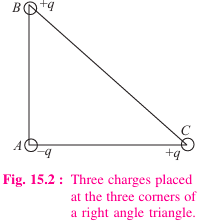
Ans: Given: Charges at A: +q,
B: +q, C: -q
AB = AC
Let AB = AC = a
Forces on charge at C (-q):
Force due to charge at A (F₁):
F₁ = kq²/a² (attractive, along CA)
Force due to charge at B (F₂):
F₂ = kq²/a² (attractive, along CB)
Since AB = AC and
angle A = 90°,
angle ACB = angle ABC
= 45°
The angle between F₁ and F₂ = 90°
Resultant force:
F = √(F₁² + F₂²)
= √2 × F₁
= √2 × kq²/a²
Direction: The resultant force is directed toward point A, making an angle of 45° with both AC and BC.

Hi, I’m Dev Kirtonia, Founder & CEO of Dev Library. A website that provides all SCERT, NCERT 3 to 12, and BA, B.com, B.Sc, and Computer Science with Post Graduate Notes & Suggestions, Novel, eBooks, Biography, Quotes, Study Materials, and more.
Subject Ka Complete Video Solution Dekhein
Step-by-step easy concept explanation aur full questions Answer ke liye watch karein ya app download karein:

 Buy Now