
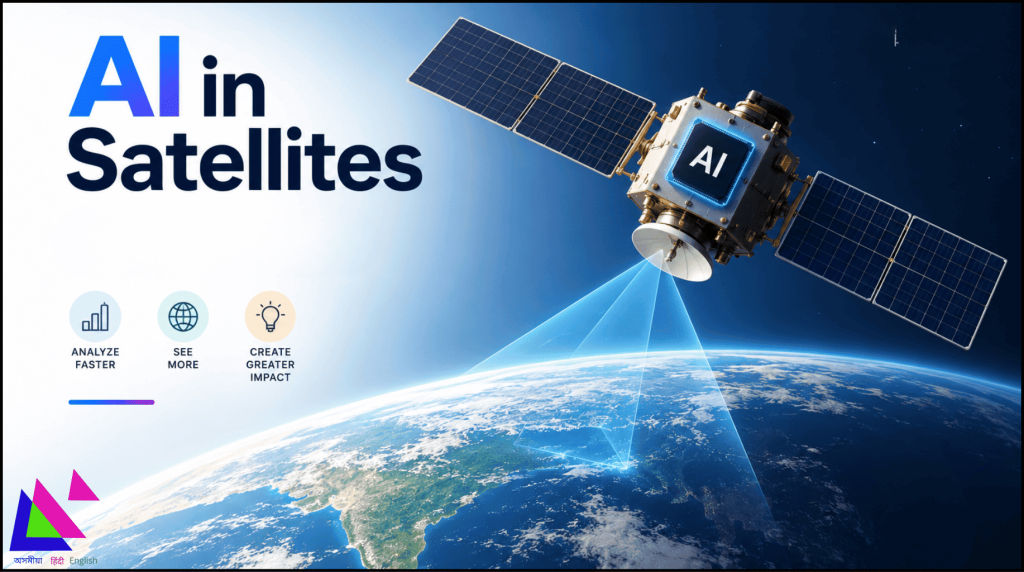
AI in Satellites could change how future spacecraft collect, process and respond to information. Instead of sending every piece of data back to Earth for analysis, satellites can increasingly use onboard computing and AI to identify useful information closer to where it is collected.
This is becoming especially relevant for India as its space sector works toward more complex missions. ISRO’s 2026 spacecraft-operations conference highlighted AI and machine learning as important technologies for more autonomous and efficient mission operations.
Why Would a Satellite Need AI?
Satellites continuously collect information from space and Earth.
Depending on their mission, they can monitor:
- Weather.
- Land.
- Agriculture.
- Oceans.
- Forests.
- Disaster zones.
- Infrastructure.
The problem is that sending every piece of raw information to Earth takes communication bandwidth and time. AI can help filter that information.
How Would Onboard AI Work?
The basic idea is straightforward:
Satellite captures data → AI analyzes it → Important information is identified → Useful data is sent to Earth
For example, instead of sending thousands of images for humans to examine, an onboard system could identify images showing a specific event or change and prioritize those for transmission.This does not eliminate ground-based analysis. It simply moves some processing closer to the source.
Where Could It Help India?
India operates satellites for communication, Earth observation, navigation and scientific purposes.
AI could support areas such as:
Agriculture
- Crop monitoring.
- Land-use analysis.
- Vegetation changes.
Disaster Management
- Flood monitoring.
- Forest-fire detection.
- Damage assessment.
Environment
- Forest monitoring.
- Water-body changes.
- Coastal observation.
Mission Operations
- Detecting unusual spacecraft conditions.
- Supporting operational decisions.
- Improving efficiency.
- A More Autonomous Spacecraft
One of the biggest possibilities is greater spacecraft autonomy.
Future systems could potentially detect certain conditions without waiting for a ground operator to analyze every piece of information.
For example, AI could help identify:
- Unusual sensor readings.
- Equipment anomalies.
- Important changes in Earth imagery.
- Events that require faster attention.
However, autonomous capability does not mean removing humans completely. Mission teams would still establish rules, monitor spacecraft and handle important decisions.
Why Is This Important for Deep-Space Missions?
Communication becomes more difficult as spacecraft travel farther from Earth.For distant missions, there can be significant communication delays.That makes onboard intelligence more useful because a spacecraft may need to process information locally instead of waiting for instructions for every small decision.
India’s Space Vision & The Challenges
India’s Space Vision 2047 includes major future missions such as the Bharatiya Antariksh Station, Chandrayaan-4 and the Venus Orbiter Mission.As missions become more complex, technologies that improve autonomy and data processing could become increasingly valuable.
The Challenges
AI in Satellites also faces challenges that ordinary AI systems do not.
- Limited Resources: Spacecraft have strict limits on power, weight and computing hardware.
- Reliability: A software failure in space can be extremely difficult to fix.
- Radiation: Space electronics must operate in a harsh radiation environment.
- Data Quality: AI decisions depend on the quality of the data available to the system.
- Security: Connected space systems need strong protection against cyber and communication threats.
What Could the Future Look Like?
The next generation of satellites could combine:
- AI processors.
- Advanced sensors.
- Faster onboard computing.
- Inter-satellite communication.
- Autonomous decision-support systems.
Together, these technologies could help spacecraft process more information while reducing unnecessary communication with Earth.
Conclusion
AI in Satellites is becoming an important part of the move toward smarter and more autonomous space missions. ISRO has already highlighted AI and machine learning as technologies that can support more efficient spacecraft operations.For India, the opportunity is particularly interesting as future missions become more ambitious.
The goal is not to make satellites completely independent. Instead, AI can help spacecraft understand data faster, respond more efficiently and work more intelligently alongside human mission teams.
FAQs
1. What is AI in satellites?
Ans: It means using artificial intelligence onboard spacecraft for tasks such as data analysis, monitoring and mission support.
2. Why process data in space?
Ans: Local processing can reduce the amount of data that needs to be sent to Earth and help identify important information faster.
3. Can AI make satellites autonomous?
Ans: AI can support greater autonomy, but human teams will still play an important role in mission operations.
4. Does ISRO use AI?
Ans: ISRO has highlighted AI and machine learning for more autonomous and efficient mission operations. AI in Satellites can help improve satellite data analysis, monitoring, navigation, and mission decision-making.
5. Why is onboard AI useful for deep-space missions?
Ans: Communication delays make local processing more valuable when spacecraft operate far from Earth.

Hi, I’m Dev Kirtonia, Founder & CEO of Dev Library. A website that provides all SCERT, NCERT 3 to 12, and BA, B.com, B.Sc, and Computer Science with Post Graduate Notes & Suggestions, Novel, eBooks, Biography, Quotes, Study Materials, and more.







 Buy Now