
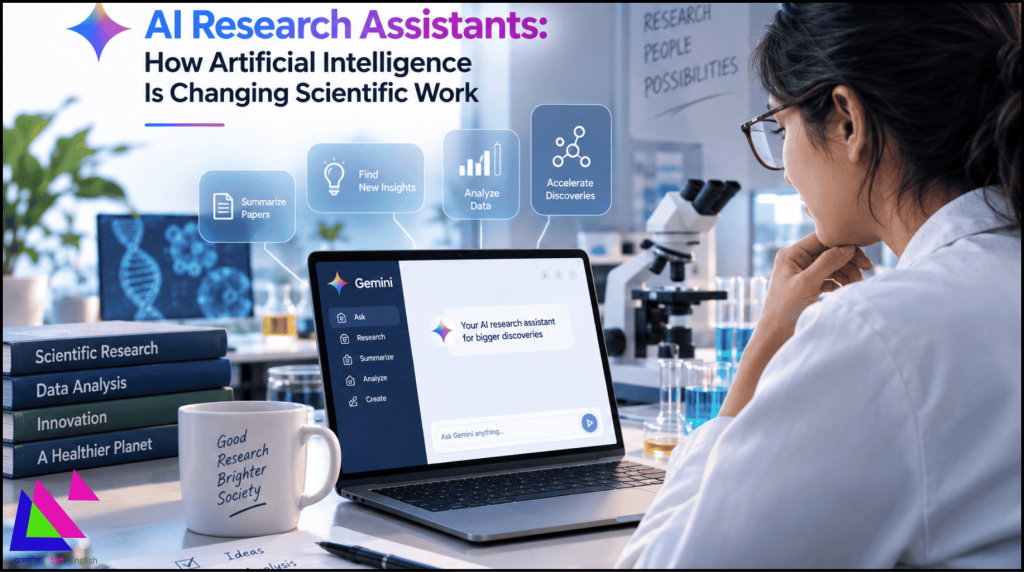
AI Research Assistants are becoming an important tool for scientists as researchers look for faster ways to search information, analyze data and explore new ideas.Google Research, for example, has developed an Empirical Research Assistance system that scientists have used for real-world research tasks. Other research efforts are also exploring AI systems that can help with hypothesis generation, experiment design and data analysis.
The goal is not simply to make scientists work faster. Instead, researchers are exploring whether AI can take over some repetitive tasks and allow scientists to spend more time on important questions.
What Can AI Research Assistants Do?
AI tools can support different stages of scientific research.
They can help with:
- Searching and organizing research material.
- Summarizing scientific papers.
- Analyzing data.
- Writing or improving research code.
- Exploring possible hypotheses.
- Designing parts of experiments.
- Comparing research findings.
- Automating repetitive research tasks.
However, scientists still need to check the results before using them in important research.
Why Are Scientists Using AI?
Scientific research often involves large amounts of information.
A researcher may need to:
- Read existing studies.
- Identify useful findings.
- Organize information.
- Analyze data.
- Develop a hypothesis.
- Design an experiment.
- Review the results.
AI can help with some of these steps.For example, Google Research has reported that its empirical research assistance tools have helped scientists explore real-world research problems and support parts of the research process.
Can AI Help Discover New Ideas?
This is one of the most interesting possibilities.Researchers are exploring AI systems that can suggest hypotheses or identify connections that humans may not notice immediately.AI can process large amounts of information quickly and compare different pieces of evidence.
This could help researchers:
- Find patterns in large datasets.
- Generate possible explanations.
- Explore multiple research directions.
- Identify areas that need further investigation.
- Reduce time spent on repetitive analysis.
However, an AI-generated idea is not automatically a scientific discovery. Researchers must test it through proper experiments and evidence.
AI and Scientific Software
Research often depends on specialized software.
Scientists may need to write code to:
- Process data.
- Run simulations.
- Analyze experiments.
- Create models.
- Visualize results.
A research-focused AI system can potentially help create or improve this software.
A Nature study also highlighted how scientific discovery can be slowed by the manual creation of software needed for computational experiments.
Benefits of AI Research Assistants
1. Faster Information Search: AI can help researchers organize large amounts of literature more quickly.
2. Less Repetitive Work: Researchers can automate some routine tasks.
3. Data Analysis: AI can help identify patterns in large datasets.
4. More Research Ideas: AI can suggest possible directions for further investigation.
5. Better Use of Time: Scientists may spend less time on routine work and more time on experiments and interpretation.
Challenges and Risks
AI Research Assistants are not perfect, and scientists need to understand their limitations.
- Incorrect Information: AI can produce inaccurate answers or misunderstand research material.
- Weak Hypotheses: A generated idea may sound convincing but still fail under scientific testing.
- Data Problems: Poor-quality or incomplete data can affect AI-generated results.
- Lack of Human Judgment: AI cannot replace the experience and judgment of researchers when interpreting complex findings.
- Reproducibility: Researchers need to document how AI contributed to their work so others can understand and evaluate the process.
What Should Scientists Do?
The safest approach is to treat AI as a research tool, not the final authority.
Researchers should:
- Verify important claims.
- Check sources.
- Review AI-generated code.
- Test suggested hypotheses.
- Document AI use.
- Keep human oversight throughout the research process.
This approach allows scientists to benefit from AI without blindly trusting its output.
Will AI Replace Scientists?
Probably not.
Science requires curiosity, judgment, experimentation and interpretation. AI can support these activities, but researchers still need to decide which questions matter and whether the evidence actually supports a conclusion.
Instead, AI may become a research partner that handles some of the routine work.
The Future of AI-Assisted Research
AI Research Assistants could become more capable as models improve and gain access to specialized scientific tools.
Future systems may help researchers move from:
Question → Research → Hypothesis → Experiment → Analysis
with AI supporting several stages along the way.Still, human scientists will remain responsible for evaluating evidence and deciding whether a result is scientifically meaningful.
Conclusion
AI Research Assistants are changing how scientists can approach research. From literature analysis and coding to hypothesis generation and data processing, AI can support several parts of the scientific workflow.
However, speed does not replace scientific judgment. Researchers must verify AI-generated information, test ideas properly and maintain control over important decisions.
The most useful future may not be scientists versus AI. It could be scientists working with AI to explore more questions and spend more time on meaningful discoveries.
FAQs
1. What are AI Research Assistants?
Ans: They are AI-powered tools designed to support researchers with tasks such as literature search, data analysis, coding and hypothesis exploration.
2. Can AI conduct scientific research independently?
Ans: AI can support several research tasks, but scientists still need to evaluate results and conduct appropriate experiments.
3. Can AI generate research ideas?
Ans: Yes. AI systems can suggest hypotheses and research directions, but researchers must test those ideas.
4. Can AI replace scientists?
Ans: AI can automate some research tasks, but scientific judgment, experimentation and interpretation still require human expertise.
5. Why are research assistants becoming important?
Ans: They can help researchers handle large amounts of information and reduce time spent on repetitive tasks.

Hi, I’m Dev Kirtonia, Founder & CEO of Dev Library. A website that provides all SCERT, NCERT 3 to 12, and BA, B.com, B.Sc, and Computer Science with Post Graduate Notes & Suggestions, Novel, eBooks, Biography, Quotes, Study Materials, and more.







 Buy Now