
AI in Cars is moving beyond simple navigation and voice commands. Automakers are now adding conversational AI that can understand natural language and help drivers control different parts of a vehicle.
Mahindra’s new BE 6 SPORTEQ is one recent example. The electric SUV includes TEQ_Talk, a conversational assistant built with Google Gemini technology. Mahindra says the system uses 17 specialized AI agents and supports more than 100 core vehicle functions along with 48 apps. This shows how AI could change the way drivers interact with their cars.
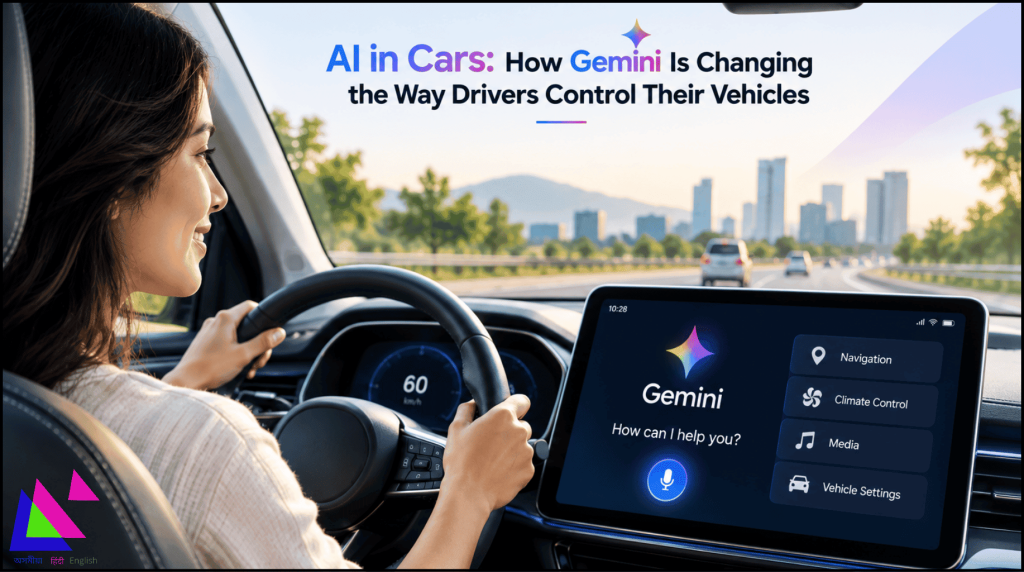
What Can Gemini Do in a Car?
Traditional voice systems usually require specific commands. Conversational AI aims to make interaction more natural.
In the BE 6 SPORTEQ, the system can support:
- Vehicle controls.
- Navigation.
- Music.
- News.
- Climate-related functions.
- Cabin features.
- Access to the digital owner’s manual.
- Other connected applications.
Instead of remembering exact commands, drivers can speak more naturally and ask the system to perform supported tasks.
How Is This Different From Normal Voice Control?
A traditional voice assistant may require a command such as:
“Navigate to Delhi.”
A conversational system is designed to understand more natural requests and the context behind them.For example, a driver could ask for directions, change the cabin temperature, or request information without using a fixed command format.
The main difference is:
- Traditional system: Works with predefined commands.
- AI assistant: Understands more natural language.
- AI-powered system: Can connect conversation with multiple vehicle functions.
This could make in-car technology easier to use, especially for people who do not want to navigate through multiple menus while driving.
Why Are Automakers Adding AI?
Cars are becoming increasingly connected.
Modern vehicles already include:
- Large displays.
- Connected navigation.
- Streaming services.
- Digital assistants.
- Smartphone integration.
- Advanced driver features.
AI can bring these systems together through a more conversational interface.
As a result, drivers may not need to interact with separate menus for every task.
Benefits of AI in Cars
1. Easier Interaction: Drivers can communicate using everyday language instead of memorizing commands.
2. Less Manual Input: Voice-based controls can reduce the need to touch screens while driving.
3. More Functions: AI can connect different vehicle features through one assistant.
4. Better Personalization: A conversational system can potentially provide more personalized responses based on the driver’s request.
5. More Useful Information: Drivers can ask for navigation, news, vehicle information and other supported services through one interface.
What Are the Limitations?
AI in Cars also comes with important challenges.
- Accuracy: An AI system can misunderstand a request or provide an incorrect response.
- Safety: Drivers should not depend on AI for decisions that require full attention or professional judgment.
- Connectivity: Some connected AI features may depend on internet access and cloud services.
- Privacy: Connected vehicles can process information about users, locations, preferences and vehicle activity. Manufacturers therefore need to handle such information responsibly.
- Distraction: A conversational assistant should make driving easier, not encourage drivers to spend more time interacting with screens or complex features.
What Does This Mean for Drivers?
The biggest change may be the way people interact with their cars.Instead of thinking of the vehicle as a machine with many separate controls, drivers may increasingly treat it as a conversational digital assistant.
In the future, drivers could potentially use voice to:
- Find destinations.
- Adjust vehicle settings.
- Control entertainment.
- Understand vehicle features.
- Access information.
- Manage connected services.
However, the exact capabilities will depend on the vehicle, software and available services.
The Future of AI-Powered Cars
AI in Cars is likely to become more common as automakers add more connected features.The next step could involve AI assistants that understand the driver’s broader needs and coordinate multiple functions.However, manufacturers will need to focus on reliability and safety at the same time. A powerful assistant is useful only when it responds correctly and does not distract the driver.
Conclusion
AI in Cars is changing the traditional idea of a vehicle voice assistant. Mahindra’s BE 6 SPORTEQ shows how conversational AI can connect navigation, entertainment, vehicle controls and other services through a single interface.
The technology is still developing, and drivers should not expect AI to handle every task perfectly. Still, the direction is clear: future cars could become much more conversational.Instead of pressing buttons for every function, drivers may increasingly tell their cars what they need.
FAQs
1. What is AI in cars?
Ans: It refers to artificial intelligence used to provide features such as voice assistance, navigation, personalization and vehicle control.
2. What is TEQ_Talk?
Ans: TEQ_Talk is Mahindra’s conversational AI assistant, built with Google Gemini technology for the BE 6 SPORTEQ.
3. Can AI control a car’s functions?
Ans: Some AI systems can control supported functions such as navigation, entertainment and climate-related features.
4. Is AI voice control safe while driving?
Ans: It can reduce some manual interaction, but drivers should remain focused on the road and avoid relying on AI for critical decisions.
5. Will all cars get AI assistants?
Ans: AI features are likely to become more common, but availability will depend on manufacturers, models, software and connectivity.

Hi, I’m Dev Kirtonia, Founder & CEO of Dev Library. A website that provides all SCERT, NCERT 3 to 12, and BA, B.com, B.Sc, and Computer Science with Post Graduate Notes & Suggestions, Novel, eBooks, Biography, Quotes, Study Materials, and more.







 Buy Now