
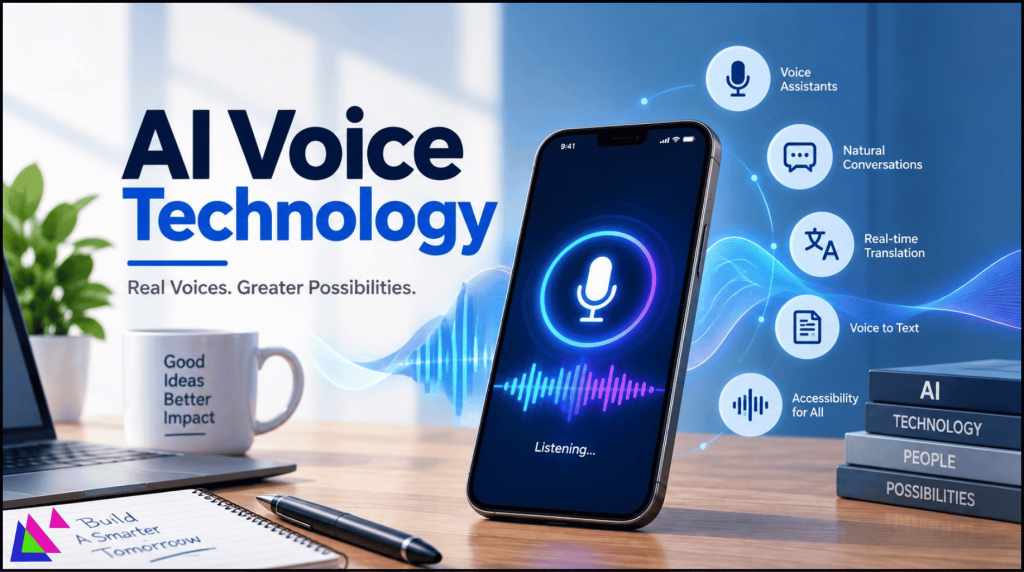
AI Voice Technology is changing the way people interact with computers. Instead of typing every message, email, or instruction, users can now speak naturally and let AI turn their words into polished text.
The technology is moving beyond traditional voice typing. Recent developments from voice AI company Wispr show how companies are trying to make speaking to a computer feel more natural and useful. Wispr recently raised $280 million in Series B funding at a $2 billion valuation and also introduced a preview of its own speech model, Canto.
How Is AI Voice Technology Different From Traditional Voice Typing?
Traditional voice typing mainly converts spoken words into text. Newer AI-powered systems can do more.
They can:
- Understand natural speech.
- Remove unnecessary words and pauses.
- Improve sentence structure.
- Add punctuation and formatting.
- Understand the context of what a person is saying.
- Turn spoken thoughts into polished writing.
Wispr Flow, for example, is designed to convert speech into polished text across different applications and is available on Mac, Windows, iPhone, and Android.
Why Are People Interested in Voice AI?
Typing can become tiring, especially when people need to write long emails, documents, or messages.Voice input offers a more natural alternative.
Some common uses include:
- Writing emails.
- Creating documents.
- Taking notes.
- Sending messages.
- Brainstorming ideas.
- Writing social media posts.
- Giving instructions to software.
- Recording thoughts quickly.
As a result, voice can become more than an accessibility feature. It can become another way to control computers.
Wispr’s Latest Move
Wispr has attracted attention because of its focus on making voice interaction useful for everyday computer work.
The company says its latest funding will help it expand its technology and product development. It has also introduced Canto, its first proprietary speech-recognition model. According to Reuters, the company says Canto is designed to work better in challenging environments, including situations with background noise.
The company now has more than 10,000 businesses using its technology, according to Reuters.
Can Voice Replace Typing?
Probably not completely.Typing still has advantages when users need to:
- Enter passwords.
- Write code.
- Edit individual words.
- Work in quiet environments.
- Handle sensitive information.
- Make precise changes.
However, voice could replace a significant amount of everyday typing.
For example, someone writing an email could simply explain what they want to say and let an AI system turn that speech into a properly structured message.
Pros of AI Voice Technology
1. Faster Input: Speaking can be quicker than typing for many users.
2. More Natural: People can explain ideas in their own words instead of thinking about every sentence before typing.
3. Hands-Free Work: Voice input allows users to interact with applications while their hands are occupied.
4. Better Accessibility: Voice can help people who find traditional typing difficult.
5. Useful Across Applications: Modern tools can work inside different apps rather than being limited to one platform.
Cons and Challenges
1. Accuracy: Speech systems can still misunderstand words, accents, or names.
2. Background Noise: Busy environments can make voice recognition harder, although newer models are working to improve this.
3. Privacy: Users need to understand how their voice recordings and transcribed information are processed.
4. Not Ideal Everywhere: Speaking aloud may not be practical in offices, classrooms, public places, or shared spaces.
5. Editing Is Still Needed: AI-generated text may require users to check and correct the final result.
What Does This Mean for Computers?
AI Voice Technology could make computers more conversational.Instead of clicking through menus or typing detailed commands, users may increasingly explain what they want in everyday language.
For example:
- “Create a short report from these notes and make the important points clear.”
- An AI system could potentially understand the instruction and complete several steps.
- This connects voice technology with the wider development of AI assistants and agents.
The Future of Voice Interaction
The growth of AI Voice Technology suggests that keyboards may not disappear, but they could become only one of several ways people interact with computers.
Future systems could combine:
- Voice.
- Text.
- Touch.
- Images.
- Screen understanding.
- AI agents.
This could make computers easier to use because people would not always need to learn specific commands or interfaces.
Conclusion
AI Voice Technology is moving beyond simple speech-to-text tools. Companies such as Wispr are investing heavily in systems that can understand natural speech and turn it into useful work. Wispr’s latest $280 million funding round and $2 billion valuation show the growing investor interest in voice-based AI interfaces.
Typing is unlikely to disappear anytime soon. However, as voice systems become more accurate and better at understanding context, speaking could become a much bigger part of how people write, work, and interact with computers.
FAQs
1. What is AI Voice Technology?
Ans: It uses artificial intelligence to understand human speech and convert it into text, commands, or other useful actions.
2. Can voice AI replace typing?
Ans: It may replace some everyday typing, but keyboards will remain useful for coding, editing, passwords, and precise text input.
3. What is Wispr Flow?
Ans: Wispr Flow is an AI-powered voice-to-text tool that converts spoken language into polished text across applications and devices.
4. What is Canto?
Ans: Canto is Wispr’s proprietary speech-recognition model, introduced alongside the company’s latest funding announcement.
5. What are the biggest challenges?
Ans: Accuracy, background noise, privacy, and situations where speaking aloud is inconvenient remain important challenges.

Hi, I’m Dev Kirtonia, Founder & CEO of Dev Library. A website that provides all SCERT, NCERT 3 to 12, and BA, B.com, B.Sc, and Computer Science with Post Graduate Notes & Suggestions, Novel, eBooks, Biography, Quotes, Study Materials, and more.







 Buy Now